Last updated: October 2026
The natural sleep aids with the most evidence are behavioural: a regular routine and CBT for insomnia, which the NHS recommends. Of supplements, ashwagandha, magnesium and chamomile have small, low-quality trials suggesting modest benefits, while valerian’s results are mixed. None works like a sleeping pill, and most need two to eight weeks of regular use.
Below: every popular natural sleep aid ranked by evidence, what’s available in the UK, how to combine them safely, and when to see your GP.
Natural sleep aids ranked by evidence
| Sleep aid | What the research shows | Evidence |
|---|---|---|
| CBT for insomnia | The treatment the NHS offers first for long-term insomnia, face to face or online | Strong |
| Ashwagandha | A 2021 review of 5 trials (400 people) found a small improvement in sleep, larger in people with insomnia, at 600mg or more for 8 weeks | Low to moderate |
| Magnesium | A 2021 review of 3 trials in older adults found people fell asleep about 17 minutes faster; the authors rated the trials low quality | Low |
| Chamomile | A 2019 review found better sleep quality, but no change in insomnia severity | Low |
| Valerian | A review of 16 trials found possible benefits on sleep quality, but most studies had serious flaws | Mixed |
| L-theanine | One small 4-week trial (30 adults, 200mg a day) found improved sleep scores | Very low |
| Passion flower | One small trial of passion flower tea found better self-rated sleep quality | Very low |
| CBD | Small, mixed studies, mostly not in people with insomnia. See CBD for sleep | Very low |
| Reishi | No good human sleep trials; animal studies only | None in people |
Supplement trials are mostly small and short, and the effects are modest. That doesn’t make them pointless, but it’s honest to treat them as part of a routine rather than a cure.
Start here: the habits that work best
- Same wake-up time every day, including weekends, and don’t sleep in after a bad night.
- Go to bed only when sleepy, and get up if you can’t sleep after about 20 minutes.
- Cut caffeine after midday, and keep alcohol low: it fragments sleep later in the night. See CBD and alcohol.
- Daylight in the morning and a cool, dark, quiet bedroom.
- A wind-down routine: the same 30 to 60 minutes each evening, away from bright screens.
The NHS offers CBT for insomnia, including online self-help programmes. See protecting your sleep when the clocks change.
If poor sleep has gone on for months, see insomnia: symptoms, causes and treatment.
The supplements in more detail
Magnesium
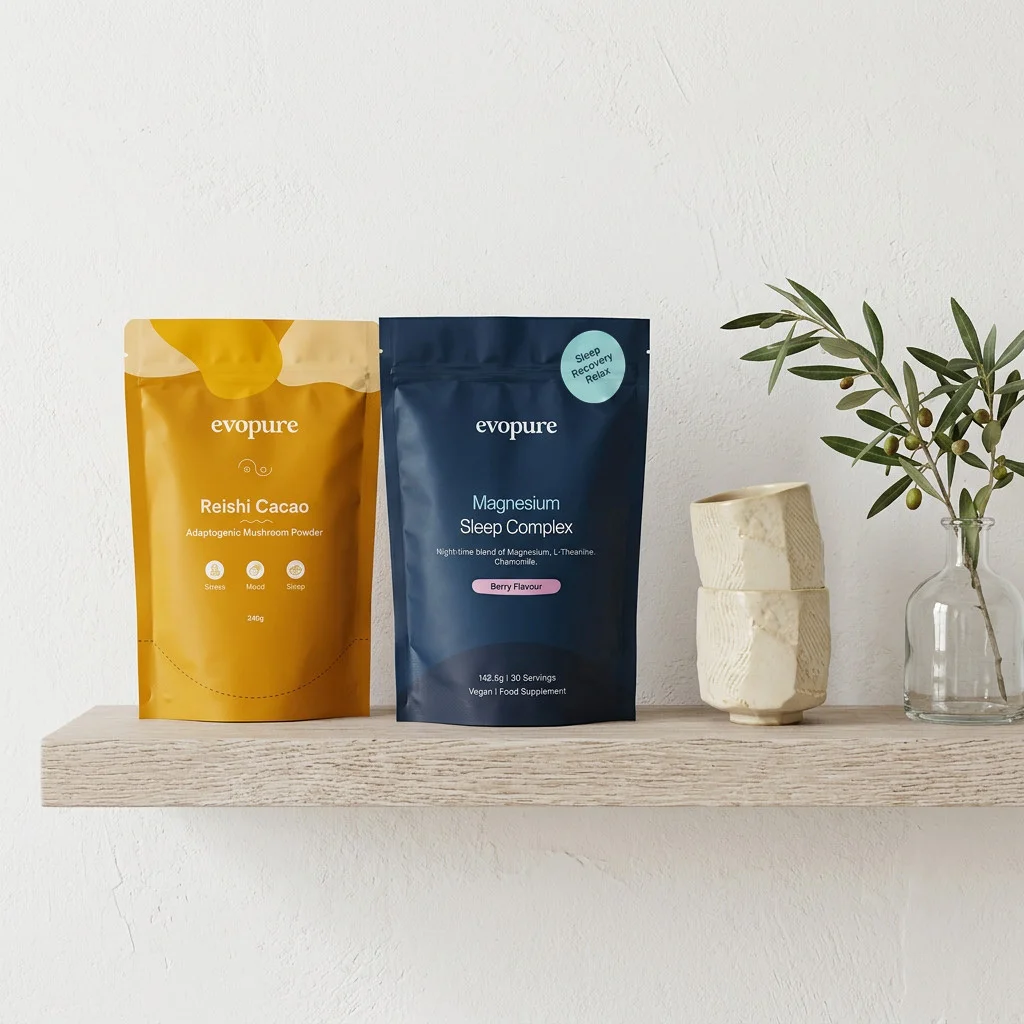
Magnesium contributes to normal psychological function and the reduction of tiredness and fatigue. It’s most likely to help if your diet is low in it. Glycinate is gentle on the stomach and popular in the evening. Our Magnesium Glycinate Sleep Complex combines bisglycinate and citrate with glycine, L-theanine and botanicals, giving 148mg of magnesium per serving as a warm drink. See magnesium for sleep.
Ashwagandha
The sleep evidence is among the better ones for a herb, but the FSA’s safety advisers are reviewing reports of liver and thyroid effects, and the FSA advises pregnant women and people with liver problems to avoid it. Read our ashwagandha UK safety review before taking it.
Chamomile, valerian and passion flower
Gentle, traditional options with small or mixed trials. Chamomile and passion flower are easy to try as an evening tea. Valerian can cause headaches or morning grogginess in some people.
CBD
Many people use CBD as part of an evening routine, but sleep trials are small and mixed. Our Sleep CBD Oil combines broad spectrum CBD with passion flower. See best CBD oil for sleep. The FSA’s 10mg a day figure is precautionary advice rather than a legal limit, set while longer-term safety research continues. At Evopure we think it is a very cautious figure, and many adults use more. If you go above it, increase slowly, and check with your GP or pharmacist first if you take any medication.
A caffeine-free evening drink
Swapping a late coffee or a nightcap for a warm, caffeine-free drink is one of the simplest changes. Our Reishi Mushroom Adaptogenic Complex is a cacao drink made for exactly that moment. See reishi mushroom.
Pharmacy sleep aids and melatonin in the UK
- Pharmacy sleeping aids contain either herbal ingredients like valerian, or an antihistamine. The NHS says they may help for 1 to 2 weeks but shouldn’t be taken for longer, and antihistamines can leave you drowsy the next day.
- Melatonin is prescription-only in the UK. See melatonin in the UK and melatonin vs CBD.
- Sleeping pills are rarely prescribed and only for a few days or weeks, because of side effects and dependence.
Combining sleep aids safely
- Add one thing at a time, for two to four weeks, so you know what helps.
- Don’t stack sedatives: avoid combining herbal sleep aids, CBD or antihistamines with alcohol, sleeping pills, or other sedating medicines.
- Check medicines with a pharmacist, especially antidepressants, blood thinners, thyroid medicines and anything for epilepsy. See CBD and medication.
- Pregnancy and breastfeeding: we don’t recommend our products during pregnancy or breastfeeding.
When to see your GP
See a GP if poor sleep has lasted months, is affecting your day, or if you snore loudly, stop breathing in your sleep, have restless legs, or feel low. These can point to conditions such as sleep apnoea or depression that need proper treatment. See magnesium and restless legs. For quick techniques to drop off, see how to fall asleep fast, and if a partner’s snoring is the problem, sleep divorce.
Before any supplement, see how to sleep better.
See also best tea for sleep, ranked by evidence.
FAQs
What is the most effective natural sleep aid?
CBT for insomnia and a consistent sleep routine have the strongest evidence. Of supplements, ashwagandha and magnesium have small, low-quality trials suggesting modest benefits.
What natural sleep aids can you buy in the UK?
Magnesium, chamomile, valerian, passion flower, L-theanine, ashwagandha and CBD are all sold in the UK. Melatonin is prescription-only.
Do natural sleep aids make you groggy?
Usually less than antihistamine sleeping aids, but valerian, CBD at higher doses and some herbs can cause morning drowsiness in some people.
Can I take magnesium and CBD together?
There’s no known interaction between them. Add one at a time so you know what helps, and check with a pharmacist if you take medication.
How long do natural sleep aids take to work?
Most trials ran for two to eight weeks. Give one aid a few weeks of regular use before judging it.
Is it safe to take sleep aids every night?
Pharmacy sleeping aids shouldn’t be taken for more than 1 to 2 weeks. For supplements, check the label and speak to your GP if you need help sleeping long term.
Sources
- NHS. Insomnia.
- Cheah KL et al. Effect of ashwagandha extract on sleep: a systematic review and meta-analysis. PLoS One, 2021.
- Mah J, Pitre T. Oral magnesium supplementation for insomnia in older adults: a systematic review and meta-analysis. BMC Complement Med Ther, 2021.
- Hieu TH et al. Therapeutic efficacy and safety of chamomile for state anxiety, generalized anxiety disorder, insomnia, and sleep quality. Phytother Res, 2019.
- Bent S et al. Valerian for sleep: a systematic review and meta-analysis. Am J Med, 2006.
- Hidese S et al. Effects of L-theanine administration on stress-related symptoms and cognitive functions in healthy adults. Nutrients, 2019.
- Ngan A, Conduit R. A double-blind, placebo-controlled investigation of the effects of Passiflora incarnata (passionflower) herbal tea on subjective sleep quality. Phytother Res, 2011.