Last updated: October 2026
5-HTP (5-hydroxytryptophan) is a compound your body makes from tryptophan and turns into serotonin, then melatonin. Supplements are extracted from Griffonia seeds. Small, mostly older trials hint at effects on mood, sleep and appetite, but the evidence is weak, and 5-HTP can interact dangerously with antidepressants and other serotonin-raising medicines.
Below: how 5-HTP works, an honest table of what the studies show, side effects, who should avoid it, the doses researchers used, its UK status, and how it compares with tryptophan, melatonin, magnesium, GABA and ashwagandha.
Safety first: do not take 5-HTP if you take an antidepressant, a triptan for migraine, tramadol, lithium, St John’s wort or any other medicine that raises serotonin, unless your doctor has said it’s OK. Together they can cause serotonin syndrome, which can be serious. If you take any medicine at all, ask your GP or pharmacist first.
What is 5-HTP?
5-HTP is a natural step in the chain your body uses to make two important messengers:
- Tryptophan, an essential amino acid you get from food, is turned into 5-HTP.
- 5-HTP is turned into serotonin, a chemical messenger involved in mood, sleep, appetite and much more.
- Some serotonin is turned into melatonin, the hormone that helps time your sleep and wake cycle.
The step from tryptophan to 5-HTP is the slow one, so the idea of taking 5-HTP is to skip the bottleneck. For the bigger picture on serotonin, see how to boost serotonin naturally and our guide to happy hormones.
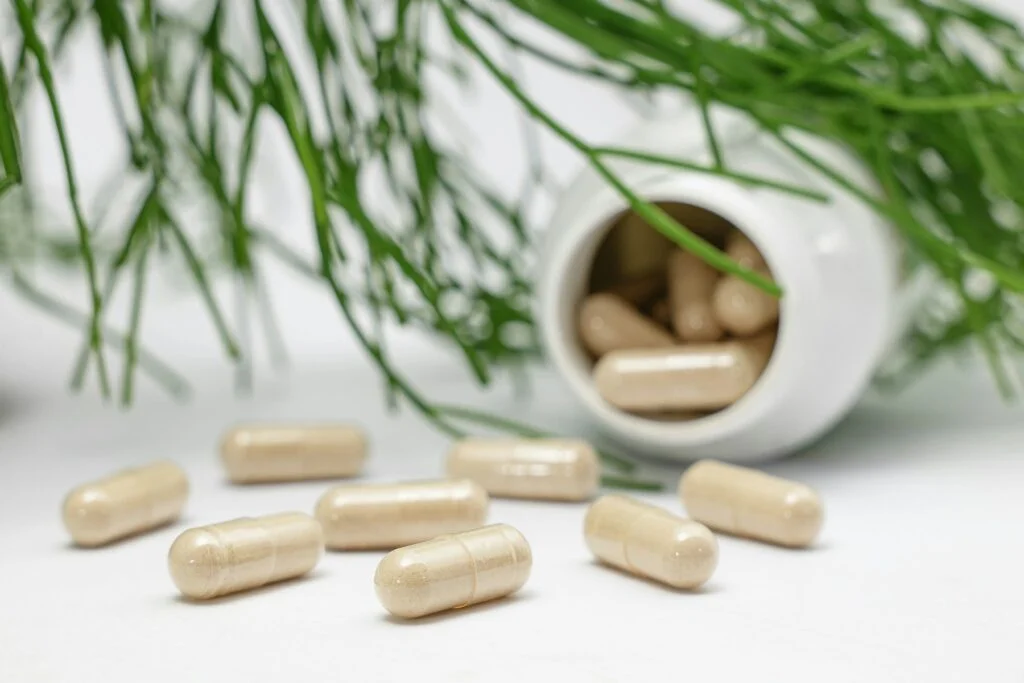
Supplement 5-HTP is extracted from the seeds of Griffonia simplicifolia, an African plant, because chemical synthesis isn’t economical at scale.
One important detail: some of the 5-HTP you swallow is turned into serotonin in the body before it reaches the brain. In medical research, 5-HTP is often given with carbidopa, a prescription drug that blocks this, so results from those studies don’t always apply to a supplement taken on its own.
Does 5-HTP work? What the evidence shows
Most 5-HTP research is small, old or uncontrolled. Here is a plain summary of the main human studies we found; the quality rating is our own judgement.
| Use | What studies show | Quality of evidence |
|---|---|---|
| Depression | A Cochrane review found only 2 of 108 trials (64 people) good enough to include: a possible benefit, but not conclusive. A 2020 meta-analysis of 13 studies was positive but rated them weak, with few placebo groups. | Low |
| Sleep | Better sleep quality scores in poor sleepers in one 12-week trial of 30 older adults (no placebo). More REM sleep in 18 people with Parkinson’s. | Very low |
| Anxiety and panic | Single 200mg doses in lab panic tests: an effect in people with panic disorder, not in healthy volunteers. No good long-term trials. | Very low |
| Appetite and weight | Less eating and some weight loss in two small trials of adults with obesity, at high doses (up to 900mg a day). | Low |
| Fibromyalgia | One 1990 trial of 50 people reported improvements; the authors called for more studies. | Very low |
The short version: the idea behind 5-HTP makes biological sense, but no use is backed by large, modern, placebo-controlled trials. That is also why regulators have not accepted any health claims for it (more on that in UK status).
5-HTP for sleep
The theory is simple: more 5-HTP means more serotonin, and more serotonin can mean more melatonin at night. In practice, the sleep research is thin:
- Older adults: in the 2024 Singapore trial, 30 people aged around 66 took 100mg a day or nothing for 12 weeks. Poor sleepers in the 5-HTP group improved their sleep quality score; good sleepers didn’t change much. The study was single-blinded and had no placebo, so expectation may have played a part.
- Parkinson’s disease: a 4-week crossover trial in 18 people found 50mg a day increased the share of REM (dreaming) sleep, with small, non-significant drops in night-time waking.
More REM sleep may also explain why some people report vivid dreams on 5-HTP, while others say their sleep got worse. Insomnia is listed among its less common side effects. If bad dreams are a problem, see our guide to nightmares.
For long-term sleep problems, the NHS suggests changing your sleep habits first, and you may be offered CBT. GPs now rarely prescribe sleeping pills. See our insomnia guide for what actually helps.
5-HTP for mood, depression and anxiety
Mood is the use 5-HTP is best known for, and the one with the most studies, but they are mostly small and of low quality:
- The Cochrane reviewers concluded that because proven, safe antidepressants exist, the clinical usefulness of 5-HTP and tryptophan is limited.
- The 2020 meta-analysis called for proper placebo-controlled trials in people with clearly diagnosed depression.
- For anxiety, there are only short lab experiments with single doses, including one with 32 healthy volunteers that found no significant overall difference.
Depression is a medical condition. Please don’t use 5-HTP to treat it yourself, and never stop or swap an antidepressant for a supplement without talking to your doctor. If you’ve been feeling down for a while, our guide to low mood explains when it might be depression and where to get help. For anxiety, see what the research says in natural supplements for anxiety.
5-HTP for appetite and weight loss
Because serotonin is involved in appetite, researchers in Italy tested 5-HTP in adults with obesity:
- 1989: 19 women took 8mg per kg of body weight a day (roughly 640mg for an 80kg person) or placebo for 5 weeks. They ate less and lost weight, and reported appetite-loss symptoms. Their mood scores didn’t change.
- 1992: 20 adults took 900mg a day or placebo for two 6-week periods. The 5-HTP group lost weight, ate fewer carbohydrates and felt full sooner.
These were small, short trials from one research group over 30 years ago, at much higher doses than the 50mg to 100mg used in the recent sleep studies, where stomach side effects become more likely. A proposed claim that 5-HTP reduces calorie intake was assessed and rejected, and it is listed as non-authorised in Great Britain. If cravings are your main issue, our guide to sugar cravings covers what helps.
5-HTP side effects
Reported side effects include the following. Stomach problems are the most common.
- nausea, vomiting and diarrhoea (reported more at doses above 100mg)
- headache
- trouble sleeping
- a fast or irregular heartbeat (less common)
- vivid dreams, which some users report and which may relate to more REM sleep
In early research, nausea and vomiting were common enough that the investigators stressed starting slowly. This matches what many users say in online reviews: feeling sick when starting at a higher dose, and some finding any benefit fades over time.
Stop taking it and get medical advice if you feel unwell, and get urgent help if you have the signs of serotonin syndrome described below.
Who should not take 5-HTP
People taking medicines that raise serotonin
This is the most important safety point. Taking 5-HTP alongside other things that raise serotonin can push levels too high and cause serotonin syndrome. The NHS describes it as a rare but serious condition that causes a fast heartbeat, sweating, shaking, twitching muscles and feeling confused or agitated.
Do not take 5-HTP without your doctor’s say-so if you take:
- antidepressants, including SSRIs (such as sertraline, citalopram or fluoxetine), SNRIs (such as venlafaxine or duloxetine), MAOIs and tricyclics
- triptans for migraine, such as sumatriptan
- the painkiller tramadol
- lithium
- the antibiotic linezolid (a published case report describes serotonin syndrome when it was combined with 5-HTP)
- carbidopa, a Parkinson’s medicine
- St John’s wort, SAMe or tryptophan supplements
This isn’t a complete list. If you take any prescribed or over-the-counter medicine, check with your GP or pharmacist before taking 5-HTP. If you develop the symptoms above after starting it, stop and call NHS 111, or 999 if they are severe.
5-HTP can also affect the results of a urine test (5-HIAA) used to diagnose and monitor some tumours, so tell your doctor if you take it before any tests.
Pregnancy, breastfeeding and under-18s
5-HTP has not been properly studied for safety in pregnancy, breastfeeding or children. Avoid it in these groups unless a doctor specifically advises it. We don’t recommend our products during pregnancy or breastfeeding, and all Evopure products are for adults only.
The eosinophilia-myalgia history (Peak X)
You may read worrying stories about 5-HTP and a rare illness called eosinophilia-myalgia syndrome (EMS), which causes severe muscle pain and a high count of a type of white blood cell. Here is the background, as neutrally as we can put it:
- In 1989, an outbreak of EMS was traced to contaminated L-tryptophan from a single manufacturer, and tryptophan supplements were taken off the market.
- In 1994, US researchers described a family who became ill after taking 5-HTP. Their batch contained an impurity not found in other samples.
- In 2003, a contaminant nicknamed “Peak X” was identified in the implicated 5-HTP and, at much lower levels, in six over-the-counter products.
- In 2004, a review argued that no definitive cases of toxicity had emerged in 20 years of worldwide use, and that the Peak X findings were overstated.
Experts still disagree on how much risk there is. The Cochrane reviewers noted that the possible link had not been resolved. The practical takeaway is that purity matters, and it’s one more reason to be cautious with long-term use.
5-HTP dosage and timing: what studies used
There is no official recommended dose of 5-HTP in the UK. The table shows what researchers used. It is not a recommendation, and some of these studies were in people under medical supervision.
| Study | Who took part | Dose | How long |
|---|---|---|---|
| Sleep, 2024 | 30 older adults | 100mg a day | 12 weeks |
| Sleep in Parkinson’s, 2022 | 18 people with Parkinson’s | 50mg a day | 4 weeks |
| Panic challenge, 2002 | 24 people with panic disorder, 24 healthy | 200mg, single dose | One day |
| Appetite, 1989 | 19 women with obesity | 8mg per kg a day | 5 weeks |
| Appetite, 1992 | 20 adults with obesity | 900mg a day | 12 weeks |
Best time of day to take 5-HTP? We found no trials comparing morning and evening doses. The sleep trials above don’t show that one time works better than another.
How long does 5-HTP last? In small studies from around 1980, 5-HTP taken by mouth reached its highest blood levels after about 2 to 3 hours, and its half-life was about 6 hours. These studies gave carbidopa at the same time, so the figures for a supplement on its own may differ.
Starting slowly: the same researchers saw nausea and vomiting when doses were built up and stressed the importance of a slow start. This is general information, not advice to take 5-HTP. Speak to a pharmacist first.
Is 5-HTP legal in the UK?
Yes. 5-HTP is sold in UK health shops and online as a food supplement. Food Standards Scotland’s guidance explains that food supplements don’t need a licence or government approval to be sold in the UK, and the business selling them is responsible for making sure they’re safe. That means a 5-HTP supplement hasn’t been through the checks that licensed medicines go through.
5-HTP has no authorised health claims in Great Britain. The official GB nutrition and health claims register lists proposed 5-HTP claims about mood, concentration and reducing calorie intake as non-authorised, because the evidence did not substantiate them. Only authorised claims may be used on food and supplements in Great Britain, so UK sellers shouldn’t claim that 5-HTP improves mood, sleep or appetite.
For comparison, melatonin is a prescription-only medicine in the UK, and melatonin supplements are not authorised for sale here. See melatonin in the UK.
5-HTP vs tryptophan, melatonin, magnesium, GABA and ashwagandha
| What it is | Evidence for sleep or calm | Authorised GB health claims | Main caution | |
|---|---|---|---|---|
| 5-HTP | Serotonin precursor from Griffonia seeds | Very limited | None | Serotonin-raising medicines; nausea |
| L-tryptophan | Essential amino acid in food; the body turns it into 5-HTP | Limited | None (sleep and mood claims rejected) | Also feeds serotonin, so treat it with the same medicine caution |
| Melatonin | Sleep-timing hormone | Used mainly for short-term sleep problems in people aged 55 and over | Not applicable: prescription-only in the UK | Needs a prescription |
| Magnesium | Essential mineral | Mixed | Yes, including normal psychological function and normal functioning of the nervous system | The NHS says 400mg or less a day from supplements is unlikely to cause harm |
| GABA | Calming brain messenger, taken as a supplement | Very limited; unclear how much reaches the brain | None | Check with a GP or pharmacist if you take any medicine |
| Ashwagandha | Ayurvedic root | A small effect in a 2021 review of 5 trials, at 600mg a day or more for 8 weeks or longer | None | Not for pregnancy or thyroid conditions |
5-HTP vs tryptophan: tryptophan is one step earlier in the same chain. 5-HTP skips the slow step, but both feed serotonin, so the same medicine caution applies.
5-HTP vs melatonin: 5-HTP is a raw material the body may turn into melatonin. Melatonin itself is prescription-only in the UK.
5-HTP vs magnesium: they work in different ways. Magnesium is an essential mineral that contributes to normal psychological function and the normal functioning of the nervous system; it doesn’t act on serotonin. See magnesium for sleep.
5-HTP vs GABA: GABA is the brain’s main calming messenger, but there’s no human data showing GABA supplements reach the brain. See our GABA supplement guide.
5-HTP vs ashwagandha: ashwagandha has more trials for sleep and stress than 5-HTP, though effects are modest. See ashwagandha for sleep and ashwagandha for anxiety.
Other options people compare with 5-HTP include L-theanine, glycine and valerian root. Whatever you choose, if you take any medicine, check with your GP or pharmacist first.
A different approach for evenings
Evopure doesn’t sell 5-HTP. If you’re looking for an evening routine that doesn’t work on serotonin, our Magnesium Glycinate Sleep Complex is a different approach rather than a replacement.
It’s a berry-flavoured drink with magnesium bisglycinate and citrate (148mg magnesium per serving), plus glycine, L-theanine, chamomile, passionflower, hops and oat straw. Magnesium contributes to normal psychological function, the normal functioning of the nervous system and the reduction of tiredness and fatigue.
It isn’t a substitute for any medicine. If you take an antidepressant or any other prescribed medicine, please check with your GP or pharmacist before adding any supplement, including ours.
When to see a GP
- You’ve had trouble sleeping for weeks and it’s affecting your day.
- You’ve felt low, hopeless or lost interest in things for weeks.
- Anxiety or panic is stopping you doing everyday things.
- You take any medicine and are thinking about trying 5-HTP or another supplement.
Adults in England can also refer themselves to NHS Talking Therapies. If you feel unable to cope or have thoughts of harming yourself, call 999, NHS 111 or Samaritans on 116 123.
For the step before 5-HTP, see our guide to tryptophan, including UK food sources and safety.
FAQs
What is 5-HTP used for?
People take 5-HTP hoping to support mood, sleep or appetite, because the body turns it into serotonin and then melatonin. The research behind these uses is small and mostly low quality, and there are no authorised health claims for it in Great Britain.
Can I take 5-HTP with antidepressants?
Not without your doctor’s agreement. Combining 5-HTP with SSRIs, SNRIs, MAOIs, tricyclics or other medicines that raise serotonin, such as triptans or tramadol, can cause serotonin syndrome, which can be serious. Speak to your GP or pharmacist first.
What are the side effects of 5-HTP?
The most common are nausea, vomiting and diarrhoea, especially at higher doses. Headache, trouble sleeping, vivid dreams and a fast heartbeat have also been reported. Stop and get medical advice if you feel unwell.
How long does 5-HTP last in the body?
Small studies from around 1980 found blood levels peaked about 2 to 3 hours after a dose, with a half-life of about 6 hours. Those studies also gave a prescription drug called carbidopa, so a supplement on its own may behave differently.
Is 5-HTP legal in the UK?
Yes. It is sold as a food supplement, which doesn’t need government approval before sale. It has no authorised health claims in Great Britain, so sellers shouldn’t claim it improves mood, sleep or appetite.
Is 5-HTP better than melatonin for sleep?
There’s no good head-to-head research. Melatonin is a prescription-only medicine in the UK, used mainly for short-term sleep problems in people aged 55 and over. 5-HTP’s sleep evidence is very limited.
Does 5-HTP help with weight loss?
Two small Italian trials from around 1990 found people with obesity ate less and lost weight on high doses of up to 900mg a day. The evidence is old and limited, and a claim that 5-HTP reduces calorie intake has been rejected in Great Britain.
Sources
- Shaw K, Turner J, Del Mar C (2002). Tryptophan and 5-hydroxytryptophan for depression. Cochrane Database of Systematic Reviews.
- Javelle F et al (2020). Effects of 5-hydroxytryptophan on distinct types of depression: a systematic review and meta-analysis. Nutrition Reviews.
- NHS. Sertraline (side effects including serotonin syndrome, and medicines and supplements that don’t mix).
- NHS. About melatonin.
- Department of Health and Social Care. Great Britain nutrition and health claims (NHC) register.
- Food Standards Scotland. Business guidance for food supplements.
Other studies mentioned (PubMed IDs): Sutanto CN et al, Clinical Nutrition 2024 (38309227); Meloni M et al, Sleep and Breathing 2022 (34403081); Schruers K et al, Psychiatry Research 2002 (12559480); Maron E et al, Journal of Psychopharmacology 2004 (15260907); Ceci F et al, Journal of Neural Transmission 1989 (2468734); Cangiano C et al, American Journal of Clinical Nutrition 1992 (1384305); Caruso I et al, Journal of International Medical Research 1990 (2193835); Magnussen I and Nielsen-Kudsk F, 1979 (311987) and 1980 (6966118); Michelson D et al, Journal of Rheumatology 1994 (7699627); Klarskov K et al, Journal of Rheumatology 2003 (12508395); Das YT et al, Toxicology Letters 2004 (15068828); Maffei ME, International Journal of Molecular Sciences 2020 (33375373); Ostabal Artigas MI, Medicina Clinica 2015 (25978918); Spies PE et al, European Journal of Hospital Pharmacy 2017 (31156918). Also: EFSA NDA Panel opinion on 5-hydroxytryptophan health claims, EFSA Journal 2009;7(9):1273; Memorial Sloan Kettering Cancer Center, About Herbs: 5-HTP (2022); NHS medicines information for sumatriptan.
This guide is general information, not medical advice. Evopure does not sell 5-HTP. Evopure makes the Magnesium Glycinate Sleep Complex.