Last updated: October 2026
Turkey tail is a common woodland mushroom best known for its immune-active compounds, PSK and PSP. In Japan, PSK has been used alongside conventional cancer treatment, and a small trial found turkey tail was well tolerated by women after breast cancer treatment. For healthy people, benefits are unproven. Side effects are usually mild: digestive upset and, rarely, darkened nails.
Below: what turkey tail is, what the research shows, side effects, who should avoid it, and how it’s taken.
What is turkey tail?
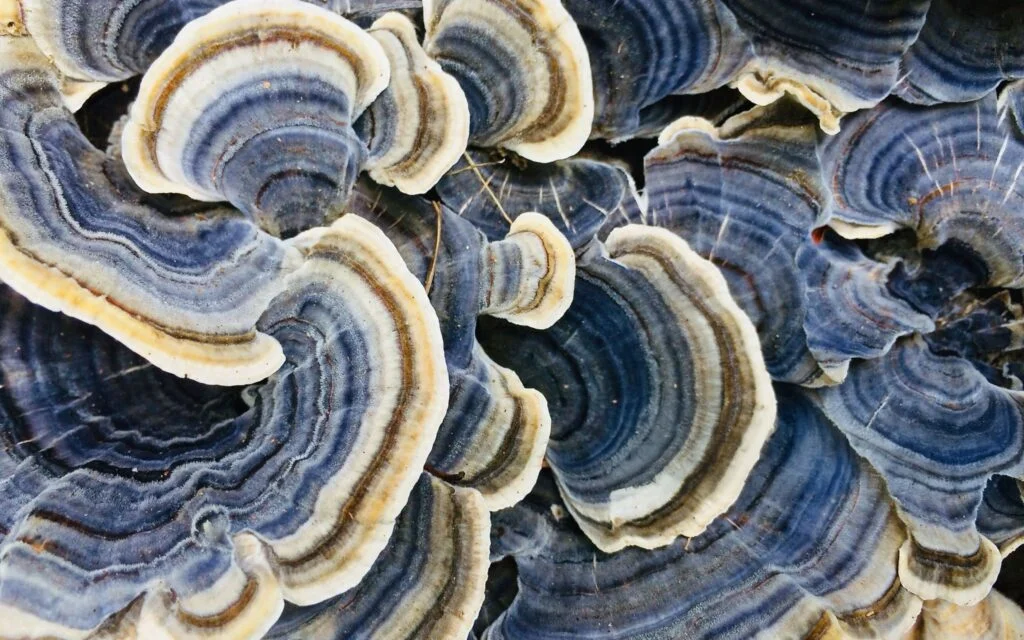
Turkey tail (Trametes versicolor) is a thin, fan-shaped bracket fungus with bands of brown, tan and grey, resembling a turkey’s tail. It grows on dead wood across the UK and much of the world. It’s too tough to eat as a food, so it’s used as a tea or as a powdered extract in capsules. Its best-studied compounds are two protein-bound polysaccharides: PSK (polysaccharide-K, also called krestin) and PSP (polysaccharide peptide).
Turkey tail benefits: what the research shows
| Area | Evidence |
|---|---|
| Immune function | PSK and PSP affect immune cells in lab and animal studies; small human studies show changes in immune markers |
| Gut health | Acts as a prebiotic in small studies, feeding beneficial gut bacteria |
| Antioxidant | Rich in phenols and flavonoids in lab tests |
| Alongside cancer treatment | Studied as an add-on in Asia; see below |
Most research uses specific standardised extracts, so results may not apply to every turkey tail product. Compare it with other mushrooms in the functional mushrooms UK guide.
Turkey tail and cancer: an honest view
You’ll often read that turkey tail “fights cancer”. The reality is more limited. PSK has been used in Japan as an addition to standard treatment for some cancers, and in a small US safety trial, 9 women who had finished breast cancer treatment took up to 9g of turkey tail a day for 6 weeks without problems, with some changes in immune markers. That’s a safety study, not proof that it treats cancer.
Turkey tail is not a cancer treatment and should never replace medical care. If you have cancer, speak to your oncology team before taking any supplement, as some can interact with chemotherapy or other treatments.
Turkey tail side effects
- Digestive upset: bloating, gas, diarrhoea or dark stools
- Darkening of the fingernails, reported with PSK
- Allergic reactions, which are rare
Stop taking it and speak to a GP if you notice anything unusual.
Who should avoid turkey tail?
- People with cancer, unless their oncology team agrees
- People with autoimmune conditions or taking immunosuppressants, such as after a transplant
- People taking blood thinners or diabetes medicines (check with a pharmacist)
- Pregnant or breastfeeding women, as there’s no safety data
- Anyone allergic to mushrooms or moulds
How to take turkey tail
- Extract capsules or powders: the most common form; follow the label.
- Tea: simmer dried turkey tail for an hour or more; it has a mild, earthy taste. See how to make mushroom tea.
- Don’t forage unless you’re an expert; several look-alike species grow on the same wood.
If you’re looking for a mushroom to take in the evening, reishi is the more traditional choice; see reishi for sleep and the best mushrooms for anxiety.
FAQs
What are turkey tail mushroom benefits?
Turkey tail contains PSK and PSP, which affect immune cells in research, and may act as a prebiotic. Benefits for healthy people are unproven.
What are the side effects of turkey tail?
Usually mild digestive upset such as bloating or dark stools. Darkened nails have been reported with PSK. Allergic reactions are rare.
Does turkey tail cure cancer?
No. PSK has been used alongside standard cancer treatment in Japan, but turkey tail is not a cancer treatment. Speak to your oncology team before taking it.
Does turkey tail affect blood pressure?
There’s little evidence. If you take blood pressure or other regular medicines, check with your pharmacist first.
Can you eat turkey tail?
It’s too tough to eat as a food. It’s used as a tea or in extract form.
Does turkey tail grow in the UK?
Yes, it’s common on dead wood in UK woodlands. Don’t forage it unless you can identify it with certainty.
Sources
- Torkelson CJ et al (2012). Phase 1 clinical trial of Trametes versicolor in women with breast cancer. ISRN Oncology.
- Sadowska A et al (2026). Medicinal mushrooms and their bioactive compounds: from traditional use to therapeutic potential. Molecules.
- Memorial Sloan Kettering Cancer Center. Coriolus versicolor (turkey tail).
This guide is general information, not medical advice.