


Last updated: October 2026
Yoga nidra, sometimes called NSDR (non-sleep deep rest), is a guided relaxation you do lying down. You stay awake while a voice leads you through your breath and body, moving you into a state between waking and sleep. Small trials suggest it may improve sleep and lower stress. Sessions take 10 to 40 minutes and need no experience.
This guide covers what yoga nidra is, what the research shows, how it differs from meditation and NSDR, a step-by-step script you can follow tonight, the best time to do it, and who should take care.
Try it now: lie on your back, close your eyes and take three slow breaths. Then move your attention slowly through your body, right thumb, fingers, palm, wrist, all the way to your toes, simply noticing each part without changing anything. That’s the heart of yoga nidra. The full script is below.
What is yoga nidra?
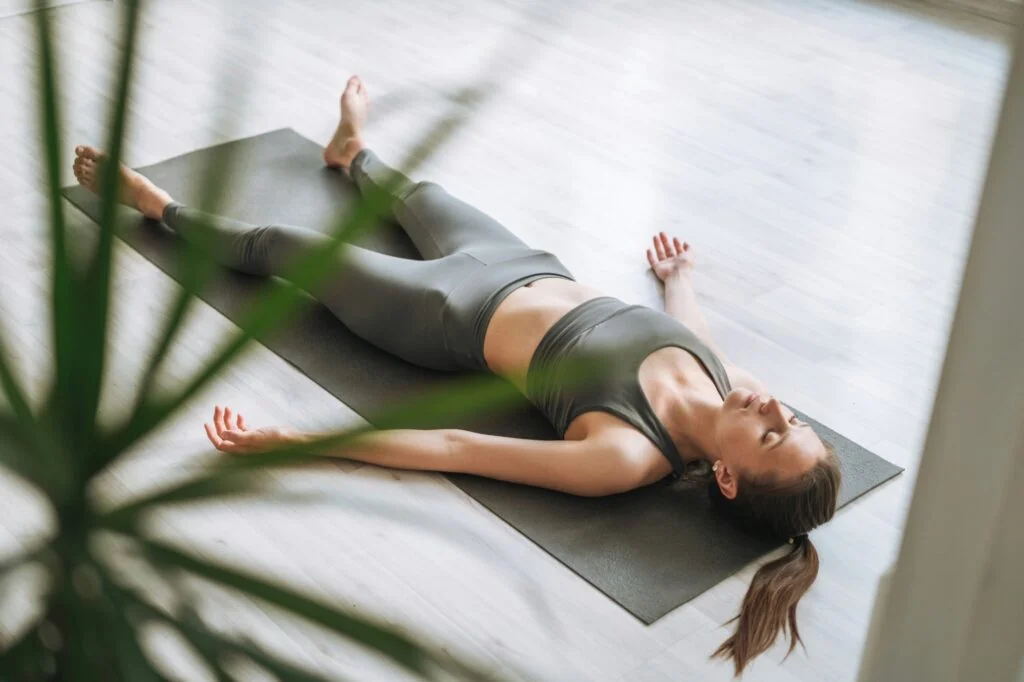
Yoga nidra means “yogic sleep”. Despite the name, it doesn’t involve any yoga poses. You lie still, usually on your back, and follow spoken instructions that guide your attention through a set sequence: settling, an intention, a body scan, breath awareness, noticing sensations and images, then slowly returning.
The aim is to rest deeply while staying aware. Many people describe it as the most relaxed they feel all day, and it’s easy to do because the voice does the work. You don’t need to “clear your mind” or sit cross-legged.
Yoga nidra vs NSDR vs meditation
| Yoga nidra | NSDR | Mindfulness meditation | |
|---|---|---|---|
| Position | Lying down | Lying down | Usually sitting |
| Guidance | Guided, set sequence, often with an intention | Guided; a modern, non-spiritual version of yoga nidra and similar practices | Guided or silent |
| Main focus | Body scan, breath, sensations, deep rest | Body scan and breath, deep rest | Noticing thoughts and the present moment |
| Typical length | 20 to 40 minutes | 10 to 30 minutes | 5 to 30 minutes |
| Falling asleep | Common, and fine if it’s bedtime | Common | Less common |
NSDR, short for non-sleep deep rest, is a name popularised online for yoga nidra-style practices without the spiritual language. In practice, they’re very similar. If you prefer seated practices, see mindfulness for beginners.
What the research shows
Research on yoga nidra is growing but still small. The main findings so far:
- Insomnia: in a randomised trial in India of people with chronic insomnia, yoga nidra improved sleep quality, total sleep time and time spent in deeper stages of sleep, measured both by questionnaires and sleep studies. Saliva cortisol also fell.
- Stress and wellbeing: a 2025 randomised trial gave adults an online 11-minute or longer yoga nidra audio to practise daily for 2 months. Compared with a waitlist, it produced small improvements in wellbeing, and regular practice was linked with lower cortisol.
- Overall: a 2026 review of the sleep studies found promising effects on sleep and insomnia scores, but only five studies in total, so the authors called for larger trials.
The honest summary: yoga nidra is low cost, low risk and promising for sleep and stress, but it isn’t proven to the standard of treatments like CBT for insomnia. Think of it as a useful tool alongside good sleep habits. See insomnia and how to relieve stress.
What does yoga nidra feel like?
People commonly describe:
- heaviness or warmth in the body
- a floating or “drifting” feeling, between awake and asleep
- losing track of the instructions for a while, then coming back
- feeling refreshed, calm or a little groggy afterwards
- sometimes, emotions or memories coming up
All of these are normal. There’s no way to do it wrong. If you drift off, just pick up the instructions again when you notice.
A 20-minute yoga nidra script you can follow
Read this through once, then try it from memory, or record yourself reading it slowly and play it back. Pause for a few breaths between each step.
- Settle (2 minutes). Lie on your back with a pillow under your head and knees. Let your arms rest slightly away from your body, palms up. Cover yourself with a blanket. Close your eyes. Notice the points where your body touches the floor or bed.
- Breathe (2 minutes). Take three slow breaths, longer out than in. Then let your breath be natural. Silently say to yourself, “I am awake and resting.”
- Set an intention (1 minute). Choose a short, positive phrase in the present tense, such as “I am calm” or “I rest easily”. Repeat it three times in your mind.
- Body scan (7 minutes). Move your attention slowly through your body, just naming each part: right thumb, index finger, middle finger, ring finger, little finger, palm, back of the hand, wrist, forearm, elbow, upper arm, shoulder, armpit, right side of the waist, hip, thigh, knee, shin, ankle, heel, sole, each toe. Repeat on the left side. Then the back of the body, from heels to the back of the head. Then the front: forehead, eyebrows, eyes, cheeks, nose, lips, jaw, throat, chest, belly. Finally, the whole body at once.
- Breath counting (3 minutes). Count your breaths backwards from 27 to 1: “breathing in, 27; breathing out, 27; breathing in, 26…” If you lose count, start again from 27. It doesn’t matter if you never reach 1.
- Opposites (2 minutes). Notice a feeling of heaviness, as if your body is sinking. Then lightness, as if it’s floating. Then warmth. Then coolness. Just imagine each for a few breaths.
- Rest (2 minutes). Let go of all instructions. Simply rest, aware of the space behind your closed eyes.
- Return (1 minute). Repeat your intention three times. Notice the sounds around you. Wiggle your fingers and toes, roll onto your side, and when you’re ready, slowly sit up. If it’s bedtime, you can skip this step and simply drift off.
Prefer audio? Search for free “yoga nidra” or “NSDR” recordings from reputable teachers or apps, and choose one with a voice you find calming.
Best time to do yoga nidra
| When | Why |
|---|---|
| In bed at night | As part of a wind-down; it’s fine to fall asleep |
| If you wake in the night | A calmer alternative to scrolling your phone. See waking at 3am |
| Early afternoon | A 10 to 20 minute reset instead of a nap or more caffeine. See afternoon slump |
| After a stressful event | To help your body come down from stress mode |
Yoga nidra for sleep
Yoga nidra suits sleep well because it combines several things that help: lying still in the dark, slowing your breathing, and giving a busy mind something gentle to focus on. To make it part of a bedtime routine:
- Do it in bed with the lights off, at the same time each night.
- Put your phone on aeroplane mode if you’re using a recording, and set it to stop automatically.
- Combine it with the basics: a regular wake time, a cool dark room and less caffeine after midday. See how to sleep better and how to fall asleep fast.
- If worries keep you awake, write them down first. See anxiety at night.
Many people pair a relaxation practice with a warm evening drink. Our Magnesium Glycinate Sleep Complex is a caffeine-free berry bedtime drink with L-theanine, and magnesium contributes to normal psychological function. Our Reishi Mushroom Adaptogenic Complex is a cosy cacao drink for an evening routine.
Tips for beginners
- Start short. 10 to 15 minutes is plenty at first.
- Get comfortable and warm. Your body cools as you relax, so use a blanket.
- Don’t try too hard. Just follow the instructions; relaxation comes by itself.
- Practise regularly. The trials used daily practice over weeks.
- Try different voices. If one recording doesn’t suit you, another might.
- Pair it with breathing. See box breathing and nervous system regulation.
Who should take care
Yoga nidra is gentle and safe for most people. Take care, or speak to your GP or therapist first, if you have experienced trauma, PTSD, severe depression or psychosis, as deep relaxation and body focus can occasionally bring up distressing feelings. You can always open your eyes and stop. Don’t practise while driving or operating machinery. If poor sleep or anxiety is affecting your daily life, see your GP; adults in England can refer themselves to NHS Talking Therapies. See how to deal with anxiety.
FAQs
What is yoga nidra?
A guided relaxation you do lying down, moving your attention through breath and body while staying awake, in a state between waking and sleep.
Is NSDR the same as yoga nidra?
Very similar. NSDR (non-sleep deep rest) is a modern, non-spiritual name for yoga nidra-style guided rest.
Does yoga nidra help you sleep?
Small trials suggest it may improve sleep quality and insomnia symptoms, but larger studies are needed. It works best alongside good sleep habits.
How long should yoga nidra be?
Anything from 10 to 40 minutes. A 2025 trial found benefits from daily 11-minute sessions over 2 months.
Is it OK to fall asleep during yoga nidra?
Yes. At bedtime, that’s often the goal. During the day, try sitting slightly propped up if you want to stay awake.
Can yoga nidra replace sleep?
No. It can help you feel rested and may help you sleep better, but it isn’t a substitute for a full night’s sleep.
Sources
- Datta K et al (2021). Yoga nidra practice shows improvement in sleep in patients with chronic insomnia: a randomized controlled trial. National Medical Journal of India.
- Moszeik EN et al (2025). The effects of an online yoga nidra meditation on subjective well-being and diurnal salivary cortisol: a randomised controlled trial. Stress and Health.
- Singh S et al (2026). Effect of yoga nidra (yogic sleep) in sleep disturbances and insomnia: systematic review and meta-analysis. Sleep and Breathing.
- NHS Every Mind Matters. How to fall asleep faster and sleep better.
This guide is general information, not medical advice. Evopure makes the Magnesium Glycinate Sleep Complex and Reishi Mushroom Adaptogenic Complex.