
Last updated: October 2026
A muscle knot is a tight, tender spot in a muscle, often called a myofascial trigger point, that aches when pressed and can send pain nearby. Most come from long spells at a desk, stress, overuse or poor sleep, and ease within a few weeks with movement, heat, self-massage and regular breaks.
Below: what a knot really is, what causes knots, how to get rid of one at home, how long they last and the signs it isn’t a knot at all.
Need help now? Call 999 if you have chest pain that feels tight or crushing, or pain spreading to your arm, neck or jaw. Ask for an urgent GP appointment or call 111 if you have throbbing pain and swelling in one calf or thigh, which can be a blood clot. See all the red flags.
What is a muscle knot?
“Knot” is an everyday word for a small, firm, sore spot inside a muscle. It feels tender when pressed, and the ache can spread, for example from the top of your shoulder up into your neck. The muscle isn’t actually tied in a knot.
Clinicians often call these spots myofascial trigger points: a tender point within a tight band of muscle, thought to be a small patch of fibres that stays partly contracted and irritated.
The science is genuinely debated:
- For: small studies at the US National Institutes of Health in 2005 and 2008 sampled the fluid inside the upper shoulder muscle of 9 volunteers. People with active, painful trigger points had higher levels of chemicals linked with pain and inflammation than people without them.
- Against: a 2009 review of 9 studies found that examiners don’t reliably agree on where trigger points are or whether a tight band is there, although they agree better on tenderness. A 2015 critique in the journal Rheumatology went further and argued the trigger point theory has no sound scientific basis.
- Common ground: even the critics say the pain and tenderness are real. They think sensitised nerves explain them better than a physical lump in the muscle.
The practical upshot is the same either way: the things that ease knots (movement, heat, pressure, sleep and less stress) are low risk to try.
Where knots show up
| Area | What it often feels like | Common triggers |
|---|---|---|
| Top of the shoulders and base of the neck | A tender lump you can pinch; ache that can creep up the neck into the head | Desk and phone work, stress, carrying bags on one side. See stiff neck and tension headaches |
| Under or beside the shoulder blade | A spot you can’t quite reach, often worse after a long day at a laptop | Rounded shoulders, reaching for a mouse, sleeping on one side. See shoulder pain |
| Lower back | A tight band either side of the spine, stiff on standing up | Long periods sitting, lifting, new exercise. See lower back pain |
| Calves | A tight, tender spot after running or a long walk | Overuse, new shoes or hills. A sudden, hard tightening is more likely a cramp |
| Forearms and jaw | Aching from gripping, typing or clenching | Repetitive work, teeth clenching when stressed |
Throbbing pain with swelling in one calf is different: it needs checking the same day. See the red flags.
What causes muscle knots?
There is rarely one cause. Usually a few things add up:
- Staying in one position. Sitting at a desk or looking down at a phone for hours keeps the same muscles working without a break. Our guide to posture explains why moving often matters more than finding one “perfect” position.
- Stress and tension. Many people hold stress in raised shoulders and a clenched jaw without noticing. Long, pressured working days are a common pattern: see stress at work.
- Overuse and new exercise. Doing more than your muscles are used to, such as a new gym routine, a house move or a long run, can leave tight, tender spots for a few days.
- Poor sleep. A 2013 review found that poor sleep reliably predicts new and worsening pain, and is a stronger predictor of pain than pain is of poor sleep.
- Dehydration? Often repeated online, but we couldn’t find good research showing that dehydration causes knots.
How to get rid of a muscle knot
No single trick melts a knot instantly, but these steps help.
- Keep moving. The NHS advice for back pain is to stay active and carry on with daily activities, and to avoid long spells in bed. Gentle movement is better than holding the area still.
- Use heat. The NHS suggests a heat pack or hot water bottle wrapped in a tea towel for stiffness or muscle spasms. For the neck, it suggests 20 minutes, 2 to 3 times a day. Never put heat directly on your skin; our hot water bottle guide covers safe use. A warm shower or an Epsom salt bath is an easy way to warm up before self-massage.
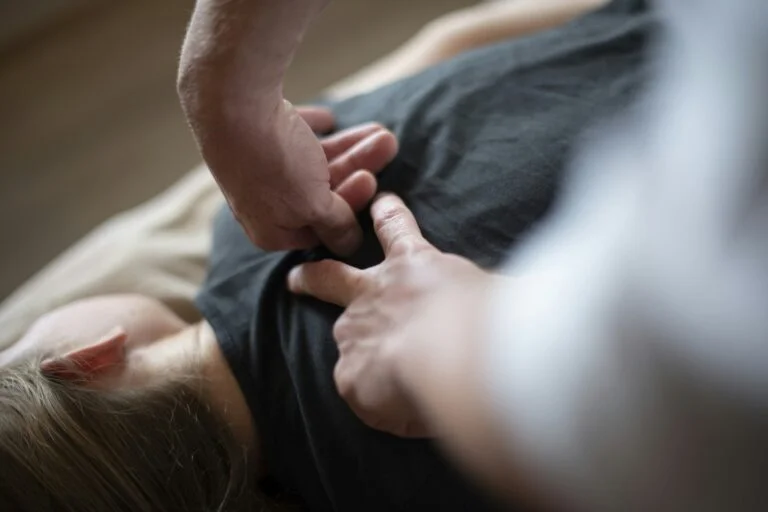
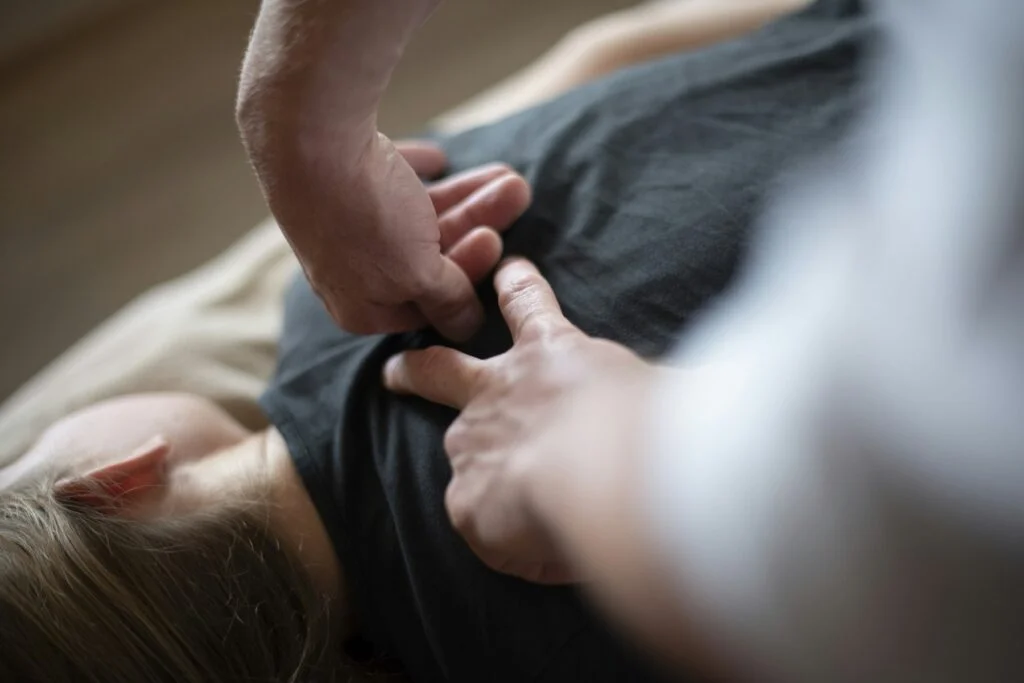
- Press on it. Steady pressure from your fingers, a massage ball or a foam roller is the classic home approach. See how to do it below.
- Stretch gently. Slow shoulder rolls, neck tilts and chest-opening stretches suit upper back knots. Stop if anything makes the pain much worse.
- Take breaks. The Health and Safety Executive (HSE) says short, frequent breaks from screen work are better than long, occasional ones: 5 to 10 minutes every hour beats 20 minutes every 2 hours. Stand up, move and change position.
- Ask a pharmacist about pain relief if you need it, especially if you take other medicines.
How to massage a knot out yourself
Physios call steady pressure on a tender spot “ischaemic compression”. You can do a simple version at home:
- Warm up first with a shower or a few minutes of heat.
- Find the spot. For the upper back, put a tennis ball or massage ball between your back and a wall. Lying on the floor gives more pressure, so start against the wall.
- Lean in gently. Aim for a firm “good pain” of about 5 or 6 out of 10, never sharp pain. Breathe slowly and hold for up to a minute, or roll slowly over the area.
- Move on. Work the area around the knot too, then stand up and move your shoulders or back.
- Little and often. A few minutes once or twice a day beats one long, heavy session.
A foam roller works the same way for larger muscles such as the calves, thighs and upper back. Keep it off your lower back and the front and sides of your neck, and avoid pressing on bruises, broken skin, varicose veins or anywhere swollen.
Massage guns are a powered version of the same idea: use a low setting, keep the head moving and stay off bony areas and the neck. Our muscle recovery guide covers foam rolling, massage and other recovery tools. A balm or oil helps your hands glide; see how to use a massage balm.
What the evidence says
Research on knots is mostly small studies, so treat these results as a guide.
| Option | What the research shows |
|---|---|
| Steady pressure (self-massage or a therapist) | A 2023 review of 15 trials (725 people with neck pain) found pressure on trigger points reduced pain and improved movement in the short term compared with sham or no treatment. A 2022 review across myofascial pain found it raised pain tolerance but made no clear difference to how much pain people reported |
| Foam rolling | A 2019 meta-analysis of 21 studies found rolling after exercise reduced muscle pain by about 6%. Overall effects were small, and it looked most useful as a warm-up |
| Dry needling (by a physio) | A 2017 review of 13 trials found very low to moderate quality evidence of less pain for up to 12 weeks. There was no clear evidence of long-term benefit. In the 2023 neck pain review, it beat pressure alone straight after treatment |
| Heat | Recommended by the NHS for stiffness and muscle spasms. Low risk and easy to try |
| Movement and stretching | The NHS advises staying active for back pain and gentle exercises for neck pain |
Professional help. If knots keep coming back, a physiotherapist can use hands-on techniques or dry needling (fine needles placed into tight spots) and, most usefully, give you a strengthening plan. The NHS says that in many areas you can refer yourself to NHS musculoskeletal (MSK) services, such as physiotherapy, without seeing a GP first.
How long do muscle knots last?
There’s no good research on knots specifically, so the closest guide is NHS advice on the pain they cause. The NHS says most neck pain only lasts a few weeks, and back pain usually improves within a few weeks too, although it can last longer or keep coming back.
A knot after a heavy session often eases in a few days. A knot that lasts months or years usually has something feeding it, such as the same desk set-up, ongoing stress or poor sleep. That is when a physio’s plan is most worthwhile.
The NHS suggests seeing a GP if back pain hasn’t improved after a few weeks of home treatment, stops you doing day-to-day things, or sits between your shoulders rather than in your lower back.
When it isn’t a knot: red flags
Call 999 if you have:
- chest pain that feels tight, heavy or squeezing, or pain spreading to your arms, neck or jaw (possible heart attack)
- pain and swelling in one leg with shortness of breath or chest pain (possible blood clot in the lungs)
- back pain with numbness, tingling or weakness in both legs, numbness around your bottom or genitals, or loss of bladder or bowel control
Do not drive yourself to A&E.
Calf pain: the NHS says throbbing pain in one leg, usually the calf or thigh, with swelling, red or darkened skin or swollen veins can be a deep vein thrombosis (DVT). Ask for an urgent GP appointment or call 111. Don’t massage or roll a calf that is swollen and painful.
A lump that behaves differently: knots are tender and come and go. The NHS advises seeing a GP if a lump gets bigger, is painful, red or hot, is hard and doesn’t move, or lasts more than 2 weeks, or if you have a swelling in your neck, armpit or groin that doesn’t go down within 2 weeks.
Feeling unwell: ask for an urgent GP appointment or call 111 if back pain comes with feeling hot, cold or shivery, or the pain is severe or getting worse quickly.
Numbness or pins and needles: pain that spreads into an arm or leg with numbness, tingling or weakness can come from a trapped nerve rather than a knot. See a GP if it doesn’t settle.
How to stop knots coming back
- Move every hour. Set a reminder to stand, roll your shoulders and walk for a few minutes.
- Set up your desk. The HSE suggests having the top of the screen at about eye level, straight in front of you, and a separate keyboard and mouse for long laptop sessions.
- Build strength gradually. Regular strengthening work for your upper back, shoulders and core, built up slowly. A physio can tailor a plan.
- Protect your sleep. Given the strong link between poor sleep and pain, a steady bedtime and a wind-down routine are worth the effort.
- Release tension on purpose. Progressive muscle relaxation teaches you to notice and let go of tension in your shoulders and jaw.
Where our products fit (honestly)
No balm or supplement gets rid of knots, and CBD isn’t a treatment for muscle pain or muscle knots. Movement, heat, sleep and proper advice come first. If you’re curious about the research, see what the CBD and pain trials actually show.
Our CBD Balm, Muscle and Joint Support is a massage balm made with broad spectrum CBD, peppermint, eucalyptus and juniper. It feels cooling and non-greasy, and some people like using it to help their hands glide during a self-massage after a warm shower.
Our Magnesium Glycinate Sleep Complex is an evening drink with magnesium bisglycinate and citrate, glycine and L-theanine. Magnesium contributes to normal muscle function. For more on magnesium and muscles, see magnesium for muscle pain.
If you also take CBD by mouth: the FSA’s 10mg a day figure is precautionary advice rather than a legal limit, set while longer-term safety research continues. At Evopure we think it is a very cautious figure, and many adults use more. If you go above it, increase slowly, and check with your GP or pharmacist first if you take any medication.
Our products are for adults (18+) only. We don’t recommend our products during pregnancy or breastfeeding. If you take prescribed medicines, check with your pharmacist before adding a supplement.
If the ache sits between your shoulder blades, read our guide to upper back pain.
FAQs
Are muscle knots real?
The pain and tenderness are real. What causes them is debated: some researchers describe tight, irritated patches of muscle called trigger points, while others think sensitised nerves explain the soreness better. Either way, movement, heat and pressure are sensible things to try.
Do muscle knots go away on their own?
Most do. A knot after a heavy session often eases in a few days, and the NHS says most neck and back pain improves within a few weeks. Knots that keep coming back usually have a cause worth fixing, such as desk set-up, stress or poor sleep.
Should you massage a muscle knot?
Yes, gently. Steady pressure with your fingers, a massage ball or a foam roller is fine for most knots. Aim for firm but comfortable pressure, never sharp pain. Don’t massage a calf that is swollen, red or throbbing, as that can be a blood clot.
Is heat or ice better for a muscle knot?
Heat usually suits knots, because they are about stiffness and tension rather than a fresh injury. The NHS suggests a heat pack or hot water bottle wrapped in a tea towel. A wrapped cold pack is better for a new injury with swelling.
Can dehydration cause muscle knots?
It’s often said, but there’s no good research showing that dehydration causes knots. Drinking enough is good for your health in general, but it isn’t a proven fix for knots.
Why do I keep getting knots in my shoulders?
Usually a mix of long spells at a desk or on a phone, stress that makes you tense your shoulders, poor sleep and not enough upper back strength. Regular breaks, desk changes, strengthening work and relaxation help stop them coming back.
Does CBD balm get rid of muscle knots?
No. CBD isn’t a treatment for muscle pain or knots. Some people like a balm to help their hands glide during self-massage, and it’s the massage, movement and heat that do the work.
Sources
- NHS. Back pain.
- NHS. Neck pain and stiff neck.
- NHS. Deep vein thrombosis (DVT).
- NHS. Heart attack.
- NHS. Lumps.
- Health and Safety Executive. Work routine and breaks and Good posture when using DSE.
- Shah JP, et al. An in vivo microanalytical technique for measuring the local biochemical milieu of human skeletal muscle. J Appl Physiol, 2005. PMID 16037403.
- Shah JP, et al. Biochemicals associated with pain and inflammation are elevated in sites near to and remote from active myofascial trigger points. Arch Phys Med Rehabil, 2008. PMID 18164325.
- Lucas N, et al. Reliability of physical examination for diagnosis of myofascial trigger points: a systematic review of the literature. Clin J Pain, 2009. PMID 19158550.
- Quintner JL, Bove GM, Cohen ML. A critical evaluation of the trigger point phenomenon. Rheumatology, 2015. PMID 25477053.
- Xu A, et al. Effectiveness of ischemic compression on myofascial trigger points in relieving neck pain: a systematic review and meta-analysis. J Back Musculoskelet Rehabil, 2023. PMID 36872769.
- Lu W, et al. Effect of ischemic compression on myofascial pain syndrome: a systematic review and meta-analysis. Chiropr Man Therap, 2022. PMID 36050701.
- Wiewelhove T, et al. A meta-analysis of the effects of foam rolling on performance and recovery. Front Physiol, 2019. PMID 31024339.
- Gattie E, Cleland JA, Snodgrass S. The effectiveness of trigger point dry needling for musculoskeletal conditions by physical therapists: a systematic review and meta-analysis. J Orthop Sports Phys Ther, 2017. PMID 28158962.
- Finan PH, Goodin BR, Smith MT. The association of sleep and pain: an update and a path forward. J Pain, 2013. PMID 24290442.
This guide is general information, not medical advice. If you’re worried about pain or a lump, speak to a GP, pharmacist or physiotherapist, and call 999 in an emergency. Evopure makes the CBD Balm, Muscle and Joint Support and the Magnesium Glycinate Sleep Complex.