
Last updated: October 2026
To use a hot water bottle safely, fill it no more than two-thirds full with hot, not boiling, water, squeeze out the air, screw the stopper tight and always use a cover. Never sit or lie on it, never use it with an electric blanket, and replace it every two to three years, sooner if it shows any wear.
Below: a safety checklist, how to read the daisy wheel date mark, who shouldn’t use one, burns first aid, sleep and period pain, and how it compares with an electric blanket and a wheat bag.
How to use a hot water bottle safely
Burns usually happen while filling the bottle, or when it leaks or splits. This checklist, based on advice from RoSPA, the Children’s Burns Trust and Trading Standards, covers all three.
- Check it first. Look for cracks, splits, thin or sticky patches and fading, especially around the neck. If you’re unsure, replace it.
- Never use boiling water. The Children’s Burns Trust suggests letting a boiled kettle cool for about five minutes before filling.
- Fill to two-thirds at most, holding the bottle upright by the neck.
- Squeeze out the air gently, holding the neck pointing away from you, then screw the stopper on tightly.
- Always use a cover or wrap it in a towel. Never put a hot water bottle directly on bare skin.
- Don’t sit, lie or kneel on it. Pressure can make it burst or leak.
- Never use it with an electric blanket.
- Empty it after use and let it dry upside down.
Adults should always do the filling, and it’s worth checking older relatives’ bottles too.
The daisy wheel: how to tell how old your hot water bottle is
Most hot water bottles have a small flower-shaped stamp near the neck, often called a daisy wheel. It shows when the bottle was made:
- The number in the middle is the year. “23” means 2023.
- The 12 petals around it are the months, January to December.
- The dots inside a petal show the week of that month.
So “23” in the centre with dots in the fourth petal means April 2023. Take the cover off to find it. If there is no wheel, or you can’t read it, treat the bottle as old.
How often should you replace a hot water bottle?
Every two to three years, and sooner if it shows any wear. Devon and Somerset Trading Standards say two to three years after first use, Scotland’s burns network says no older than three years, and the Children’s Burns Trust is stricter at two years. Rubber weakens with age, so an old bottle is more likely to split. If yours is past two years and used nightly, replace it.
Who shouldn’t use a hot water bottle
- Babies. The Lullaby Trust advises never putting a hot water bottle in a baby’s sleep space.
- Young children. The Children’s Burns Trust urges families to avoid using hot water bottles for children.
- People with reduced feeling in their skin. Diabetes is the most common cause of nerve damage (peripheral neuropathy) in the UK, so you may not feel heat building up or a leak. Scotland’s burns network advises people with diabetes never to rest their feet on a hot water bottle.
- People with Raynaud’s or chilblains. The NHS advises warming cold skin slowly, not on a radiator or in hot water, and the same applies to a hot water bottle. See our guides to chilblains and Raynaud’s.
- Anyone very drowsy, for example after alcohol or sedating medicine, who might fall asleep pressed against it.
Hot water bottle burns: the facts and first aid
According to the British Standards Institution, burns units in England and Wales treated 968 hot water bottle cases in 2024, up from 501 in 2020. A UK study of burns data found the biggest rises between winter 2021 and winter 2022 were in children (up 60%) and adults over 65 (up 69%). The Children’s Burns Trust reports 239 children had life-altering hot water bottle burns or scalds in 2025.
In a German study, the lower tummy, thighs and forearms were burned most often. Long, repeated heat can also cause a mottled brown, net-like rash called erythema ab igne (“toasted skin”), linked to hot water bottles, heaters and laptops. If you see it, stop the heat and mention it to your GP.
First aid for a hot water bottle burn or scald
- Hold the burn under cool running water for 20 minutes, as soon as possible (the NHS says within 3 hours).
- Remove clothing or jewellery near the burn, but not anything stuck to it.
- Once cooled, lay cling film loosely over it. Don’t wrap it round.
- Don’t put creams, oils or butter on it, don’t use sticky plasters, and don’t burst blisters.
Go to A&E or call 999 if the burn is large or deep, or on the face, genitals or bottom. Call NHS 111 if you’re unsure, and always call 111 for advice about a burn on a child under 5.
Using a hot water bottle for sleep
To fall asleep, your body sheds heat through your hands and feet. In a Swiss sleep lab study, how warm people’s hands and feet were compared with their trunk was the best predictor of how quickly they fell asleep, and people with persistently cold hands and feet take longer to drop off. In a small Korean study of six young men in a cool room, bed socks cut the time to fall asleep by about 7.5 minutes and added about 32 minutes of sleep.
The safest way to use a hot water bottle is to warm the bed, not hug it all night:
- Put it in its cover under the duvet 20 to 30 minutes before bed, where your feet will go.
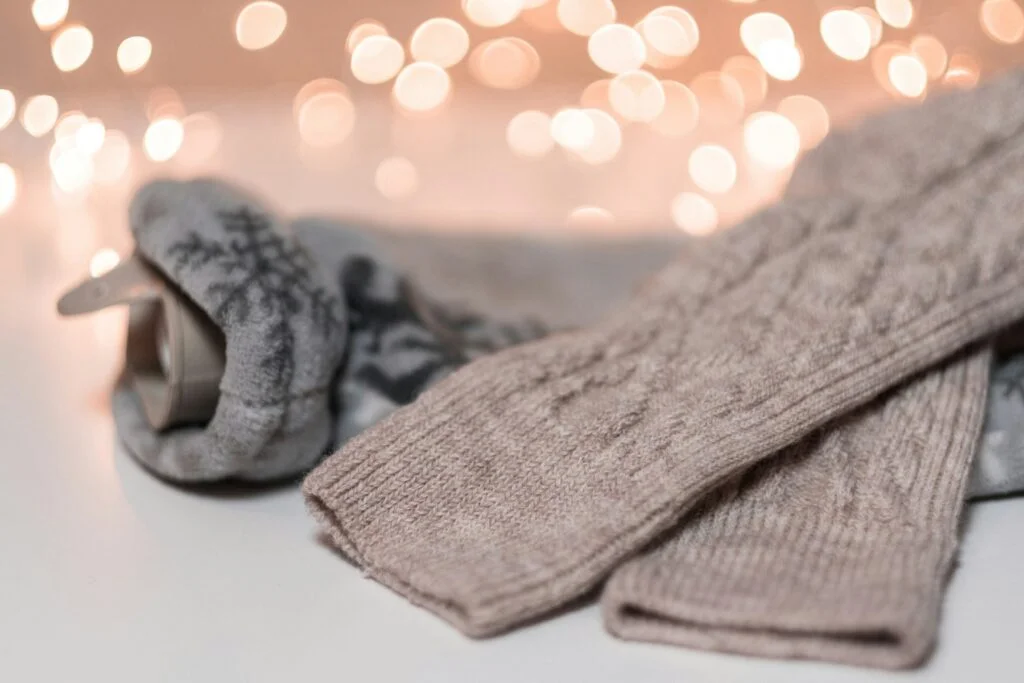
- When you get in, move it away and wear bed socks instead.
- Keep the bedroom itself cool. See our guide to the best temperature for sleep.
Pair it with a calm bedtime routine, such as an Epsom salt bath and dim lights. See also how to fall asleep fast.
If you like a drink as part of your wind-down, our Magnesium Glycinate Sleep Complex is a caffeine-free berry powder with magnesium bisglycinate and citrate, L-theanine and chamomile. Magnesium contributes to a reduction of tiredness and fatigue and to the normal functioning of the nervous system.
Hot water bottles for period pain, back pain and aches
Period pain. The NHS suggests putting a heat pad or a hot water bottle wrapped in a tea towel on your tummy. A 2026 review of 57 trials with more than 5,000 women found heat is likely to reduce period pain compared with no treatment, and may work about as well as anti-inflammatory painkillers. See our full guide to period pain relief, and if cramps keep you awake, read about insomnia before your period.
Back and neck pain. The NHS suggests a wrapped heat pack or hot water bottle for back stiffness or muscle spasms, and for neck pain, 20 minutes, 2 to 3 times a day. See our guides to lower back pain and stiff neck.
Hot water bottle vs electric blanket vs microwave wheat bag
| Hot water bottle | Electric blanket | Microwave wheat bag | |
|---|---|---|---|
| Best for | Warming the bed, period pain, aches | Warming the whole bed evenly | Short, targeted heat on a sore spot |
| Main risk | Scalds from filling, leaks or splitting | Fire if old, damaged or wet | Overheating and catching fire, especially in bed |
| Key safety rule | Two-thirds full, hot not boiling, always covered | Unplug before bed unless it has an all-night thermostat; never use with a hot water bottle | Follow the heating time exactly; let it cool fully before reheating |
| Use in bed overnight? | Warm the bed, then move it away | Only all-night models, as instructed | No: fire services advise not using wheat bags in bed or under blankets |
| Replace | Every 2 to 3 years, or sooner if worn | When more than 10 years old | If it looks scorched or smells burnt |
Whichever you use, follow the instructions and check it for wear each winter. For more ways to stay warm, read why am I always cold?, our winter wellness guide and our take on hygge.
Buying a new hot water bottle: what to look for
- A BS 1970 marking. BS 1970:2012 is the British Standard for rubber and PVC hot water bottles. It was withdrawn in 2024 and the BSI has since reformed a committee to reinstate and update it, so the mark is still a good sign.
- A recent date on the daisy wheel, so you know it’s genuinely new and not old stock.
- The maker’s name and instructions.
- Rubber or PVC. Both are covered by the standard. If you have a latex allergy, choose one that isn’t natural rubber.
- A thick, removable cover.
Avoid second-hand bottles and any without markings. If you’re buying one as a winter gift, see our wellness stocking fillers.
Always reaching for a hot water bottle? Find out why your feet get so cold and when it’s worth seeing a GP.
Thinking of an electric blanket instead? See our electric blanket safety guide.
FAQs
How often should you replace a hot water bottle?
Every two to three years, and straight away if it shows cracks, splits, thin or sticky patches. Trading Standards say two to three years after first use; the Children’s Burns Trust says not to use one more than two years old.
What does the flower symbol on a hot water bottle mean?
It is a date mark, often called a daisy wheel. The number in the middle is the year it was made, the 12 petals are the months, and the dots inside a petal show the week.
Can you put boiling water in a hot water bottle?
No. Use hot, not boiling, water. Let a boiled kettle cool for about five minutes, fill the bottle to no more than two-thirds, squeeze out the air and screw the stopper on tightly.
Is it safe to sleep with a hot water bottle?
It is safest to use it to warm the bed, then move it away from your body before you fall asleep. Never lie on it, always use a cover, and don’t use it with an electric blanket switched on.
Does a hot water bottle help with period pain?
Heat can help. The NHS suggests a hot water bottle wrapped in a tea towel on your tummy, and a large review of trials found heat therapy likely reduces period pain compared with no treatment.
Can you use a hot water bottle with an electric blanket?
No. Fire services advise never using a hot water bottle with an electric blanket, because a leak or spill can cause an electrical fault and increase the risk of fire.
Are hot water bottles safe for children?
The Children’s Burns Trust urges families to avoid using them for children, and the Lullaby Trust advises never putting one in a baby’s sleep space. If older children use one, an adult should fill it.
Sources
- RoSPA. Keeping safe as well as warm: reducing the risk of burns from hot water bottles (October 2025).
- Children’s Burns Trust. Hot water bottles.
- BSI. New committee to review and update hot water bottle specification (May 2025).
- Devon and Somerset Trading Standards. Hot water bottle safety (October 2024).
- Care of Burns in Scotland (NHS). Help prevent hot water bottle scalds and burns this winter.
- NHS. Burns and scalds; Period pain; Back pain; Neck pain; Peripheral neuropathy.
- Greater Manchester Fire and Rescue Service. Electric blankets.
- West Sussex Fire and Rescue Service. Firefighters issue warning after wheat bag fire in Worthing (January 2026).
- Chu MH et al. Has the energy poverty crisis fuelled a rise in hot water bottle burn injuries within the United Kingdom? Burns, 2024.
- Milewski MR et al. Hot water bottle burn injuries: a 10-year retrospective analysis in Germany. Innov Surg Sci, 2025.
- Kräuchi K et al. Functional link between distal vasodilation and sleep-onset latency? Am J Physiol, 2000.
- Pache M et al. Cold feet and prolonged sleep-onset latency in vasospastic syndrome. Lancet, 2001.
- Ko Y, Lee JY. Effects of feet warming using bed socks on sleep quality in a cool environment. J Physiol Anthropol, 2018.
- Yuan D et al. Heat therapy for primary dysmenorrhea: a systematic review and meta-analysis. Front Med, 2026.
- Forouzan P et al. Heater-associated erythema ab igne: case report and review. Cureus, 2020.
This guide is general information, not medical advice. Evopure makes the Magnesium Glycinate Sleep Complex.