






Last updated: October 2026
Spacegoods is a London-based brand selling flavoured mushroom drink powders. Its main product, Rainbow Dust, lists lion’s mane, cordyceps and chaga (1,000mg each per 8g scoop) plus KSM-66 ashwagandha, maca and vitamin B5. When we checked its UK labels in October 2026, caffeine was 120mg per serving in Coffee and 80mg in Chocolate.
Below: the full range, what’s in each scoop, caffeine by flavour, the Spacegoods hot chocolate and the new Sleep+ evening blend, what the research says about each mushroom, and a checklist for comparing any mushroom drink. These are facts from Spacegoods’ own website and labels, not a review. Evopure isn’t connected with Spacegoods.
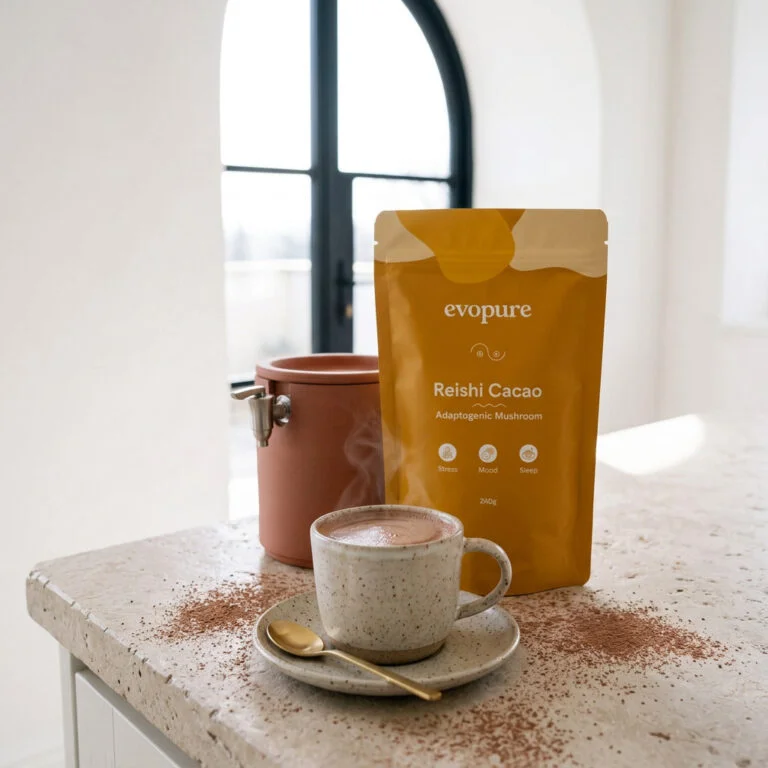
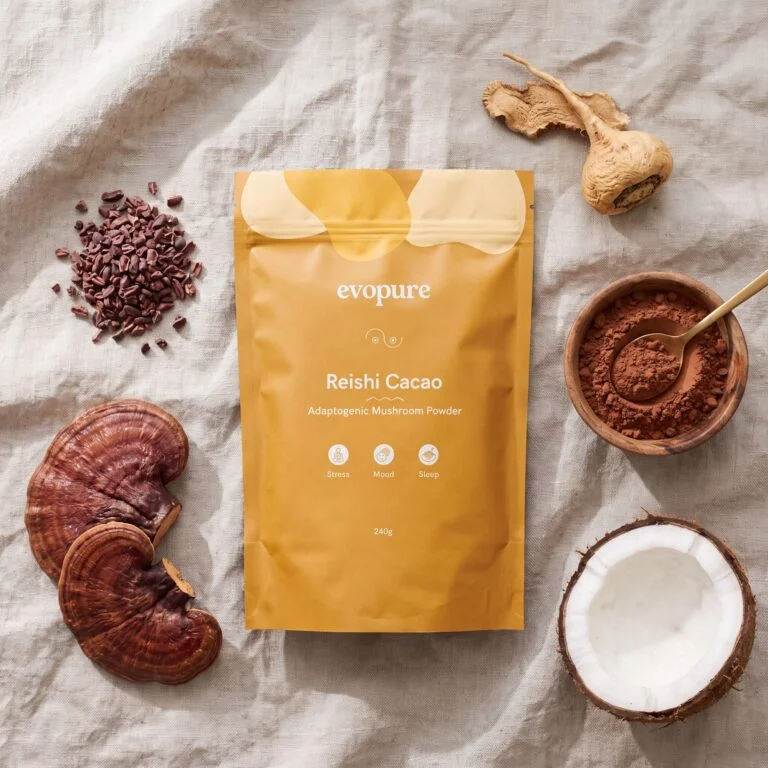
Looking for a reishi hot chocolate? Our Reishi Mushroom Adaptogenic Complex is a hot chocolate made with reishi mushroom extract, organic cacao and maca, with no added coffee. It contains a little natural caffeine from the cacao. Evopure isn’t connected with Spacegoods.
What does Spacegoods sell?
Spacegoods says it is based in London, makes its products in England and ships UK orders from Birmingham. Here is the range on spacegoods.com when we checked on 23 October 2026:
| Product | What it is | Caffeine listed |
|---|---|---|
| Rainbow Dust | Mushroom coffee or chocolate powder, 6 flavours | 80 to 120mg per scoop |
| Rainbow Dust Decaf | Decaf coffee version | Under 10mg per scoop |
| Matcha Dust | Matcha powder with mushrooms | 60mg per scoop |
| Oat Mushroom Latte | Ready-to-drink 250ml cans | 120mg per can |
| Sleep+ Magnesium | Chocolate evening blend | None listed |
| Hydro Dust, Glow Dust | Electrolyte and collagen drinks | Not covered here |
Most products come as starter kits or monthly subscriptions, with one-off pouches and 7 or 14 sachet sample packs too.
What’s in Spacegoods Rainbow Dust?
The active ingredients are the same across flavours. This is what the Coffee and Chocolate labels listed per 8g scoop:
| Ingredient | Per 8g scoop | Label detail |
|---|---|---|
| Lion’s mane | 1,000mg | 12:1 extract, fruiting body |
| Cordyceps sinensis | 1,000mg | 20:1 extract, fruiting body |
| Chaga | 1,000mg | 12:1 extract, fruiting body |
| KSM-66 ashwagandha | 300mg | 12:1 root extract |
| Maca root | 250mg | 10:1 extract |
| Caffeine | 80 to 120mg | Depends on flavour |
| Vitamin B5 | 6mg | 100% of the reference intake |
The base changes by flavour. Coffee is mostly chicory root fibre (inulin) and spray-dried coffee, with added caffeine. Chocolate is reduced-fat cocoa powder with added caffeine and stevia. Decaf uses decaffeinated coffee. A scoop has 21 to 25 calories, and a pouch holds 30 servings.
Other details Spacegoods lists: vegan, gluten-free, no added sugar, made in England, and third-party lab tested, including for heavy metals and allergens. None of the mushrooms has an authorised health claim in the UK. The vitamin B5 does: pantothenic acid contributes to the reduction of tiredness and fatigue.
Reading the mushroom figures. On its Sleep+ label, Spacegoods shows the extract behind each mushroom figure: 1,000mg of reishi comes “from 66.7mg 15:1 extract”, so the figure is the equivalent weight of dried mushroom. The Rainbow Dust labels give the extract ratios but not the extract weights. Spacegoods’ help centre also shows some earlier ingredient lists with different ratios, so go by the pouch you buy.
How much caffeine is in Spacegoods?
It depends on the product and flavour. From Spacegoods’ labels and help centre, checked 23 October 2026:
- Rainbow Dust Coffee: 120mg per scoop.
- Rainbow Dust Chocolate: 80mg per scoop.
- Other Rainbow Dust flavours: the product page gives 80 to 120mg.
- Rainbow Dust Decaf: “less than 10mg per serving”.
- Matcha Dust: 60mg, from matcha green tea.
- Oat Mushroom Latte: 120mg per can.
For scale, the NHS estimates 100mg in a cup of instant coffee and 75mg in a cup of tea. The European Food Safety Authority (EFSA) says up to 400mg a day, and single doses up to 200mg, raise no safety concerns for healthy adults. In pregnancy the NHS limit is 200mg a day.
Spacegoods suggests one scoop in the morning and says you can have up to three a day. Three scoops of the Coffee flavour would be 360mg before any tea or coffee, so it’s worth adding up. You may see other caffeine figures online, for example on overseas store listings; the pouch you buy is the one to go by. See how long caffeine lasts.
Is there a Spacegoods hot chocolate?
Yes, two, and they are made for different times of day:
- Rainbow Dust Chocolate is the morning product in chocolate form. It has the same mushrooms and ashwagandha as the coffee flavours, plus 80mg of added caffeine.
- Sleep+ is the evening product. Spacegoods calls it “a delicious hot chocolate blend” made with cocoa, mushrooms and rice peptides, and lists no caffeine.
So if you want a mug in the evening, check which chocolate you have. Cocoa itself naturally contains a little caffeine (the NHS estimates under 25mg in a 50g bar of plain dark chocolate); our hot chocolate before bed guide covers how much.
Spacegoods Sleep+: the sleep product (formerly Astro Dust)
Sleep+ Magnesium went on sale on 13 October 2026. Spacegoods’ help centre calls it “the next evolution” of Astro Dust and says existing Astro Dust subscribers keep receiving Astro Dust. The Sleep+ chocolate label lists, per 8g scoop:
| Ingredient | Per 8g scoop |
|---|---|
| Magnesium (bisglycinate, citrate, taurinate) | 200mg, 53% of the reference intake |
| L-glycine | 2,250mg |
| Maitake mushroom | 1,000mg, from 125mg of 8:1 extract |
| Reishi mushroom | 1,000mg, from 66.7mg of 15:1 extract |
| PeptiSleep (rice protein hydrolysate) | 250mg |
| L-tryptophan | 250mg |
| Montmorency cherry powder | 150mg |
| Lemon balm | 150mg, from 37.5mg of 4:1 extract |
| Chamomile flower | 150mg |
The base is reduced-fat cocoa powder with acacia gum, chocolate flavouring and stevia, at 14 calories a scoop. Spacegoods suggests one scoop a day as you wind down, and says one scoop of Rainbow Dust in the morning plus one of Sleep+ in the evening is fine.
What the evidence says. No sleep claim is authorised in the UK for any of these ingredients. Magnesium has authorised claims, such as contributing to normal functioning of the nervous system and to a reduction of tiredness and fatigue. Spacegoods’ page cites a 2024 controlled study of PeptiSleep; the drink itself hasn’t been tested in published trials. For the research on the individual ingredients, see magnesium for sleep, glycine for sleep and tryptophan.
If you take another magnesium supplement too, add them up: the NHS says 400mg or less a day of magnesium from supplements is unlikely to cause harm.
The mushrooms in Spacegoods: what the research says
No published trial has tested Rainbow Dust itself, so here is the honest picture ingredient by ingredient. None of these mushrooms has an authorised health claim in the UK. For a side-by-side, see lion’s mane vs reishi vs cordyceps.
Lion’s mane
The best-known trial gave 30 Japanese adults aged 50 to 80 with mild cognitive impairment about 3g a day of dried lion’s mane for 16 weeks. Their test scores rose compared with placebo, then fell back after they stopped. A 2023 UK pilot gave 41 healthy young adults 1.8g a day: they were quicker on one task an hour after a single dose, with a trend towards lower stress at 28 days, but also null results. More in our lion’s mane guide.
Lion’s mane is often sold as a nootropic. For the wider picture, see our nootropics UK guide: what they are, what is legal and what the evidence shows.
Cordyceps sinensis
Spacegoods says it uses Cordyceps sinensis, not Cordyceps militaris. In 20 healthy older adults, 333mg of a Cs-4 extract three times a day for 12 weeks raised one measure of exercise capacity by about 10%. In 22 trained cyclists, 3g a day for 5 weeks made no difference to endurance. See cordyceps.
Chaga
Memorial Sloan Kettering says chaga’s safety and efficacy “have yet to be evaluated in clinical studies”. Chaga is very high in oxalate, and there are case reports of kidney damage after heavy, long-term use, such as 4 to 5 teaspoons of powder a day for 6 months. Read chaga mushroom before taking it daily.
Reishi and maitake (in Sleep+)
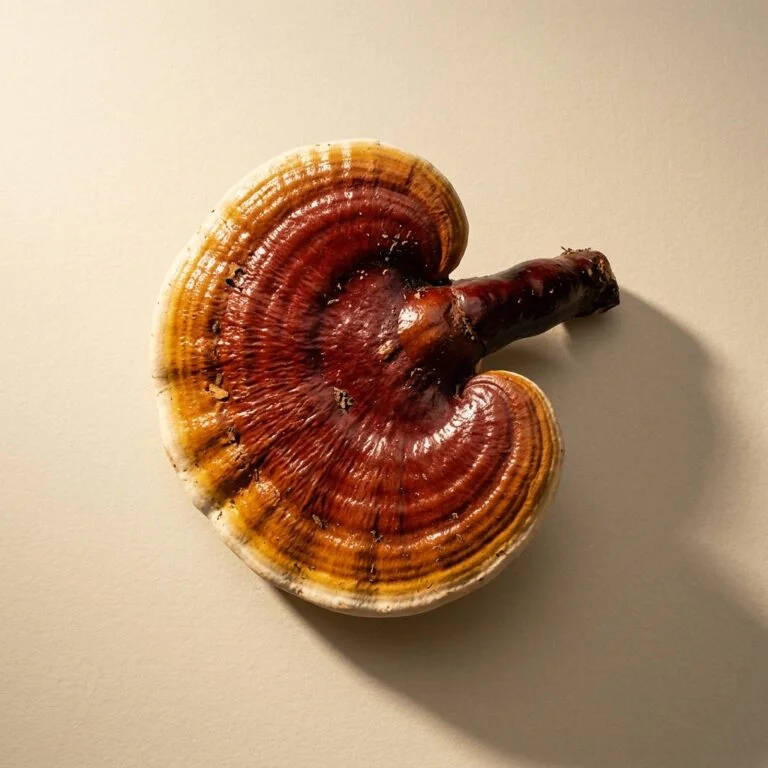
Both have small, mixed human studies. Our reishi guide and maitake guide cover the trials and the cautions.
KSM-66 ashwagandha
KSM-66 is a branded ashwagandha root extract. In one well-known trial of a full-spectrum root extract, 64 adults with chronic stress took 300mg twice a day for 60 days; Rainbow Dust has 300mg once a day. The FSA has been gathering evidence on ashwagandha’s safety. See ashwagandha side effects.
How to compare mushroom drinks (any brand)
If you’re looking at a Spacegoods alternative, the same label questions apply to every brand. We haven’t tested Spacegoods and don’t score it; this is the checklist we’d use for any mushroom drink, ours included.
| Check | What to look for | Why it matters |
|---|---|---|
| Part used | Fruiting body or mycelium | They are different materials |
| Extract | Ratio and extract weight | Shows how much was used |
| Amounts | mg per serving for each mushroom | “Blend” alone hides doses |
| Caffeine | mg per serving, by flavour | Adds to your daily total |
| Beta-glucans | A stated percentage | A measurable active compound |
| Testing | Third-party tests, heavy metals included | Shows what was checked |
| Who it’s for | Pregnancy, children, medication | Safety advice on the label |
On beta-glucans: lab methods exist that measure beta-glucan separately from starch, so a stated beta-glucan figure tells you more than a general “polysaccharides” one.
Is Spacegoods worth it? That’s a personal call, and we haven’t tried it. Rainbow Dust is a caffeinated coffee replacement with several mushrooms in one scoop, while some people prefer a single mushroom or no caffeine. For more on the category, see mushroom coffee and how to choose a mushroom supplement.
Who should check first
- Pregnancy and breastfeeding: Spacegoods recommends speaking with your doctor first. Count the caffeine towards the NHS 200mg daily limit.
- Children: Spacegoods says its products are designed for adults.
- Medication: Spacegoods recommends checking with your GP. Memorial Sloan Kettering says chaga may increase bleeding risk with blood thinners, and NCCIH advises against ashwagandha for people with thyroid or autoimmune disorders.
- Kidney problems: ask your GP before using chaga regularly, because of its oxalate.
- Caffeine sensitivity: choose Decaf or Sleep+, or check the flavour’s caffeine.
If you’re comparing options: what ours contain
We don’t make a mushroom coffee, and we’re not saying ours are better. If you’re looking at evening drinks or calm, here is what’s in the Evopure products people often compare:
- Reishi Mushroom Adaptogenic Complex: a reishi hot chocolate with reishi mushroom extract, organic cacao, maca, coconut milk powder and coconut sugar. No coffee is added, but it contains a little natural caffeine from the cacao. See reishi cacao.
- Magnesium Glycinate Sleep Complex: a berry powder with magnesium bisglycinate and citrate (148mg magnesium per serving), glycine, L-theanine, chamomile, passionflower, hops and oat straw. Magnesium contributes to a reduction of tiredness and fatigue.
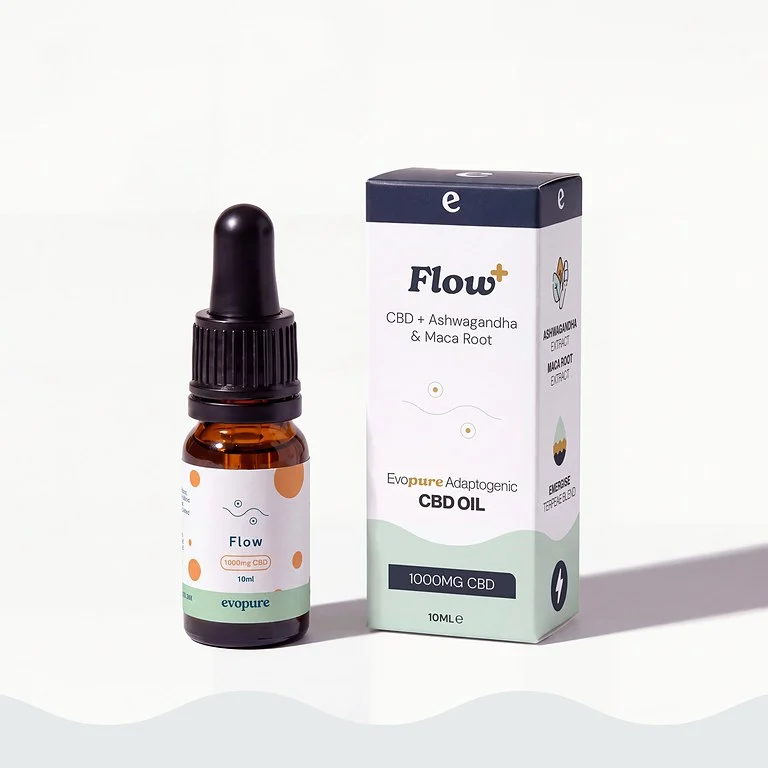
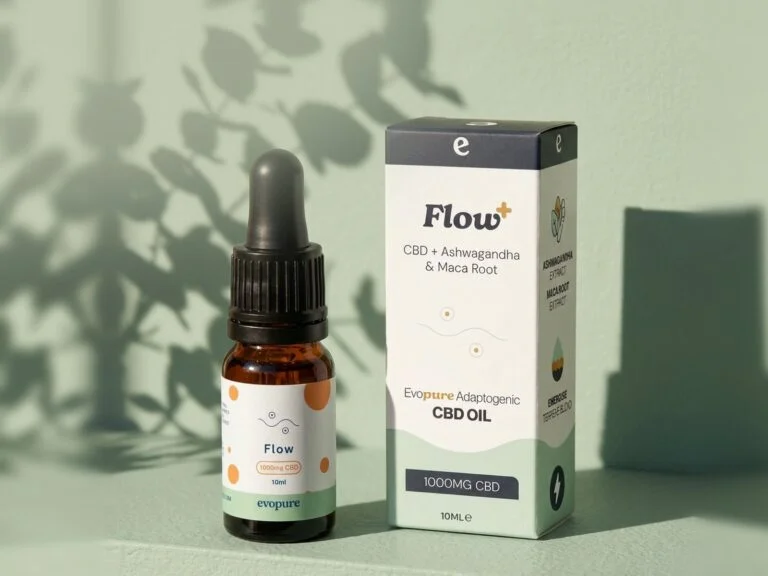
- Flow CBD Oil: broad spectrum CBD with 0% THC, plus ashwagandha and maca in MCT oil, taken drop by drop. CBD isn’t a treatment for any condition.
The FSA’s 10mg a day figure is precautionary advice rather than a legal limit, set while longer-term safety research continues. At Evopure we think it is a very cautious figure, and many adults use more. If you go above it, increase slowly, and check with your GP or pharmacist first if you take any medication.
All three are vegan, made in the UK and third-party lab tested. We don’t recommend our products during pregnancy or breastfeeding, and they are for adults only.
FAQs
What is Spacegoods?
Spacegoods is a London-based brand that sells flavoured drink powders made with functional mushrooms and adaptogens. Its main product is Rainbow Dust, a mushroom coffee or chocolate powder, alongside Matcha Dust, Oat Mushroom Latte cans and the Sleep+ evening blend.
How much caffeine is in Spacegoods Rainbow Dust?
When we checked in October 2026, the Coffee flavour listed 120mg per 8g scoop and the Chocolate flavour 80mg. The product page gives 80 to 120mg across flavours, and Decaf has less than 10mg.
Does the Spacegoods hot chocolate have caffeine?
Rainbow Dust Chocolate has 80mg of caffeine per scoop. Sleep+, the evening chocolate blend, lists no caffeine.
Does Spacegoods have a sleep product?
Yes. Sleep+ Magnesium, launched in October 2026, is the successor to Astro Dust. Per scoop it lists 200mg of magnesium, glycine, reishi, maitake, PeptiSleep, L-tryptophan, cherry, lemon balm and chamomile. No sleep claim is authorised in the UK for these ingredients.
What mushrooms are in Spacegoods?
Rainbow Dust lists lion’s mane, Cordyceps sinensis and chaga, 1,000mg each per scoop, from fruiting body extracts. Sleep+ lists reishi and maitake.
How many Spacegoods can you have a day?
Spacegoods suggests one scoop of Rainbow Dust in the morning and says up to three a day is fine. At 120mg each in the Coffee flavour, three scoops is 360mg of caffeine before any tea or coffee.
Can you have Spacegoods when pregnant?
Spacegoods recommends speaking with your doctor before using its products while pregnant or breastfeeding. The NHS advises no more than 200mg of caffeine a day in pregnancy.
Sources
- Spacegoods. Rainbow Dust Starter Kit and Sleep+ Magnesium product pages and labels, checked 23 October 2026.
- Spacegoods Help Center. Sleep and Healthcare, checked 23 October 2026.
- NHS. Foods to avoid in pregnancy (caffeine).
- NHS. Vitamins and minerals: magnesium.
- EFSA. Caffeine.
- Food Standards Agency. Summary of responses to call for evidence on ashwagandha.
- Memorial Sloan Kettering Cancer Center. Chaga mushroom.
- NCCIH. Ashwagandha.
- Mori K, et al. (2009). Improving effects of the mushroom Yamabushitake (Hericium erinaceus) on mild cognitive impairment. Phytotherapy Research. PMID 18844328.
- Docherty S, et al. (2023). The acute and chronic effects of lion’s mane mushroom supplementation on cognitive function, stress and mood in young adults. Nutrients. PMID 38004235.
- Chen S, et al. (2010). Effect of Cs-4 (Cordyceps sinensis) on exercise performance in healthy older subjects. Journal of Alternative and Complementary Medicine. PMID 20804368.
- Parcell AC, et al. (2004). Cordyceps sinensis (CordyMax Cs-4) supplementation does not improve endurance exercise performance. International Journal of Sport Nutrition and Exercise Metabolism. PMID 15118196.
- Kikuchi Y, et al. (2014). Chaga mushroom-induced oxalate nephropathy. Clinical Nephrology. PMID 23149251.
- Chandrasekhar K, et al. (2012). A prospective, randomized double-blind, placebo-controlled study of safety and efficacy of a high-concentration full-spectrum extract of ashwagandha root in reducing stress and anxiety in adults. Indian Journal of Psychological Medicine. PMID 23439798.
- McCleary BV, Draga A (2016). Measurement of beta-glucan in mushrooms and mycelial products. Journal of AOAC International. PMID 26957216.
This guide is general information, not medical advice. Evopure makes the Reishi Mushroom Adaptogenic Complex, Magnesium Glycinate Sleep Complex and Flow CBD Oil. Evopure is not connected with Spacegoods; Spacegoods product details come from spacegoods.com and its help centre, checked 23 October 2026. Labels can change, so always check the pouch you buy. If you work for Spacegoods and something here is out of date, email support@evopure.co.uk and we will correct it.