Last updated: November 2026
Signs of poor gut health include bloating, wind, constipation, diarrhoea, tummy pain or cramps and heartburn that keep coming back or change what you can eat. Tiredness, skin and mood problems are often blamed on the gut online, but that evidence is weaker. The NHS says blood in your poo or unexplained weight loss needs a GP.
Most of these signs are common and ease with everyday changes: more fibre, fermented foods, fluids, sleep and less alcohol. Below: what’s normal, the causes, the red flags and the best fermented foods.

Our honest pick
Magnesium Glycinate Sleep Complex
Evopure doesn’t sell a gut health product. If tiredness is part of how you feel, our Magnesium Glycinate Sleep Complex is an evening berry drink with 290mg of magnesium (77% NRV) per 4.75g serving, from bisglycinate and citrate. Magnesium contributes to a reduction of tiredness and fatigue. It won’t fix a gut problem, so get lasting symptoms checked first.
Add Magnesium Glycinate Sleep Complex to bag See ingredients and reviews
Subscribe and save 25% on your first order, then 20%. New to Evopure? Join our emails for 20% off a one-off first order. Free UK delivery over £45. If you take any regular medicines, check with your GP or pharmacist first. We don’t recommend our products during pregnancy or breastfeeding.
Subscribe £22.49One-off £29.99
View productWhat are the signs of bad gut health?
The most common signs of bad gut health are bloating, excess wind, constipation (the NHS says fewer than 3 poos a week), diarrhoea, tummy pain or cramps, heartburn and reacting to foods you used to eat without trouble. One bad day means little. A pattern that lasts for weeks, or keeps coming back, is the sign worth acting on.
| Sign | Usually nothing to worry about | Get it checked if |
|---|---|---|
| Bloating | After a big meal, fizzy drinks or around a period | You feel bloated regularly, or it comes with weight loss or blood in your poo |
| Wind | More after beans, cabbage or lentils | It comes with tummy pain, or constipation or diarrhoea keeps returning |
| Constipation | An odd slow day when your routine changes | It isn’t improving with treatment, or your bowel habit suddenly changes |
| Diarrhoea | A day or two after a stomach bug | It lasts more than 7 days (call 111), or there’s blood |
| Tummy pain or cramps | Brief, and eases after a poo or passing wind | It keeps coming back, or you feel a lump |
| Heartburn | Now and then, after large or late meals | You have it most days, or food sticks when you swallow |
| Reacting to foods | One rich or spicy meal | Dairy or wheat regularly upsets you: ask about lactose intolerance or coeliac disease |
iWhen bloating, tummy pain and a change in bowel habit happen together for months, IBS is a common cause, and a GP can rule out other conditions first. See also foods that help constipation, acid reflux and magnesium and bloating.
Poor gut health symptoms outside the gut
Tiredness, low mood, poor sleep, skin flare-ups and brain fog are often listed as poor gut health symptoms. The gut-brain link is real, but most of that research is in animals or shows associations rather than cause. Tiredness alongside gut symptoms has a clearer medical link: coeliac disease and anaemia from hidden bleeding can both cause it.
- Tiredness: the NHS says see a GP if you’re constipated and tired all the time; a blood test is the quick check. See tired after eating, iron deficiency symptoms and why am I always tired?
- Stress and mood: the NHS lists stress and anxiety among IBS triggers. See anxiety and your stomach and stress symptoms.
- Brain fog and sleep: no test links these to gut bacteria. See brain fog and sleep hygiene.
- Skin: there’s no good evidence that a “gut reset” clears skin conditions.
What causes poor gut health?
Common causes of poor gut health are a low-fibre diet (most UK adults eat about 20g of fibre a day against a 30g target), lots of ultra-processed food, alcohol, stress, poor sleep and too little movement. Some medicines and conditions such as IBS, coeliac disease and lactose intolerance cause the same symptoms, which is why lasting ones need a GP.
- Diet: too little fibre, too few different plants, too little fluid. See high fibre foods.
- Medicines: the NHS lists NSAIDs (such as ibuprofen), some laxatives, antifungal medicines and statins among medicines that can cause wind, and opioid painkillers often cause constipation. Antibiotics can upset gut bacteria and cause diarrhoea. Never stop a prescribed medicine without speaking to your GP.
- Conditions: IBS, coeliac disease, lactose intolerance and, less often, Crohn’s disease or ulcerative colitis.
Signs of poor gut health that need a GP
iSee a GP if you have any of these, which the NHS lists as possible symptoms of bowel cancer. Most people with them don’t have cancer, but they need checking:
- a change in your poo that’s unusual for you, such as looser poo, diarrhoea or constipation
- needing to poo more or less often than usual
- blood in your poo (it may look red or black), or bleeding from your bottom
- often feeling you need to poo, even straight after going
- tummy pain, bloating or a lump in your tummy
- losing weight without trying
- feeling very tired or short of breath
iAsk for an urgent GP appointment or call NHS 111 if your poo is black or dark red, or you have bloody diarrhoea. Call 999 or go to A&E if you’re bleeding non-stop from your bottom, or there’s a lot of blood or large clots. Don’t drive yourself.
For women, feeling bloated frequently (the NHS says roughly 12 or more times a month) is also one of the main symptoms of ovarian cancer, so regular bloating is worth a GP visit. Try not to be embarrassed: GPs talk about this every day. For the tests a GP may use, including the FIT test, see can you test your gut health?
How to improve poor gut health: first steps
To improve poor gut health, build up fibre slowly towards the UK target of 30g a day, eat a wider range of plants, add a fermented food, drink 6 to 8 glasses of fluid a day (NHS), cut back on alcohol, move daily and protect your sleep. Most people notice a difference within a few weeks.
- Add fibre gradually: oats, beans, lentils, wholegrains, fruit and vegetables. Too fast causes wind.
- Aim for variety: different plants feed different gut bacteria.
- Add one fermented food a day (see the table below).
- Keep a food and symptom diary for 2 weeks to spot triggers before cutting foods out.
Our full gut health guide has 10 steps, a one-day meal plan and the best drinks. For supplements, start with supplements for digestion ranked by evidence.
Best fermented foods for gut health
The best fermented foods for gut health are ones that still contain live microbes: live yoghurt, kefir, chilled unpasteurised sauerkraut and kimchi, miso and live kombucha. In a 17-week Stanford trial, healthy adults who built up to about 6 servings a day had more diverse gut bacteria and lower inflammatory markers.
| Fermented food | Live microbes? | What studies show | Watch out for |
|---|---|---|---|
| Live yoghurt | Yes, if the pot says “live” or “bio” | Authorised GB claim: live yoghurt cultures improve lactose digestion of the product in people who have difficulty digesting lactose | Sugar in flavoured pots |
| Kefir | Yes, usually a wider mix than yoghurt | Small, short human studies | Sugar in flavoured kefir |
| Sauerkraut | Only if chilled and unpasteurised | One small IBS trial (34 people) | Salt |
| Kimchi | Only if chilled and unpasteurised | Small trials; still debated as a probiotic food | Salt and chilli |
| Miso | Some, but boiling kills them | Little gut research in people | Salt: stir in at the end |
| Kombucha | Some, if unpasteurised | Very few human trials | Sugar, caffeine, a little alcohol |
| Sourdough bread | No: baking kills them | Wholemeal sourdough still adds fibre | Choose wholemeal |
A 2025 review of 19 trials in healthy adults found eating fermented foods was linked to slightly more frequent bowel movements, softer stools and fewer tummy symptoms, although the certainty of the evidence was mostly low. Start with a spoonful or a small glass a day and build up, as a sudden increase can cause wind.
Is kimchi good for gut health? Live kimchi works much like sauerkraut; our gut health guide answers it in full. For kombucha’s sugar and alcohol, see kombucha benefits.
Is sauerkraut good for gut health?
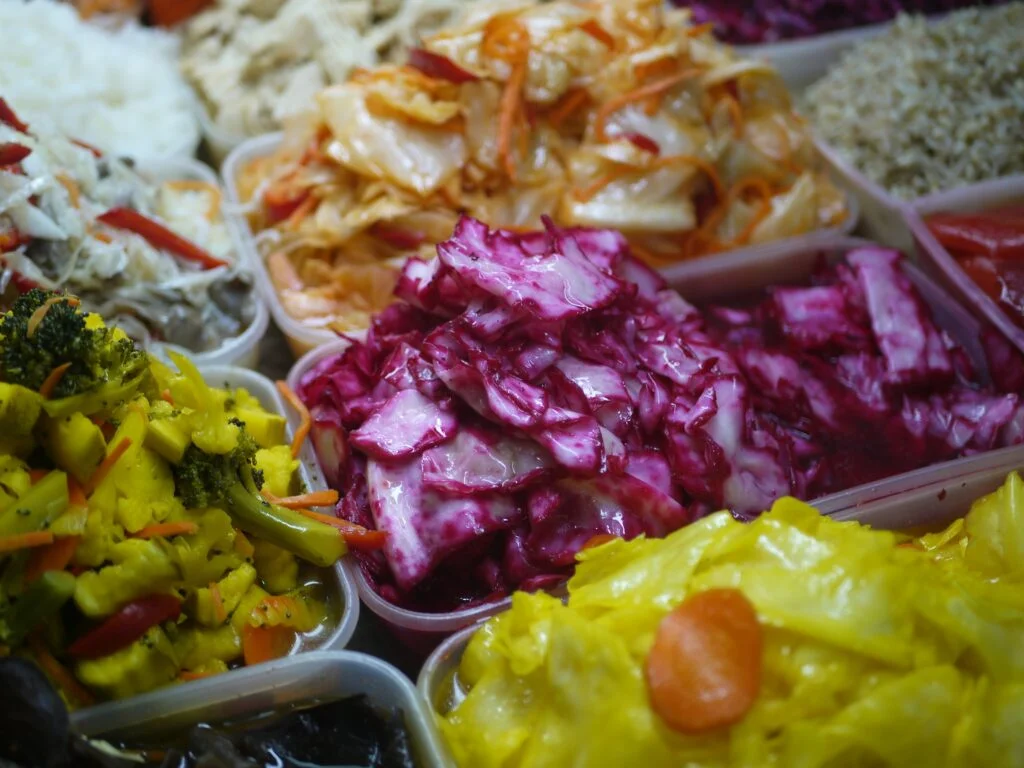
Sauerkraut can be good for gut health if it’s live: chilled, unpasteurised sauerkraut contains lactic acid bacteria such as Lactiplantibacillus plantarum, plus fibre from cabbage. In a small pilot trial in 34 people with IBS, 6 weeks of daily sauerkraut eased symptoms, and pasteurised sauerkraut worked about as well as live.
The researchers suggested the cabbage fibre may matter as much as the bacteria. Shelf-stable jars are usually pasteurised, so look in the chiller cabinet. Check the salt: over 1.5g per 100g is high, and adults should have no more than 6g of salt a day (NHS).
Fermented foods vs probiotic supplements
Fermented foods contain a changing mix of unnamed microbes; a probiotic supplement contains named strains at a stated dose. The British Dietetic Association says kefir and kombucha aren’t considered probiotics. Our guide to the best probiotics for gut health in the UK explains which strains have evidence, and for what.
Next step
Start with food: build up fibre, add one live fermented food and get any red-flag symptom checked. We don’t sell a gut product. If tiredness is part of the picture, our Magnesium Glycinate Sleep Complex is a berry evening drink with 290mg of magnesium (77% NRV) per 4.75g; magnesium contributes to a reduction of tiredness and fatigue. Or swap a late snack for Reishi Cacao, a warm cacao drink with 0.5g reishi, 0.5g maca and 0.3g cinnamon per 8g (a little natural caffeine from the cocoa).
Add Magnesium Glycinate Sleep Complex to bag Add Reishi Cacao to bag
Adults only. Both are vegan and made in the UK. If you take any regular medicines, check with your GP or pharmacist first. We don’t recommend our products during pregnancy or breastfeeding. Subscribe and save 25% on your first order, then 20%. New to Evopure? Join our emails for 20% off a one-off first order. Free UK delivery over £45.
Sources 13
- NHS. Symptoms of bowel cancer.
- NHS. Bloating; Farting (flatulence); Constipation.
- NHS. Diarrhoea and vomiting; Heartburn and acid reflux.
- NHS. Symptoms of ovarian cancer.
- NHS. IBS symptoms (triggers).
- NHS. How to get more fibre into your diet; Salt: the facts; Water, drinks and your health.
- British Dietetic Association. Probiotics: food fact sheet.
- Department of Health and Social Care. Great Britain nutrition and health claims (NHC) register (live yoghurt cultures and lactose digestion).
- Wastyk HC et al (2021). Gut-microbiota-targeted diets modulate human immune status. Cell (PMID 34256014).
- Mukherjee A et al (2025). Impact of fermented foods consumption on gastrointestinal wellbeing in healthy adults: a systematic review and meta-analysis. Front Nutr (PMID 41141260).
- Nielsen ES et al (2018). Lacto-fermented sauerkraut improves symptoms in IBS patients independent of product pasteurisation: a pilot study. Food Funct (PMID 30256365).
- Cha J et al (2024). Does kimchi deserve the status of a probiotic food? Crit Rev Food Sci Nutr (PMID 36718547).
- David LA et al (2014). Diet rapidly and reproducibly alters the human gut microbiome. Nature (PMID 24336217).
This guide is general information, not medical advice. Evopure does not sell a gut health product. Evopure makes the Magnesium Glycinate Sleep Complex and Reishi Cacao.