Last updated: October 2026
Matcha is powdered whole green tea leaf, so you drink the leaf itself rather than an infusion. A cup gives you caffeine plus L-theanine and catechins such as EGCG. Research on matcha and green tea is promising but mostly small, short or observational. For most people, the caffeine is the main thing to watch.
Below: what matcha is, what the research really shows, matcha vs coffee vs green tea, how much caffeine is in it, side effects and who should be careful, the best time to drink it, and how to make it.
Matcha in 30 seconds: about 19 to 44mg of caffeine per gram of powder, so a 2g serving has roughly 38 to 89mg. That’s usually less than a coffee, but a heaped, double-strength latte can match one.
What is matcha?
Matcha comes from the same plant as all tea, Camellia sinensis. The bushes are shaded before harvest, which raises the leaves’ L-theanine, caffeine and chlorophyll (hence the bright green). The leaves are then steamed, dried and stone-ground into a fine powder. Because you whisk it in and drink it all, you take in the whole leaf, so matcha is more concentrated than ordinary green tea.
Quality varies a lot, from high-grade ceremonial powders to much lower-grade ones, and the balance of theanine, caffeine and catechins shifts with harvest time and growing method. “Ceremonial” grade is for drinking straight; cheaper, more bitter “culinary” grade is for lattes and baking.
Matcha benefits: what the research says
Most matcha research is small, short and often funded by tea companies. A 2023 critical review concluded the evidence is still limited and firm conclusions can’t yet be drawn. Here’s an honest summary.
| Claim | What the evidence shows | Strength |
|---|---|---|
| Calmer focus | Caffeine plus L-theanine improved attention on demanding tasks in small trials; matcha itself gave slight effects on attention speed | Moderate, small trials |
| Stress | One 39-person trial found lower anxiety with a theanine-rich matcha relatively low in caffeine | Early |
| Memory in older adults | Mixed: one trial saw gains in women only; a 12-month trial found no change in its main scores | Weak and mixed |
| Heart health | Green tea slightly lowered cholesterol and blood pressure in a few trials | Limited |
| Weight loss | Green tea preparations gave a small weight loss, not likely to be clinically important | Good evidence of a small effect |
| Skin and hair | Very little human evidence for drinking matcha | Very weak |
Focus and attention: caffeine plus L-theanine
In a 27-person trial, 50mg of caffeine with 100mg of L-theanine improved speed and accuracy on an attention-switching task more than caffeine alone, and a 44-person trial found similar results with 40mg of caffeine and 97mg of L-theanine. See L-theanine benefits.
Trials of matcha itself are smaller. In 23 people, 4g of matcha gave slight improvements in attention and reaction speed, with no change in mood. In 42 young adults taking 2g a day for two weeks, attention held up better after a mildly stressful task. Encouraging, but small. See how to focus better and brain foods.
Stress and mood
A Japanese team found matcha’s calming effect in mice only appeared when caffeine and EGCG were low relative to theanine. In their 39-person trial, people given a matcha with that profile reported lower anxiety than with placebo. Most matcha on sale has more caffeine than that, so don’t assume any matcha will feel calming.
Brain ageing and heart health
In older adults, one 12-week trial saw a memory score improve in women only, and a 12-month trial found no change in its main scores. Matcha’s catechins, such as EGCG, act as antioxidants in lab tests, and a Cochrane review found green tea slightly lowered LDL cholesterol and blood pressure, but in only a handful of trials.
Weight loss: the honest answer
A Cochrane review of green tea preparations in overweight adults found the weight loss was small and not likely to be clinically important. Swapping a sugary drink for unsweetened matcha can help, but that’s the swap doing the work.
Matcha vs coffee vs green tea
| Matcha | Coffee | Green tea | |
|---|---|---|---|
| How it’s made | Shade-grown tea leaves stone-ground to a powder you whisk in and drink whole | Roasted, ground beans brewed in water | Leaves steeped in water, then removed |
| Caffeine | About 19 to 44mg per gram, so roughly 38 to 89mg in a 2g serving | About 100mg in a cup of instant; filter and coffee-shop coffee can contain more | About 75mg in a cup of tea (NHS figure for black or green) |
| L-theanine | Yes, more than most green teas (about 50mg in a 2.7g serving in one trial) | None | Some, usually less than matcha |
| Taste | Grassy, savoury, slightly bitter, creamy when whisked | Roasted, rich, bitter | Light and grassy; bitter if over-brewed |
| Best for | Steady morning focus with a moderate dose of caffeine | A bigger, faster caffeine hit | A lighter everyday cup |
All figures vary. Matcha’s caffeine depends mostly on how much powder you use, and coffee varies with the bean, the strength and the cup size.
Is matcha better than coffee for anxiety and jitters?
Matcha may feel gentler for some people, mainly because a typical serving has less caffeine than a mug of coffee and it comes with L-theanine. But L-theanine doesn’t cancel caffeine out, and a coffee-shop latte made with two or three scoops can match a coffee. If caffeine makes you anxious, the dose matters more than the drink. See does caffeine cause anxiety? and coffee crash. Other swaps include mushroom coffee; energy drinks often add sugar to a large dose.
How much caffeine is in matcha, and how much is safe?
Laboratory analyses put matcha powder at about 19 to 44mg of caffeine per gram. Green tea leaves contain about 11 to 25mg per gram, and less reaches your cup because you throw the leaves away.
- 1g of matcha: about 19 to 44mg of caffeine
- 2g: about 38 to 89mg
- 4g (a strong latte): about 76 to 178mg
Check the label for the grams in a scoop. The European Food Safety Authority (EFSA) considers up to 400mg of caffeine a day from all sources, and single doses up to 200mg, safe for most healthy adults. In pregnancy, the NHS advises no more than 200mg a day. Tea, coffee, cola and chocolate all count.
Matcha side effects and who should be careful
Caffeine sensitivity, anxiety and sleep
Most side effects are caffeine side effects: jitters, a racing heart, feeling on edge and poor sleep. How quickly you clear caffeine varies a lot between people, partly due to genes, and caffeine interacts with many medicines, so ask your pharmacist if you take regular medication.
Upset stomach
Some people find strong matcha on an empty stomach makes them queasy. Having it after breakfast usually helps. See coffee on an empty stomach.
Iron absorption
The NHS lists tea and coffee among the drinks that make iron harder to absorb in large amounts. In a classic study, tea, coffee and cocoa served with a meal cut the iron absorbed from it by 50 to 90%. Matcha wasn’t tested, but it’s rich in similar polyphenols. If you’re vegan, vegetarian or low in iron, drink it between meals. See iron-rich foods.
Green tea extract supplements and the liver
The real safety concern is about pills, not drinks. EFSA concluded that catechins from green tea infusions are generally safe, with typical intakes of 90 to 300mg of EGCG a day. But from food supplements, 800mg of EGCG a day may be linked with early signs of liver damage, and EFSA couldn’t identify a safe dose. Matcha sits in between: one 2.7g serving in a trial held about 300mg of total catechins. A couple of cups is very different from concentrated extract capsules, but there’s no need to take matcha in pill form.
Pregnancy and breastfeeding
Matcha counts towards the NHS limit of 200mg of caffeine a day in pregnancy. Avoid green tea extract supplements, and ask your midwife or GP if unsure.
Children
The NHS says tea and coffee are not suitable for babies or young children. For older children, EFSA’s safety level is 3mg per kg of body weight a day, far lower than the adult figure. We’d keep matcha as a grown-up drink.
Best time to drink matcha (and matcha and sleep)
Mid-morning, after breakfast, suits most people: you get the lift when you need it and time to clear the caffeine before bed. Early afternoon is fine too, especially instead of a second coffee. See afternoon slump and how to boost energy naturally.
Caffeine peaks 30 to 120 minutes after you drink it, and its half-life is about 3 to 6 hours, so around half of a 2pm matcha can still be in your system at 7pm. In a sleep study, caffeine taken 6 hours before bed still disrupted sleep.
Our rule of thumb: stop matcha at least 6 hours before bed, earlier if you’re sensitive. For a 10:30pm bedtime, that means your last cup by about 4pm. For evening drinks, see the best tea for sleep.
How to make matcha and a matcha latte
Traditional matcha (usucha)
- Sift 1 to 2g of matcha (about half to one level teaspoon) into a bowl.
- Add a splash of hot water at around 80°C (let a boiled kettle stand for a few minutes). Boiling water makes it bitter.
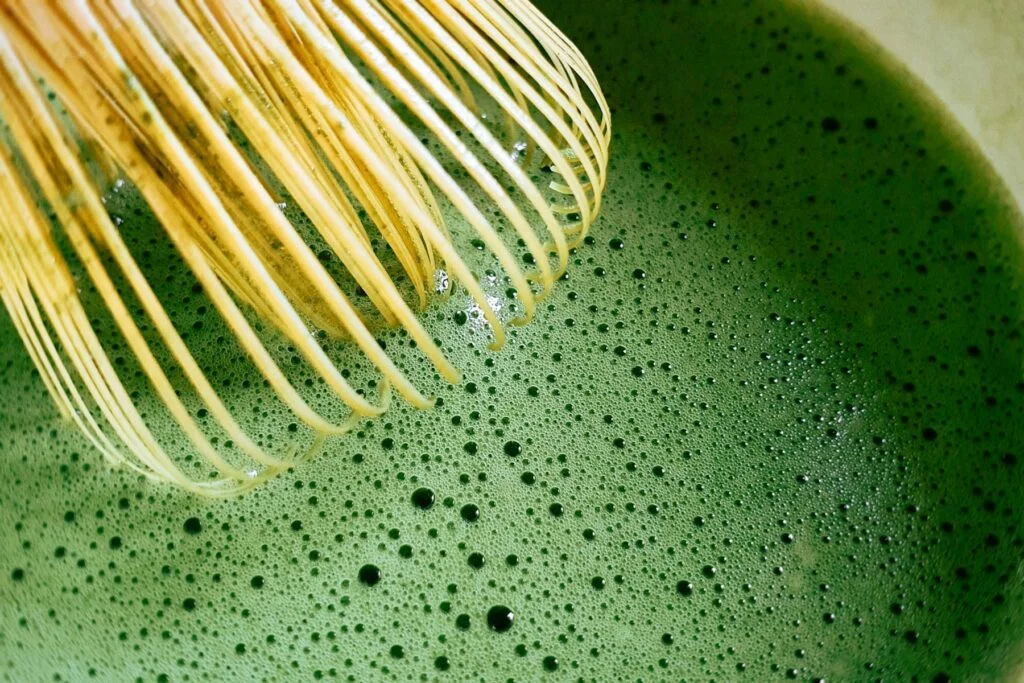
- Whisk briskly in a W shape with a bamboo whisk or milk frother until smooth.
- Top up to about 70 to 100ml of water and whisk to a fine foam.
Matcha latte
Whisk the matcha into a little hot water, then pour over about 200ml of warm or iced milk. Coffee-shop versions often use sweetened blends or syrups, so check the sugar if you have one daily.
Buying tip: look for bright green powder with matcha as the only ingredient; “matcha latte” blends often add sugar and milk powder.
If you’d rather have something cosy with less of a buzz
Matcha is a daytime drink. For a warm ritual later on, a hot chocolate or caffeine-free herbal tea fits better. Our Reishi Mushroom Adaptogenic Complex is a reishi hot chocolate made with cacao and coconut sugar. It’s made with cacao, so it contains a little natural caffeine; if you’re very sensitive, have it earlier in the evening. See reishi cacao benefits, healthy hot chocolate and adaptogens for energy for what the research does and doesn’t show.
See also caffeine half-life and when to stop.
Weighing up other swaps too? See our guide to coffee alternatives, with caffeine compared for 12 drinks.
FAQs
Is matcha good for you?
For most healthy adults, a cup or two a day is a reasonable choice. It gives you caffeine, L-theanine and catechins. Research on specific benefits is promising but small, and the caffeine is the main thing to watch.
Does matcha have more caffeine than coffee?
Usually less per cup, but it depends on how much powder you use. A 2g serving has roughly 38 to 89mg. The NHS uses about 100mg for a cup of instant coffee, and filter coffee can contain more.
How much matcha can I drink a day?
Count all your caffeine. EFSA considers up to 400mg a day safe for most healthy adults. One to three servings of 1 to 2g fits comfortably for most people; have less if you’re sensitive, and stop at least 6 hours before bed.
Is matcha better than coffee for anxiety?
It may feel gentler, because a typical serving has less caffeine and it contains L-theanine. But L-theanine doesn’t cancel caffeine out, and a strong matcha latte can match a coffee. If caffeine makes you anxious, cut the dose.
Can I drink matcha when pregnant?
Count it towards the NHS limit of 200mg of caffeine a day in pregnancy, avoid green tea extract supplements, and check with your midwife or GP if you’re unsure.
Does matcha help you lose weight?
Not by much. A Cochrane review found green tea preparations led to a small weight loss that was not likely to be clinically important.
Sources
- Kochman J et al (2020). Health benefits and chemical composition of matcha green tea: a review. Molecules.
- Unno K et al (2026). Compositional diversity and functional interactions of bioactive compounds in Japanese green tea: focus on matcha, sencha, and gyokuro. Molecules.
- Sokary S et al (2023). The therapeutic potential of matcha tea: a critical review on human and animal studies. Current Research in Food Science.
- Owen GN et al (2008). The combined effects of L-theanine and caffeine on cognitive performance and mood. Nutritional Neuroscience.
- Giesbrecht T et al (2010). The combination of L-theanine and caffeine improves cognitive performance and increases subjective alertness. Nutritional Neuroscience.
- Dietz C et al (2017). An intervention study on the effect of matcha tea, in drink and snack bar formats, on mood and cognitive performance. Food Research International.
- Baba Y et al (2021). Matcha consumption maintains attentional function following a mild acute psychological stress. Nutrition Research.
- Baba Y et al (2024). Matcha does not affect electroencephalography during sleep but may enhance mental well-being. Nutrients.
- Unno K et al (2018). Stress-reducing function of matcha green tea in animal experiments and clinical trials. Nutrients.
- Sakurai K et al (2020). Effects of matcha green tea powder on cognitive functions of community-dwelling elderly individuals. Nutrients.
- Uchida K et al (2024). Effect of matcha green tea on cognitive functions and sleep quality in older adults with cognitive decline. PLoS One.
- Hartley L et al (2013). Green and black tea for the primary prevention of cardiovascular disease. Cochrane Database of Systematic Reviews.
- Jurgens TM et al (2012). Green tea for weight loss and weight maintenance in overweight or obese adults. Cochrane Database of Systematic Reviews.
- EFSA. Caffeine.
- EFSA (2018). EFSA assesses safety of green tea catechins.
- NHS. Foods to avoid in pregnancy (caffeine).
- NHS. Iron deficiency anaemia.
- NHS. Drinks and cups for babies and young children.
- Hurrell RF et al (1999). Inhibition of non-haem iron absorption in man by polyphenolic-containing beverages. British Journal of Nutrition.
- Mort JR, Kruse HR (2008). Timing of blood pressure measurement related to caffeine consumption. Annals of Pharmacotherapy.
- Nehlig A (2018). Interindividual differences in caffeine metabolism and factors driving caffeine consumption. Pharmacological Reviews.
- Drake C et al (2013). Caffeine effects on sleep taken 0, 3, or 6 hours before going to bed. Journal of Clinical Sleep Medicine.
This guide is general information, not medical advice. Evopure makes the Reishi Mushroom Adaptogenic Complex.