Last updated: October 2026
Nightmares are vivid, upsetting dreams that wake you and that you can remember, usually in the second half of the night during REM (dream) sleep. Common triggers are stress, poor sleep, alcohol, some medicines and trauma. Most people can reduce them with better sleep habits and imagery rehearsal therapy. See a GP if they’re frequent or affect your days.
iBelow: how nightmares differ from night terrors, what causes them, how to stop them, a simple way to rewrite a recurring nightmare, what to do after one, and when to see a GP.
Nightmares vs night terrors in adults
People often use the two words for the same thing, but they are different events that happen in different kinds of sleep. The quickest test: if you woke up scared and can tell someone what the dream was about, it was almost certainly a nightmare. If a partner says you screamed or sat bolt upright but you remember nothing, that sounds more like a night terror.
Sleep talking is another common, usually harmless night-time habit. If it bothers you or a partner, see how to stop sleep talking.
| Nightmares | Night terrors | |
|---|---|---|
| When in the night | Usually later in the night | Usually in the first few hours of sleep |
| Sleep stage | Mostly REM (dream) sleep | Deep non-REM sleep |
| Do you wake fully? | Yes, and you quickly know where you are | No. The person is only partly awake, confused and hard to comfort |
| Do you remember it? | Yes, often in vivid detail | Usually not, or only a single frightening image |
| What others see | Very little until you wake, then a frightened, upset person | Screaming, thrashing or getting out of bed with eyes open while still asleep |
| Who gets them | Children and adults, at any age | Mostly children aged 3 to 8; less common in adults |
Night terrors in adults, how to handle them and how they link to sleepwalking are covered in our full guide to night terrors. Waking up unable to move is different again: see sleep paralysis. And if your dreams are intense but not frightening, read about vivid dreams.

Our pick
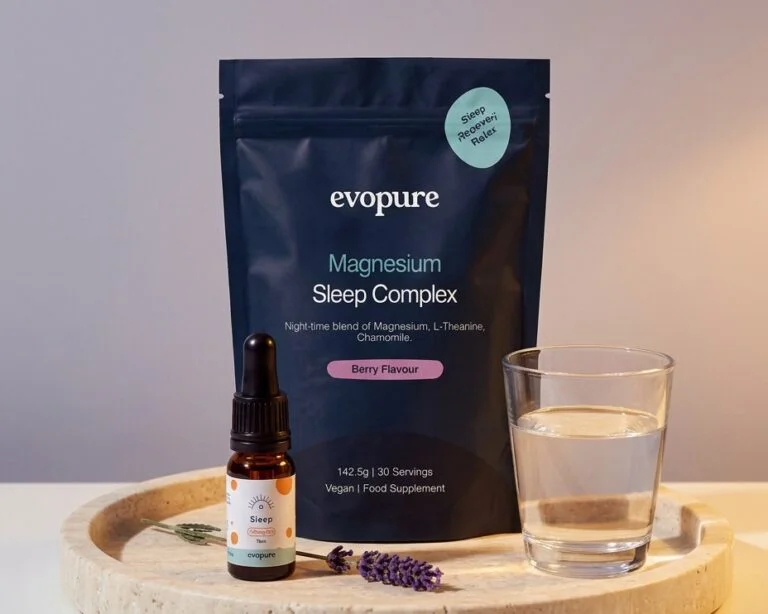
Magnesium Glycinate Sleep Complex
Magnesium Glycinate Sleep Complex is a berry drink powder with 148mg of magnesium a scoop from bisglycinate and citrate, plus glycine and L-theanine. Magnesium contributes to a reduction of tiredness and fatigue.
Add Magnesium Glycinate Sleep Complex to bag See ingredients and reviews
Vegan and made in the UK. Free UK delivery over £45, 14-day returns on unopened items.
Subscribe £22.49One-off £29.99
View productThe FSA’s 10mg a day figure for CBD is precautionary advice rather than a legal limit, set while longer-term safety research continues. At Evopure we think it is a very cautious figure, and many adults use more. If you go above it, increase slowly, and check with your GP or pharmacist first if you take any medication.
What causes nightmares?
Most adults have a bad dream now and then, and an occasional nightmare is not a sign that anything is wrong. Frequent nightmares usually have a trigger, and often more than one at once.
| Cause | Why |
|---|---|
| Stress and anxiety | Daytime worries often show up in dreams, and a busy, anxious mind at bedtime makes broken sleep more likely. See anxiety at night |
| Trauma and PTSD | Repeated nightmares about a frightening event can be a sign of post-traumatic stress disorder (PTSD) |
| Poor, short or irregular sleep | Being overtired, shift work and changing your sleep times all unsettle the sleep cycle and can lead to more intense dreaming |
| Alcohol | It delays dream sleep early in the night and disturbs the second half, when most dreaming happens. See alcohol and sleep |
| Stopping alcohol and some substances | Coming off alcohol, cannabis or some sleeping tablets can cause vivid dreams and nightmares for a while |
| Medicines | Some antidepressants, beta blockers (often used for blood pressure), sleeping tablets, stimulants and Parkinson’s medicines are linked to nightmares |
| Late, heavy meals | Many people blame cheese or a late curry. The evidence is weak: it comes mostly from surveys, and poor sleep may explain the link better than any food |
| Fever or illness | Can cause strange, vivid dreams |
Never stop or change a prescribed medicine because of nightmares without speaking to your GP or pharmacist first. Stopping some medicines suddenly can cause withdrawal effects, including worse dreams. Often the dose or timing can be changed, or there is an alternative.
Why do I keep having nightmares every night?
Nightly nightmares usually mean something is keeping your mind on high alert: ongoing stress, a recent loss, a traumatic memory, a new medicine or very poor sleep. Recurring nightmares about the same thing can also become a habit of their own. The dream repeats, you dread going to bed, you sleep worse, and that makes the next nightmare more likely. The good news is that this loop often responds well to the steps below, especially imagery rehearsal therapy.
How to stop nightmares
Start with the basics for two to three weeks. Many people find that occasional nightmares settle with these alone. If they don’t, add imagery rehearsal therapy (next section).
- Keep regular sleep and wake times, including at weekends. See how to sleep better.
- Wind down for an hour with dim lights and no screens.
- Avoid scary or stressful content before bed: news, horror films, work emails.
- Cut back on alcohol, especially in the evening, and avoid drinking to get to sleep.
- Eat your evening meal 2 to 3 hours before bed.
- Write down worries before bed so they are on paper rather than in your head.
- Manage daytime stress. A few minutes of slow breathing can help you settle. Try box breathing or these ways to calm down quickly.
- Rewrite a recurring nightmare using imagery rehearsal therapy.
- Talk about it. Telling someone you trust about a recurring dream can take some of the fear out of it.
- Ask for help if nightmares are linked to trauma or haven’t improved after a few weeks. Talking therapies work well.
Many people find a calm evening routine helps them settle. Magnesium contributes to normal psychological function and to the normal functioning of the nervous system. Our Magnesium Glycinate Sleep Complex is a warm bedtime drink that fits into that routine. It isn’t a treatment for nightmares. It’s for adults only, we don’t recommend our products during pregnancy or breastfeeding, and check with your GP or pharmacist first if you take any medication.
Imagery rehearsal therapy: rewrite the ending
Imagery rehearsal therapy (IRT) is the treatment the American Academy of Sleep Medicine recommends for nightmare disorder and for nightmares linked to PTSD. It is a talking therapy technique, but the core of it is simple enough to try at home for everyday recurring nightmares.
- Write the nightmare down during the day, not at bedtime. Keep it brief.
- Change the story. Change the ending, or any part of it, in any way you like. It doesn’t need to be realistic. The monster can shrink, the door can open, you can fly away.
- Write out the new version in full.
- Rehearse it in your mind for a few minutes each day, picturing it as vividly as you can. Keep going for a few weeks.
The idea is that you are training a new response to the dream rather than repeating the old one. In studies, people using imagery rescripting and rehearsal had large drops in how often they had nightmares, and their sleep tended to improve too. A therapist can guide you through it, which matters if the nightmares relive a real traumatic event: please don’t work through trauma-based dreams alone.
Some people also use lucid dreaming, learning to notice you are dreaming so you can change the dream from inside. It is listed as an option for nightmare disorder, but the evidence is thinner than for IRT.
What to do after a nightmare
- Remind yourself it was a dream and you’re safe.
- Breathe slowly with a longer out-breath.
- Ground yourself: notice the bed, the room, the sounds. See grounding techniques.
- Turn on a dim light and sip some water.
- If you can’t settle after 20 minutes, get up and do something calm before going back to bed.
- Jot down a few words about the dream if it’s one that keeps coming back, so you can rewrite it the next day.
Nightmare disorder: when to see a GP
Nightmare disorder is when nightmares happen often and cause real distress or get in the way of daily life. It affects around 4% of adults. Doctors sometimes grade it by how often it happens: less than once a week is mild, once a week or more is moderate, and every night is severe.
iSee a GP if:
- you have nightmares regularly and they disrupt your sleep or your days
- you’ve started dreading going to bed
- you feel tired, low or on edge during the day because of them
- they started after a frightening or traumatic event
- they started after a new medicine or a change of dose
If your nightmares replay something traumatic, and you also have flashbacks, feel constantly on guard or avoid reminders, ask your GP about PTSD. You can also refer yourself to an NHS talking therapies service without seeing a GP first. If you need help urgently, call 111 and choose the mental health option, or call Samaritans free on 116 123.
What a GP or specialist may suggest
Treatment depends on the cause. Cognitive behavioural therapy (CBT), including imagery rehearsal therapy, can help adults with frequent nightmares, and counselling or trauma-focused therapy may be offered when nightmares follow a traumatic event. If a medicine seems to be the trigger, your GP may change the dose, the timing or the medicine itself.
Medicines are sometimes used for nightmares linked to PTSD. The best known is prazosin, a blood pressure medicine that US sleep specialists list as an option. Trial results are mixed: one large study in US veterans found no benefit, while a later review of all the trials concluded it does help. It is always a specialist decision, not something to try yourself.
Nightmares in children
Nightmares are common in children and usually fade with age. The NHS advises seeing a GP if a child still has nightmares after age 6, has them often, or has them after a frightening event. Our products are for adults only and are not suitable for children. For night terrors in children, see our night terrors guide.
How nightmares work and what they mean
Most nightmares happen in REM sleep, the stage with the most vivid, story-like dreams, and they usually come later in the night. Your body often reacts as if the threat were real: people often wake sweating and breathless.
One leading theory is that dreaming helps us process emotions and gradually defuse fears. A nightmare may be what happens when that process is overwhelmed, so the fear wakes you up instead of fading. Researchers think chronic nightmares grow from a mix of being on high alert (hyperarousal) and the brain struggling to switch off fear memories.
So what does a nightmare mean? There is no good evidence that particular images, like teeth falling out or being chased, have fixed meanings, so we’d take dream dictionaries with a pinch of salt. What a nightmare often does reflect is your emotional state: worry, grief, feeling out of control or a past trauma. If the same theme keeps coming back, it is usually more useful to ask what is stressing you during the day than to decode the symbol.
Related guides
- Heard an explosion in your head just as you woke? Read about exploding head syndrome.
- Not every intense dream is a nightmare. See why you might be having vivid dreams.
- Woken by your heart racing? See how to calm anxiety at night.
- Jolting awake as you fall asleep, with a falling feeling, is usually a hypnic jerk rather than a dream: see hypnic jerks explained.
Sources 12
- NHS. Night terrors and nightmares.
- NHS. Post-traumatic stress disorder (PTSD).
- Morgenthaler TI et al (2018). Position paper for the treatment of nightmare disorder in adults: an American Academy of Sleep Medicine position paper. Journal of Clinical Sleep Medicine.
- Gieselmann A et al (2019). Aetiology and treatment of nightmare disorder: state of the art and future perspectives. Journal of Sleep Research.
- Hansen K et al (2013). Efficacy of psychological interventions aiming to reduce chronic nightmares: a meta-analysis. Clinical Psychology Review.
- Thompson DF, Pierce DR (1999). Drug-induced nightmares. Annals of Pharmacotherapy.
- Ebrahim IO et al (2013). Alcohol and sleep I: effects on normal sleep. Alcoholism: Clinical and Experimental Research.
- Nielsen T, Powell RA (2015). Dreams of the Rarebit Fiend: food and diet as instigators of bizarre and disturbing dreams. Frontiers in Psychology.
- Nielsen T, Levin R (2007). Nightmares: a new neurocognitive model. Sleep Medicine Reviews.
- Castelnovo A et al (2018). NREM sleep parasomnias as disorders of sleep-state dissociation. Nature Reviews Neurology.
- Raskind MA et al (2018). Trial of prazosin for post-traumatic stress disorder in military veterans. New England Journal of Medicine.
- Yücel DE et al (2020). Comparative efficacy of imagery rehearsal therapy and prazosin in the treatment of trauma-related nightmares in adults: a meta-analysis of randomized controlled trials. Sleep Medicine Reviews.
This guide is general information, not medical advice. Evopure makes the Magnesium Glycinate Sleep Complex. Our products are for adults only. We don’t recommend our products during pregnancy or breastfeeding.