Last updated: October 2026
Restless legs syndrome (Willis-Ekbom disease) is an urge to move your legs, with tingling or crawling feelings, that starts when you rest and is worst in the evening and in bed. Triggers include low iron, pregnancy, caffeine, alcohol, smoking and some medicines. Walking, stretching or a warm bath can ease it tonight; see a GP if it keeps disturbing sleep.
iBelow: why it strikes in bed, what to try tonight, compression socks, quinine, iron, prescription medicines, pregnancy and when to see a GP.
Restless legs tonight: the quick plan
Magnesium Glycinate Sleep Complex
- Move: get up and walk around, or stretch your calves and thighs.
- Warm up: a warm bath or a heat pad on your legs before bed.
- Massage your calves and thighs with firm strokes.
- Distract your mind: a book, a puzzle or a breathing exercise.
- Tomorrow: no caffeine after midday, no alcohol in the 2 hours before bed, and ask your GP for an iron (ferritin) blood test if it keeps happening.
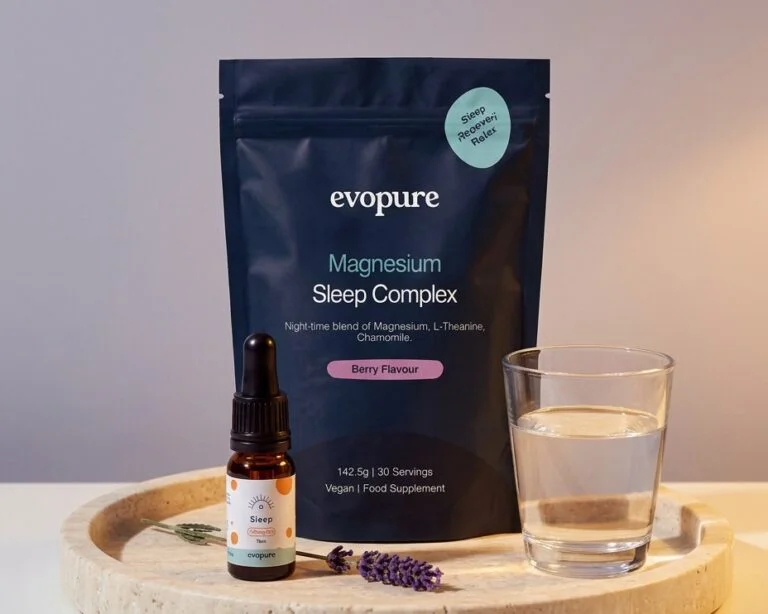
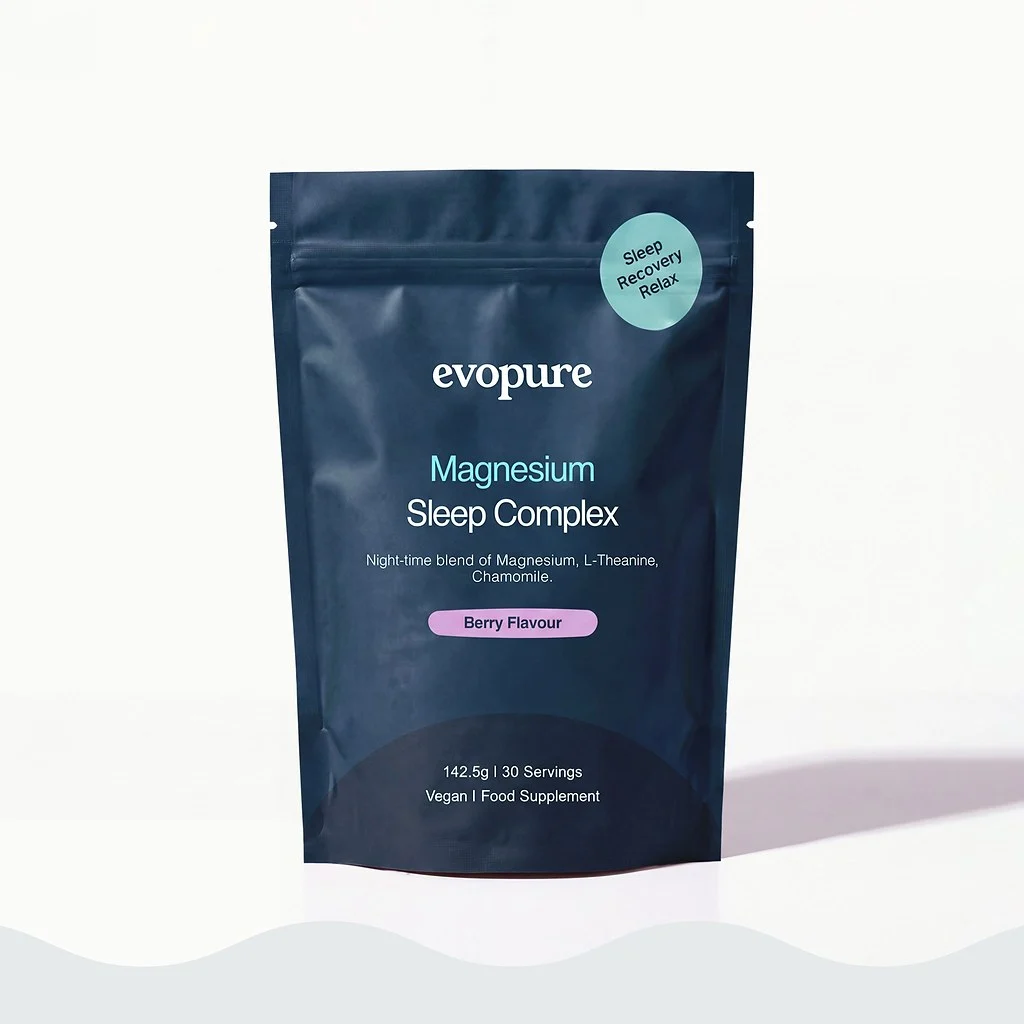
For your evening wind-down, our Magnesium Glycinate Sleep Complex is a caffeine-free berry drink with magnesium bisglycinate and citrate (290mg of magnesium per serving), glycine, L-theanine and botanicals. Magnesium contributes to normal muscle function. It isn’t a treatment for restless legs syndrome.
Add Magnesium Glycinate Sleep Complex to bag See ingredients and reviews
Vegan and made in the UK, 14-day returns on unopened items. Subscribe and save 25% on your first order, then 20%. New to Evopure? Join our emails for 20% off a one-off first order. Free UK delivery over £45.
Subscribe £22.49One-off £29.99
View productWhat is restless legs syndrome?
Restless legs syndrome (RLS) is a condition of the nervous system. It gives you an overwhelming urge to move your legs, usually with uncomfortable feelings in them, which eases while you keep moving. Because it is worst when you lie still in the evening, it often gets in the way of falling asleep.
It is common. NICE’s guidance for GPs puts it at 5 to 10% of adults in the UK, US and Europe. It becomes more common with age, and over 35, women are affected about twice as often as men. Up to half of people with RLS have a relative with it.
For many people it is mild and comes and goes. For others it is nightly and exhausting, and a real cause of insomnia.
The FSA’s 10mg a day figure for CBD is precautionary advice rather than a legal limit, set while longer-term safety research continues. At Evopure we think it is a very cautious figure, and many adults use more. If you go above it, increase slowly, and check with your GP or pharmacist first if you take any medication.
The FSA advises healthy adults to take no more than 10mg of CBD a day: about 0.2ml of the 500mg (0.1ml of the 1,000mg) gives 10mg. Adults only. If you take any regular medicines, check with your GP or pharmacist first. We don’t recommend our products during pregnancy or breastfeeding.
Restless legs symptoms and how it’s diagnosed
No blood test or scan confirms restless legs. A GP diagnoses it from your description, using four features set by the International Restless Legs Syndrome Study Group:
- An urge to move your legs, usually with unpleasant feelings in them.
- It starts or gets worse when you rest, such as sitting on the sofa or lying in bed.
- Moving eases it, at least for as long as you keep walking or stretching.
- It is worse in the evening or at night than during the day.
And the symptoms must not be better explained by something else, such as cramps, swollen legs or an awkward position.
People describe tingling, burning, itching, throbbing, a creepy-crawly feeling or “fizzy water in the veins”, often worst just below the knee. NICE notes it is painful for 30 to 50% of people, and the arms can be affected too.
iYour GP may still suggest blood tests to look for a cause: NICE recommends a full iron check, ideally in the morning after an overnight fast, and sometimes kidney function, thyroid, blood sugar and vitamin B12.
What causes restless legs in bed?
Why it’s worse at night and when you lie down
Two things come together in bed. RLS is triggered by stillness, and lying down is the stillest you are all day. And dopamine, the brain chemical most involved in RLS, follows a daily rhythm that NICE says may explain why symptoms build in the evening.
Primary restless legs (no clear cause)
In most people there is no single cause. This is primary (idiopathic) RLS. It often runs in families, and dopamine and the way the brain handles iron both seem to play a part, even when blood iron looks normal. It tends to get slowly worse over the years.
Secondary restless legs (a cause you can find)
Sometimes RLS is brought on by something else, and treating that can ease it. The most common links, according to NICE:
| Cause | What to know |
|---|---|
| Iron deficiency | Found in about 1 in 4 people with RLS. A ferritin blood test checks your iron stores. See iron deficiency symptoms |
| Pregnancy | Affects about 1 in 5 pregnant women, most often in the third trimester, and usually goes after the birth |
| Advanced kidney disease | About 1 in 5 people on dialysis has RLS |
| Nerve damage (peripheral neuropathy) | Can sit alongside RLS. Numbness and pins and needles that don’t ease with movement point more to nerves. See pins and needles |
| Other conditions | Weaker links with Parkinson’s, multiple sclerosis, diabetes, an underactive thyroid, rheumatoid arthritis and obesity |
Medicines and drinks that can make it worse
NICE lists several medicines that can trigger RLS or make it worse:
- antidepressants, including SSRIs, SNRIs and tricyclics
- antihistamines, including some in over-the-counter sleep aids and allergy tablets
- some antipsychotics, and lithium
- some anti-epilepsy medicines
- anti-sickness medicines such as metoclopramide and prochlorperazine
- beta-blockers
iHeavy use of alcohol, caffeine or chocolate is on the same list. If your legs got worse after starting a new medicine, don’t stop it yourself. Speak to your GP or pharmacist, who can check whether a change is possible.
What helps restless legs at night?
How to help restless legs at night: get up and walk, stretch or massage your calves and thighs, and have a warm bath or use a heat pad before bed. A book or puzzle can distract you. Cut caffeine after midday and alcohol in the 2 hours before bed. For mild symptoms, these NHS steps may be all you need.
When your legs start up in bed:
- Get up and walk. Moving eases RLS while you do it, and a few minutes walking around can settle it enough to try again.
- Stretch. Try a calf stretch against a wall, a standing thigh stretch holding a chair, or, in bed, point and flex your feet and draw slow circles with your ankles.
- Massage your legs. Firm strokes up your calves and thighs. If you like a cooling rub, our CBD Balm with peppermint, eucalyptus and juniper is a cosmetic balm for adults; it isn’t a treatment for restless legs. Our balm’s product description mentions wintergreen oil, so ask a pharmacist before using it if you’re allergic to aspirin or take a blood thinner.
- Use warmth. A warm bath before bed, or a heat pad on your legs, is on both the NHS and NICE lists. Some people prefer something cool instead, which is fine to try.
- Distract your brain. Reading, a puzzle or a relaxation exercise takes your attention off the sensations.
- Don’t lie there fighting it. Get up, do something calm in dim light and go back when sleepy. If it wakes you in the small hours, see waking up in the middle of the night.
Daily habits that make restless legs less likely
The NHS and NICE prevention steps, with a note on the evidence:
| Habit | What to do | Evidence note |
|---|---|---|
| Caffeine | None after midday: tea, coffee, cola and energy drinks | NHS and NICE advice, based on experience rather than trials |
| Alcohol | None in the 2 hours before bed, and cut down overall | NHS and NICE advice. See alcohol and sleep |
| Smoking | Get help to stop | NHS and NICE advice |
| Exercise | Moderate exercise most days, earlier in the day; nothing strenuous late at night | In a small 12-week trial (23 people finished), exercise three times a week improved symptoms more than no programme |
| Sleep routine | Same bedtime and wake time, no daytime naps, a dark and quiet bedroom | NHS advice. See sleep hygiene habits that work |
| Evenings | No big late meals, and put your phone down before bed | NHS advice |
Restless legs treatment in the UK
Restless legs treatment in the UK starts with self-help: walking, stretching, massage, a warm bath and no caffeine after midday. The NHS says iron supplements may be needed if a blood test shows your iron is low. If symptoms stay moderate or severe, a GP can prescribe medicines such as pregabalin, gabapentin, ropinirole or pramipexole.
| Step | What it involves | Who arranges it |
|---|---|---|
| 1. Self-help | The night-time steps and daily habits above | You |
| 2. Look for a cause | Blood tests for iron (ferritin), kidney function and more, plus a check of medicines that can make it worse | GP |
| 3. Iron | Iron tablets if your ferritin is low (NICE suggests below about 50 to 75 micrograms per litre) | GP |
| 4. Medicines | Pregabalin or gabapentin first for frequent symptoms, according to NICE; ropinirole, pramipexole or a rotigotine patch for some people | GP or specialist |
| 5. Referral | A neurologist or sleep clinic if symptoms are severe or not improving | GP |
Ropinirole and pramipexole can cause augmentation over time, with symptoms starting earlier in the day and getting stronger, so NICE now puts them second (see prescription medicines). For supplements, see what can you take for restless legs?
Do compression socks help restless legs?
Possibly, but the research is thin, and there are two very different things to separate.
Ordinary compression socks and stockings. A 2024 trial in Turkey gave 63 pregnant women with RLS either compression stockings or look-alike placebo stockings to wear by day for 3 weeks. Both groups improved, showing how much expectation matters, but the real stockings group improved more. It is one small study: a hint, not proof.
Pneumatic compression devices. These sleeves inflate and deflate around the legs for about an hour in the evening. In a 2009 US trial with 35 adults, real devices beat sham ones over a month, and a third of the real-device group had complete relief. They are medical devices, not socks, and aren’t part of NICE’s guidance for GPs.
iIf you want to try socks, choose a light, well-fitting pair and give it a couple of weeks. If you have circulation problems in your legs, diabetes or numb feet, or you’re pregnant, ask a pharmacist, GP or midwife first.
Magnesium cream and magnesium tablets
Magnesium is a hugely popular remedy, but the evidence is weak and mixed: a 2019 systematic review found only one randomised trial, which showed no clear effect, though small newer studies look more hopeful. There is also little evidence that creams, sprays or bath flakes get useful amounts through the skin, although the massage and warmth may feel soothing.
The studies, creams and best form to try are in our guide to magnesium for restless legs. See also does magnesium spray work? and the best magnesium for sleep.
Our Magnesium Glycinate Sleep Complex gives 290mg of magnesium per serving as an evening drink. Magnesium contributes to normal muscle function and to a reduction of tiredness and fatigue. It isn’t a treatment for restless legs, and it’s for adults only. If you have kidney problems or take regular medication, check with your GP or pharmacist first.
Is quinine used for restless legs?
No. Quinine isn’t one of the treatments NICE lists for restless legs, and in the UK it is tightly limited even for leg cramps, a different condition.
The MHRA, the UK medicines regulator, advised in 2010 that quinine should not be used routinely for night-time cramps: only when they regularly disrupt sleep, are very painful or frequent, other causes are ruled out and stretching hasn’t worked. It warned of a rare but potentially life-threatening fall in blood platelets, blindness in overdose, and interactions with warfarin and digoxin.
Tonic water is often suggested online, but it isn’t part of any UK guidance for restless legs. If you think your symptoms are really cramps, see leg cramps at night.
Iron and restless legs: get your ferritin checked
Iron is the best-supported thing to check. Low iron in the brain is thought to affect dopamine, and a 2019 Cochrane review of 10 trials (428 people) concluded that iron treatment probably improves restlessness and RLS severity compared with placebo.
You can be low enough in iron to matter for RLS without being anaemic. NICE advises GPs to look for a cause and prescribe iron if your ferritin (iron stores) is below about 50 to 75 micrograms per litre, so ask for your actual number rather than just whether it’s “normal”.
- Don’t self-dose high-strength iron. The NHS says 17mg a day or less from supplements is unlikely to cause harm; higher doses can cause constipation, nausea and stomach pain, and very high doses can be fatal, especially to children. Take more only if your GP advises it.
- Food still matters. See iron-rich foods, and iron tablets: who needs them and how to take them.
Prescription medicines: pramipexole, ropinirole, gabapentin and pregabalin
If self-help and iron haven’t helped and symptoms are moderate or severe, a GP may suggest medicine. This is always a decision for your GP or a specialist. NICE’s guidance for GPs (revised July 2026):
| Medicine type | Examples | Where it fits now |
|---|---|---|
| Gabapentinoids | Pregabalin, gabapentin | The first-choice medicines for frequent or daily symptoms (an off-label use) |
| Dopamine agonists | Pramipexole, ropinirole, rotigotine patch | Used to be first choice; now used for some people only, with regular monitoring |
| Opioids | Codeine, tramadol | An alternative, mainly for painful symptoms, with a risk of dependence |
| Sleeping tablets | Z-drugs and similar | A short or occasional course if sleep is badly affected |
Why dopamine agonists like pramipexole are used less
Pramipexole and ropinirole often work well at first, but over time many people develop augmentation: symptoms start earlier in the day, get stronger or spread to the arms, and the dose creeps up. NICE says this affects 40 to 70% of people over 10 years. They can also cause impulse control problems such as gambling or compulsive shopping (6 to 17% of people with RLS), and pramipexole can cause sudden sleepiness, which matters for driving.
If you take one of these, don’t stop suddenly, as symptoms can rebound badly; speak to your GP about a plan. A 2025 US sleep medicine guideline reached similar conclusions, and also advised against valerian for RLS. The BNF, the UK prescribing reference, has the full dosing and safety details.
Restless legs in pregnancy
Restless legs are very common in pregnancy. An analysis quoted by NICE found about 21% of pregnant women have them, from 8% in the first trimester to 22% in the third. Symptoms usually go after the birth, though RLS in pregnancy raises the chance of it returning later in life.
- Tell your midwife or GP, especially if it’s disturbing your sleep.
- Check your iron. Iron deficiency can trigger RLS. Your midwife can arrange a blood test, and iron may be prescribed if you’re low.
- Self-help first: the walking, stretching, massage, warmth and evening habits above.
- No self-medication. NICE says RLS medicines are not recommended during pregnancy or breastfeeding. Check with your midwife before taking any supplement; see magnesium in pregnancy.
- Know the signs of a blood clot. Pain, swelling, warmth or red or darkened skin in one leg needs an urgent call to your GP or 111. Call 999 if you also have chest pain or feel breathless.
We don’t recommend our products during pregnancy or breastfeeding.
Restless legs, leg cramps, periodic limb movements or hypnic jerks?
Several night-time leg problems get mixed up. Here’s how to tell them apart:
| Condition | What it feels like | What eases it |
|---|---|---|
| Restless legs | An urge to move with tingling or crawling feelings, worse when resting in the evening | Moving, for as long as you keep moving |
| Leg cramps | A sudden, painful tightening of one muscle, usually a calf, lasting seconds to 10 minutes. See leg cramps at night | Stretching that muscle |
| Periodic limb movements | Repeated jerks or kicks of the legs during sleep, which you often don’t notice but a partner does. Seen in most people with RLS | See a GP if they disturb your or a partner’s sleep |
| Hypnic jerks | One sudden jolt as you drift off, sometimes with a falling feeling. See hypnic jerks | Nothing needed; usually harmless |
| Muscle twitching | Small flickers under the skin, no urge to move. See muscle twitching | Usually settles on its own |
| Akathisia | Restlessness of the whole body, often from a medicine, with no evening pattern | See the prescriber; don’t stop the medicine yourself |
When to see a GP about restless legs
The NHS advises seeing a GP if restless legs are stopping you sleeping, affecting your mental health, or haven’t improved with self-help. It’s also worth going if symptoms started after a new medicine, if you’re pregnant (or see your midwife), or if you have kidney disease, diabetes or numbness in your feet. A GP can check your iron and other bloods, review your medicines and, if needed, refer you to a neurologist or sleep specialist.
Get urgent advice (GP or 111) if one leg is swollen, red, warm or painful, as that can be a blood clot (DVT) rather than RLS. Call 999 if this comes with chest pain or breathlessness.
Related guides
- Thinking of trying magnesium? See how long magnesium takes to work before you judge it.
- Many people try a cream at bedtime; here’s what the research says about magnesium cream.
- Broken nights add up: if you feel always tired no matter how much sleep you get, restless legs is one of the reasons worth ruling out.
- Total Relief Magnesium Cream: ingredients, delivery and the evidence on magnesium creams.
Next step
Magnesium Glycinate Sleep Complex
While your GP checks your iron, keep your evening routine simple. Magnesium Glycinate Sleep Complex is a caffeine-free berry drink with 290mg of magnesium (77% NRV) per 4.75g serving, from bisglycinate and citrate, plus glycine and L-theanine. Magnesium contributes to normal muscle function. It isn’t a treatment for restless legs syndrome.
Add Magnesium Glycinate Sleep Complex to bag See ingredients and reviews
Subscribe and save 25% on your first order, then 20%. New to Evopure? Join our emails for 20% off a one-off first order. Free UK delivery over £45. If you have kidney problems or take any regular medicines, check with your GP or pharmacist first. We don’t recommend our products during pregnancy or breastfeeding.
Subscribe £22.49One-off £29.99
View productSources 12
- NHS. Restless legs syndrome.
- NICE CKS. Restless legs syndrome (definition, causes, prevalence, diagnosis, investigations, management, augmentation and pramipexole), revised July 2026.
- MHRA. Quinine: not to be used routinely for nocturnal leg cramps. Drug Safety Update, June 2010.
- NHS. Vitamins and minerals: iron.
- Tommy’s. Restless legs syndrome during pregnancy.
- Allen RP et al. Restless legs syndrome/Willis-Ekbom disease diagnostic criteria: updated IRLSSG consensus criteria. Sleep Med, 2014.
- Marshall NS et al. Magnesium supplementation for the treatment of restless legs syndrome and periodic limb movement disorder: a systematic review. Sleep Med Rev, 2019.
- Trotti LM, Becker LA. Iron for the treatment of restless legs syndrome. Cochrane Database Syst Rev, 2019.
- Aukerman MM et al. Exercise and restless legs syndrome: a randomized controlled trial. J Am Board Fam Med, 2006.
- Lettieri CJ, Eliasson AH. Pneumatic compression devices are an effective therapy for restless legs syndrome: a randomized, sham-controlled trial. Chest, 2009.
- Kaplan Ö et al. The effect of compression stockings on pregnant women with restless legs syndrome: a randomized controlled study. Rev Assoc Med Bras, 2024.
- Winkelman JW et al. Treatment of restless legs syndrome and periodic limb movement disorder: an American Academy of Sleep Medicine clinical practice guideline. J Clin Sleep Med, 2025.
This guide is general information, not medical advice. Evopure makes the Magnesium Glycinate Sleep Complex and CBD Balm mentioned in this article.