Last updated: October 2026
Stress isn’t thought to cause acne on its own, but it can make existing acne worse. In student studies, spots flared during exams as stress rose. There’s no special “stress acne” pattern: it looks like ordinary spots. Treat it like any acne, with a gentle wash, non-comedogenic products and pharmacy treatments, and ease the stress too.
Below: what the research shows, how stress might affect your skin, what stress acne looks like, how it differs from hormonal acne, what helps and when to see a GP.
The exam study: when Stanford researchers followed 22 students with acne, their spots were worse during exams than in quieter weeks, and the more stressed they felt, the worse their acne was, even after allowing for changes in sleep and diet.
Does stress cause acne?
The honest answer is that stress seems to make acne worse in some people, but it hasn’t been proven to cause it. Acne starts when hair follicles get blocked with oil and dead skin cells, and hormones, genes, some medicines and greasy products all play a part.
The best evidence comes from studies that compared the same people at calm and stressful times:
- University students (2003): 22 students with acne had more severe spots during exams. Stress was closely linked with severity, and a worse diet during exams was the only other factor that stood out.
- Secondary school students in Singapore (2007): in 94 teenagers, higher stress before exams was linked with more inflamed spots (papules and pustules), especially in boys. The link was modest.
- A clinic study (2024): in 81 adults with acne, acne severity wasn’t linked with stress, anxiety or depression scores.
A 2017 review noted that relatively few studies have looked at stress as a cause of acne. Far more have looked the other way round, at the stress and low mood that acne itself causes. The British Association of Dermatologists’ Acne Support site says there isn’t yet enough research to prove stress is a definite factor.
How stress might make spots worse
Researchers have a few explanations, and more than one may be at work:
- Stress signals reach the oil glands. Lab research shows the skin’s oil-producing cells have receptors for stress messengers, including corticotropin-releasing hormone, which sits at the top of the cortisol system. These signals can affect oil production, inflammation and how the cells handle androgens (hormones such as testosterone).
- But not simply “more oil”. In the Singapore study, oil levels on the skin didn’t change between stressful and calm weeks, so other factors may matter more.
- Picking and squeezing. Many people touch or pick their skin more when they’re tense. The NHS warns that picking or squeezing spots can cause scarring.
- Sleep and food slip. Busy, stressful weeks often mean shorter nights and more snacking. Reviews describe the link between diet and acne as still debated, but it’s worth noticing your own pattern. See our guides to sleep deprivation and sugar cravings.
Curious about cortisol itself? Our guide to lowering cortisol naturally explains how the stress hormone works day to day.
What does stress acne look like, and where does it appear?
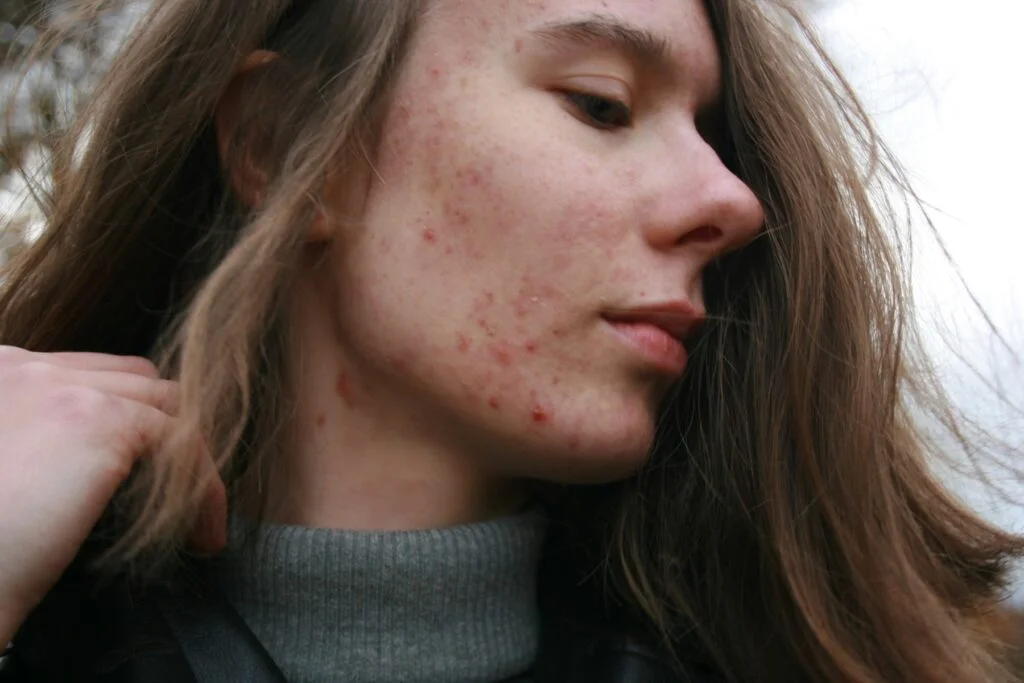
There’s no unique “stress acne”. Stress-related flares look like ordinary acne, which the NHS lists as blackheads, whiteheads, red bumps, pus-filled spots and, in more severe cases, larger painful lumps called nodules and cysts. Acne usually affects the face, chest and back.
You may see posts claiming stress spots always land on your forehead or chin, or that a spot’s position reveals its cause (“face mapping”). We found no research showing a stress-specific pattern. The clearest link in studies was with inflamed red spots, wherever you normally get acne.
The same goes for the TikTok “cortisol face” and “cortisol acne” trends. Everyday stress rarely changes how you look as dramatically as these videos suggest, as we explain in cortisol face: is it real?
Stress can show up on the skin in other ways too. If your bumps are itchy welts rather than spots, read about stress rashes and hives, and see stress and hair loss and our full list of stress symptoms.
Stress acne vs hormonal acne
The two often overlap, because stress and hormones are linked. These clues can help you spot a pattern:
| Stress-related flare | Hormonal acne | |
|---|---|---|
| When it flares | During or after a stressful spell, such as exams or a deadline | Before or during periods, in pregnancy, at menopause or with PCOS |
| Where | Wherever you usually get acne: face, chest or back | In adult women, often the lower chin, jawline and neck |
| Spot type | Mostly inflamed red spots and pus-filled spots | Inflamed spots and deeper lumps, plus small closed whiteheads |
| Pattern | Eases as the stress passes | Repeats each month in time with your cycle |
| What helps | Standard acne care plus stress management | Standard acne care; a GP may suggest the combined pill for hormone-related acne |
A small study of adult women not using acne treatment found 63% had about a quarter more inflamed spots before their period. If your breakouts follow your cycle, our guides to PMS symptoms and hormonal imbalance symptoms may help.
How to get rid of stress acne
Treat it like any acne. The NHS advises:
- Wash twice a day with a gentle cleanser, and take make-up off at the end of the day.
- Choose non-comedogenic products, which are less likely to block pores.
- Don’t pick, squeeze or scrub. Picking can scar and scrubbing irritates the skin.
- Wear loose, breathable clothing if you get spots on your chest or back.
Pharmacy treatments. Gels and creams containing benzoyl peroxide or salicylic acid are available without a prescription, and a pharmacist can help you choose. Adapalene, a retinoid, is prescription-only in the UK, so ask a GP about it.
Give it time. Acne Support advises using a treatment for at least 12 weeks before deciding whether it works, unless side effects make you stop sooner.
Easing the stress behind it
Skincare treats the spots; lowering your stress may stop a flare building. Small daily habits work best:
- Try box breathing when you notice tension, or when you catch yourself touching your face.
- Pick a few ideas from how to relieve stress and use them every day, not just in crisis weeks.
- Protect your sleep during busy spells: see how to sleep better.
- If spots are knocking your confidence, you’re not alone: the NHS notes acne can affect mental health. Our guide to low self-esteem has practical steps.
If you like a calming evening drink, our Magnesium Glycinate Sleep Complex is a caffeine-free bedtime drink with L-theanine, and magnesium contributes to normal psychological function. It isn’t a treatment for acne or spots.
You may also see CBD skincare marketed for spots. Our look at CBD and skin explains why the evidence in people is still unproven, so stick with proven acne treatments.
When to see a GP
The NHS says to see a GP if:
- you’ve tried treating acne yourself and it isn’t improving
- you have lots of spots, or deep, painful spots
- your spots are leaving scars
- the skin around spots is hot, swollen and red, which can be a sign of infection
- acne is affecting your mental health
A GP can prescribe stronger creams, antibiotics or the combined pill, or refer you to a dermatologist. If stress itself is wearing you down, mention that too.
See also PMOS, the new name for PCOS.
FAQs
Can stress cause acne?
Stress isn’t proven to cause acne on its own, but studies of students found acne got worse during stressful exam periods. If you’re prone to spots, stress may trigger a flare.
Where does stress acne appear?
Wherever you normally get acne, usually the face, chest or back. There’s no good evidence that stress spots favour the forehead or chin, or that a spot’s position reveals its cause.
How long does stress acne last?
There’s no set time. A stress-related flare may settle as the stressful spell passes, but acne treatments can take at least 12 weeks to work, so keep going with them.
How can I tell stress acne from hormonal acne?
Hormonal acne tends to follow your cycle and, in adult women, often appears on the chin, jawline and neck. Stress-related flares line up with stressful weeks instead. The two often overlap.
Can anxiety cause acne?
Anxiety and stress may worsen existing acne, partly through picking, poor sleep and diet changes. Acne can also cause anxiety and low self-esteem, so see a GP if it’s affecting your mood.
Sources
- NHS. Acne.
- British Association of Dermatologists, Acne Support. Causes of acne and Acne treatment.
- Chiu A, Chon SY, Kimball AB (2003). The response of skin disease to stress: changes in the severity of acne vulgaris as affected by examination stress. Archives of Dermatology.
- Yosipovitch G, et al. (2007). Study of psychological stress, sebum production and acne vulgaris in adolescents. Acta Dermato-Venereologica.
- Jović A, et al. (2017). The impact of psychological stress on acne. Acta Dermatovenerologica Croatica.
- Zouboulis CC, Böhm M (2004). Neuroendocrine regulation of sebocytes: a pathogenetic link between stress and acne. Experimental Dermatology.
- Karaağaç M, Akça HM, Acat Ö (2024). Lack of association of acne severity with depression, anxiety, stress, and eating attitudes. Journal of Personalized Medicine.
- Dréno B, et al. (2013). Adult female acne: a new paradigm. Journal of the European Academy of Dermatology and Venereology.
- Lucky AW (2004). Quantitative documentation of a premenstrual flare of facial acne in adult women. Archives of Dermatology.
- Ryguła I, Pikiewicz W, Kaminiów K (2024). Impact of diet and nutrition in patients with acne vulgaris. Nutrients.
This guide is general information, not medical advice. Evopure makes the Magnesium Glycinate Sleep Complex.