Last updated: October 2026
Most hip pain comes from a strain, an irritated tendon or bursa on the outside of the hip or, after about 45, osteoarthritis, and it usually starts to settle within 6 weeks. Keep moving gently, use ice or pharmacy painkillers and build up simple hip exercises. Call 999 if you can’t walk or bear weight after a fall.
Below: a “where it hurts” table, self-care, an NHS exercise routine, how to sleep, hip or back, osteoarthritis, injections and surgery, children, pregnancy and exactly who to call.
Need help now? Call 999 or go to A&E if you have severe hip pain after a fall or injury, can’t walk or put weight on the leg, or the hip or leg is numb or tingling after an injury. Call NHS 111 if severe pain starts suddenly with no injury, the hip is hot and swollen, or you have a high temperature. A child with a limp should be checked the same day. See all the red flags.
What’s causing my hip pain? Where it hurts
Where it hurts, your age and how it started are the best clues. The NHS advises against diagnosing yourself, so treat this as a guide to what to do next.
| Where or when it hurts | Common cause | What to do |
|---|---|---|
| Outside of the hip, tender over the bony point; worse lying on that side or crossing your legs | Greater trochanteric pain syndrome (GTPS), including gluteal tendinopathy and bursitis | See outer hip pain |
| Groin or front of the hip, gradual ache and stiffness, aged 45 or over, worse walking | Osteoarthritis | Exercise and weight first: see NICE advice |
| Front of the hip or groin after sport or a sudden stretch, with swelling or bruising | Muscle strain (such as a hip flexor or groin strain) or tendonitis | PRICE for 2 to 3 days (below) |
| A groin lump that gets bigger when you cough and smaller when you lie down | Hernia | See a GP; call 111 if it becomes painful or you feel sick |
| Buttock pain spreading down the leg, with tingling, numbness or burning | The lower back, including sciatica | See hip or back? |
| Pain and stiffness worse after rest, such as on waking | Rheumatoid or another inflammatory arthritis | See a GP |
| Severe pain after a fall, can’t bear weight, leg looks shorter or at an odd angle | Broken hip, most common in older people and those with osteoporosis | Call 999 |
| Hot, swollen hip with a fever or feeling shivery | Septic arthritis (a joint infection) | Urgent: call 111 |
| A child or teenager with a limp, or hip, thigh or knee pain | Irritable hip, Perthes’ disease or a slipped growth plate (SUFE) | Same-day check: see children |
| Pregnant, with pain at the front of the pelvis, hips or lower back | Pelvic girdle pain (PGP) | Tell your midwife: see pregnancy |
If several joints ache, see our guide to joint pain. Outer hip pain is more common in people with knee osteoarthritis, so our knee pain guide may help too.
How long does hip pain last?
NHS inform says new hip pain, or a flare-up, should begin to settle within about 6 weeks. Most strains feel better after about 2 weeks (avoid running for up to 8 weeks), and bursitis usually goes in a few weeks. Outer hip pain is often slower, and osteoarthritis is long term.
What to do today
After a strain or injury, the NHS recommends PRICE for 2 to 3 days: protect it, rest from exercise, ice it (wrapped in a tea towel) for up to 20 minutes every 2 to 3 hours, use a compression bandage in the day and keep the leg raised. Avoid heat, alcohol and massage for the first couple of days.
For an ache or flare-up with no injury:
- Keep moving within reason. NHS inform suggests easing off for 24 to 48 hours while moving the hip gently every hour, then building back up. Any activity is better than none.
- Ice or heat: whichever helps, up to 20 minutes with a towel against your skin. Skip it if you have poor circulation or reduced feeling. A hot water bottle is handy for stiffness.
- Stairs: up with your good leg first, down with your sore leg first, using the handrail.
- Daily habits: avoid low chairs, crossing your legs and heavy loads, and wear soft-soled, supportive shoes.
- Painkillers: the NHS suggests paracetamol or ibuprofen gel, or ibuprofen tablets if needed. Ibuprofen isn’t suitable for everyone, so ask a pharmacist.
Walking keeps you moving: build up with how many steps a day and Japanese walking.
Hip exercises: a simple NHS routine
These four come from NHS inform’s routine for hip problems. Hold a chair for balance. Check with a GP or physio first after a fall, injury or hip surgery.
- Bridge. Lie on your back, knees bent. Push your hips up, hold for a few seconds, then lower slowly.
- Standing hip extension. Facing a chair, keep one leg straight and lift it behind you without leaning forward. Hold, then return.
- Standing side leg lift. One hand on a chair, lift the outside leg straight out to the side, hold, then lower.
- Mini squat. With a chair behind you, bend your knees until your bottom lightly touches the seat, then stand up again.
How much, and the pain rule: start with 2 or 3 repetitions at a time, little and often, adding 1 or 2 every few days, up to 2 sets of 15. Keep pain at 5 out of 10 or below while you exercise. Your hip shouldn’t be worse overall afterwards, or the next morning. If it is, do fewer or go slower.
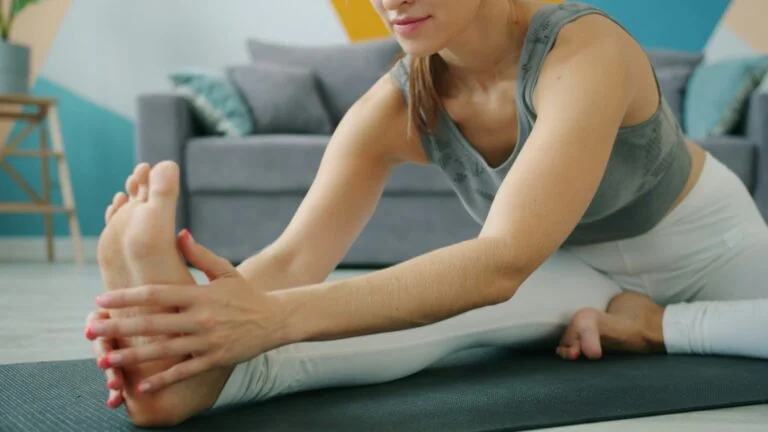
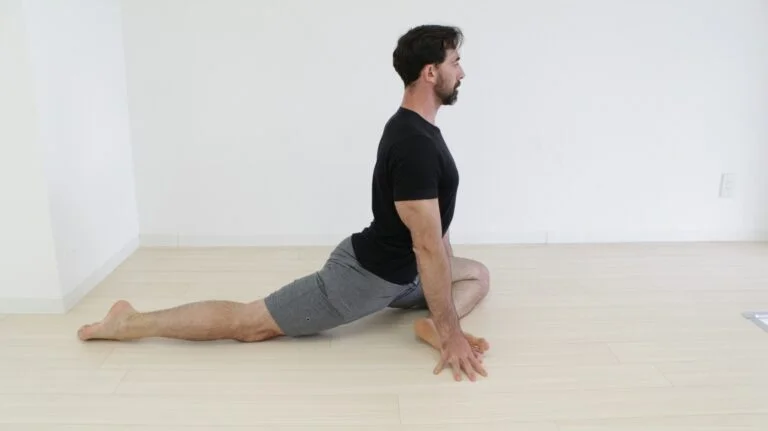
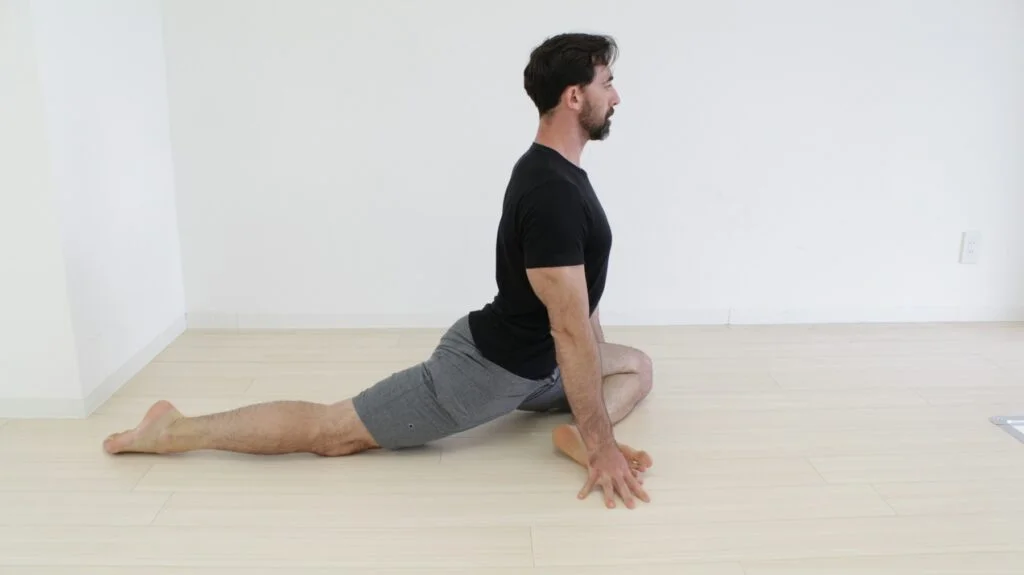
Stretches: Arthritis UK suggests a gentle knee-to-chest stretch, held for about 10 seconds, 5 to 10 times. Deep stretches such as yoga’s pigeon pose cross the leg over the body, like crossing your legs, a common trigger for outer hip pain: if one makes that pain worse, swap it for gentler moves.
Hip pain at night and how to sleep
With bursitis and outer hip pain, lying on the sore side presses on the painful spot, which is why it often hurts more at night. Osteoarthritis can also ache after you’ve been still. A Royal Berkshire NHS physio leaflet suggests:
- Lie on your back or front if you can.
- If you sleep on your side, lie on the side that doesn’t hurt with pillows between your knees, so your top hip and knee are level. This stops the top leg dropping across and squeezing the outside of the hip.
For bursitis, the NHS also suggests extra cushions around the joint. A pharmacist can help you time painkillers to cover the night, and our best sleeping position guide has more. See a GP if hip pain regularly affects your sleep.
Pain on the outside of the hip (GTPS)
Greater trochanteric pain syndrome is pain over the bony point on the outside of the hip, sometimes spreading down the thigh. It covers gluteal tendinopathy (irritated buttock tendons) and trochanteric bursitis. It is common, especially in women: in a US study of 3,026 adults aged 50 to 79, about 15% of women and 7% of men had it in one hip.
Common triggers: lying on your side, crossing your legs, repeated squatting, and standing with your weight on one hip.
What works best: a 2018 BMJ trial in 204 people with gluteal tendinopathy compared physio-led advice and exercise, one steroid injection, and waiting to see. At 8 weeks, 77% of the exercise group rated themselves a success, against 58% after an injection and 29% who waited. At a year, the exercise group still did better overall than the injection group, though pain levels were similar.
Is it my hip or my back?
Hip joint problems are usually felt in the groin or front of the hip, and outer hip pain on the side. Buttock pain is often from the back: NHS inform says pins and needles, or sharp, hot or burning pain in the leg, can mean a back problem. Sciatica usually affects your bottom and the back of one leg, often down to the foot. See our guides to lower back pain and sciatica. Numbness around your bottom or genitals, or new bladder or bowel problems, is an emergency: call 999 or go to A&E.
Hip osteoarthritis: what NICE recommends
NICE guideline NG226 says a GP can diagnose osteoarthritis without an X-ray if you are 45 or over, your joint pain is linked to activity, and any morning stiffness lasts no longer than 30 minutes.
| Option | What NICE NG226 says |
|---|---|
| Therapeutic exercise | Offer to everyone. Pain may rise at first, but regular exercise helps long term |
| Weight loss, if overweight | Any amount helps; 10% of body weight is likely to be better than 5% |
| Anti-inflammatory gel | Consider for joints other than the knee |
| Anti-inflammatory tablets | Consider if gels don’t work, with stomach protection |
| Paracetamol | Not routinely: no strong evidence of benefit |
| Glucosamine | Don’t offer: no strong evidence of benefit |
| Acupuncture, TENS, ultrasound, laser | Don’t offer |
How much does exercise help? Honestly, less than people hope. The 2026 Cochrane review of 18 trials (1,368 people) found exercise probably reduces hip pain and improves function slightly compared with no treatment, but the average change was small. Some people do much better than average, and staying active has wider health benefits, which is why NICE still puts it first.
Practical help: the NHS says a walking stick held on the opposite side to the sore hip takes some of your weight, and shock-absorbing shoes ease pressure on the joints. It also says warming rubs have little effect on osteoarthritis. For supplements, see glucosamine and turmeric; for weight, sleep and weight loss.
Injections and surgery
- Steroid injections for osteoarthritis: NICE says consider them when other medicines don’t work or to support exercise, but relief only lasts 2 to 10 weeks.
- Steroid injections for outer hip pain: they help short term, but in the BMJ trial above, advice and exercise did better.
- Hyaluronan (“gel”) injections: NICE says don’t offer them for osteoarthritis.
- Hip replacement: NICE says consider referral when symptoms substantially affect your quality of life and non-surgical treatment hasn’t worked, and that age, weight or smoking alone shouldn’t rule you out.
Hip pain in children and teenagers
The NHS says hip pain in children should always be checked. Ask for an urgent GP appointment or call 111 if a child has sudden hip, thigh or knee pain, is limping, or can’t put weight on one leg. Hip problems can be felt in the knee.
- Irritable hip is the most common cause. It usually gets better in 1 to 2 weeks with rest. Go back to the GP if pain worsens, returns, lasts beyond 2 weeks, or comes with a high temperature.
- Perthes’ disease is rare (about 1 in 9,000 children). Blood flow to the ball of the hip is interrupted, causing groin, thigh or knee pain, a limp and stiffness. About 60% recover without treatment, with regular hospital checks.
- Slipped upper femoral epiphysis (SUFE) is when the growth plate at the top of the thigh bone slips, in childhood or the teenage years. It causes a limp and vague hip, groin, thigh or knee pain, and needs urgent specialist treatment.
Our products are for adults (18+) only.
Hip and pelvic pain in pregnancy
Pelvic girdle pain (PGP), also called SPD, affects up to 1 in 5 pregnant women to some degree, the NHS says. It isn’t harmful to your baby. Pain is usually over the pubic bone at about hip level, in the lower back or the thighs, and worse walking, on stairs or turning in bed. The NHS suggests staying active within comfort, sleeping with a pillow between your legs and keeping your knees together getting in and out of the car.
Tell your midwife or GP if it makes moving difficult; they can refer you to a specialist physio. Check with your midwife or pharmacist before taking any painkiller. We don’t recommend our products during pregnancy or breastfeeding.
Red flags: when to call 999 or 111
Call 999 or go to A&E if:
- you have severe hip pain after a fall or injury
- you can’t walk or put any weight on the leg
- the hip or leg is numb or tingling after an injury
- you have numbness around your bottom or genitals, or new bladder or bowel problems
Don’t drive yourself, and take your medicines with you.
Call NHS 111 or ask for an urgent GP appointment if:
- severe hip pain started suddenly without a fall or injury
- your hip is swollen and hot, or the skin around it has changed colour
- you have hip pain with a high temperature or feel unwell
- a groin lump becomes painful, or you feel or are sick
- a child has a limp, can’t bear weight, or has new hip, thigh or knee pain
When to see a GP or physio
See a GP if hip pain is stopping your normal activities or sleep, keeps coming back or is getting worse, hasn’t improved after 2 weeks of home treatment, or your hip is stiff for more than 30 minutes after waking. A GP may offer stronger painkillers, physiotherapy, walking aids, or a referral for scans, injections or a specialist.
Physio without a GP: in most of England you can refer yourself to NHS community musculoskeletal (MSK) services, including physiotherapy, and you don’t need a diagnosis first. Find your local service on the NHS website. In Scotland, NHS inform explains how to access MSK services.
Where our products fit (honestly)
No supplement or balm is a treatment for hip pain, and nothing replaces the exercises above and proper medical advice. Here’s how our products can sit alongside a healthy routine.
Our CBD Balm, Muscle and Joint Support is a massage balm made with broad spectrum CBD, peppermint, eucalyptus and juniper. It feels cooling and non-greasy, and some people like to massage it into the hip and buttock before or after their exercises. CBD isn’t a treatment for hip pain or arthritis. Read more in our CBD balm guide and CBD for arthritis.
Our Magnesium Glycinate Sleep Complex is an evening drink with magnesium bisglycinate and citrate, glycine and L-theanine, which some people make part of their evening wind-down. Magnesium contributes to normal muscle function. For more, see magnesium for muscle pain.
If you also take CBD by mouth, keep the FSA’s advice in mind. The FSA’s 10mg a day figure is precautionary advice rather than a legal limit, set while longer-term safety research continues. At Evopure we think it is a very cautious figure, and many adults use more. If you go above it, increase slowly, and check with your GP or pharmacist first if you take any medication.
Our products are for adults (18+) only. We don’t recommend our products during pregnancy or breastfeeding. If you take prescribed medicines, check with your pharmacist before adding a supplement.
FAQs
What is the most common cause of hip pain?
In adults it is usually a strain, outer hip pain from irritated tendons or a bursa (GTPS), or osteoarthritis after about 45. In children it is usually irritable hip, but any child’s hip pain should be checked.
How long does hip pain take to go away?
Most new hip pain begins to settle within about 6 weeks, and most strains feel better after 2 weeks. See a GP if it hasn’t improved after 2 weeks of home treatment.
Should I walk with hip pain?
Usually yes. The NHS advises keeping moving without overloading the hip. After a fall, if you can’t bear weight, call 999.
How should I sleep with hip pain?
Try your back or front first. If you sleep on your side, lie on the side that doesn’t hurt with pillows between your knees so your top hip and knee are level.
How do I know if hip pain is from my back?
Buttock pain spreading down the leg, especially with pins and needles, numbness or burning, often comes from the lower back. Groin pain is more typical of the hip joint.
Is hip pain in pregnancy normal?
Pelvic girdle pain affects up to 1 in 5 pregnant women and isn’t harmful to the baby. Tell your midwife or GP if it makes moving difficult.
When should I worry about hip pain?
Call 999 if you can’t walk or bear weight after a fall. Call 111 if severe pain starts suddenly, the hip is hot and swollen, or you have a fever. A child with a limp should be checked the same day.
Sources
- NHS. Hip pain and Hip pain in children (irritable hip).
- NHS inform. Hip problems and Exercises for hip problems.
- Arthritis UK. Exercises for the hips.
- Royal Berkshire NHS Foundation Trust. Greater trochanteric pain syndrome (GTPS). Physiotherapy leaflet, 2024.
- NICE. Osteoarthritis in over 16s: diagnosis and management (NG226). 2022.
- NHS. Osteoarthritis: treatment.
- NHS. Broken hip.
- NHS. Sprains and strains and Bursitis.
- NHS. Sciatica and Hernia.
- NHS. Pelvic pain in pregnancy.
- NHS. Get NHS help for back and joint problems.
- Oxford University Hospitals. Perthes’ disease.
- Webb CW, et al. Slipped capital femoral epiphysis: rapid evidence review. Am Fam Physician, 2025. PMID 41118186.
- Segal NA, et al. Greater trochanteric pain syndrome: epidemiology and associated factors. Arch Phys Med Rehabil, 2007. PMID 17678660.
- Mellor R, et al. Education plus exercise versus corticosteroid injection use versus a wait and see approach on global outcome and pain from gluteal tendinopathy. BMJ, 2018. PMID 29720374.
- Hall M, et al. Exercise for osteoarthritis of the hip. Cochrane, 2026. PMID 42486497.
This guide is general information, not medical advice. If you’re worried about hip pain, speak to a GP, pharmacist or physiotherapist. Evopure makes the CBD Balm, Muscle and Joint Support and the Magnesium Glycinate Sleep Complex.