Last updated: October 2026
Elderberry is the dark purple fruit of the elder tree, Sambucus nigra. A few small trials suggest elderberry extract may shorten a cold or flu by a couple of days, but a well-designed 2020 flu trial found no benefit, and most studies were paid for by manufacturers. Never eat elderberries raw: always cook them.
Below: what elderberry is, the honest evidence for colds and flu, syrups versus gummies and lozenges, foraging safety, who should avoid it, elderflower versus elderberry, and what the NHS says actually helps.
The short version: elderberry is not proven to prevent colds. It might shorten one slightly if you start early, but the evidence is small, mixed and mostly industry funded. Raw berries, leaves, stems and seeds can make you sick, and some people should avoid it altogether.
What is elderberry?
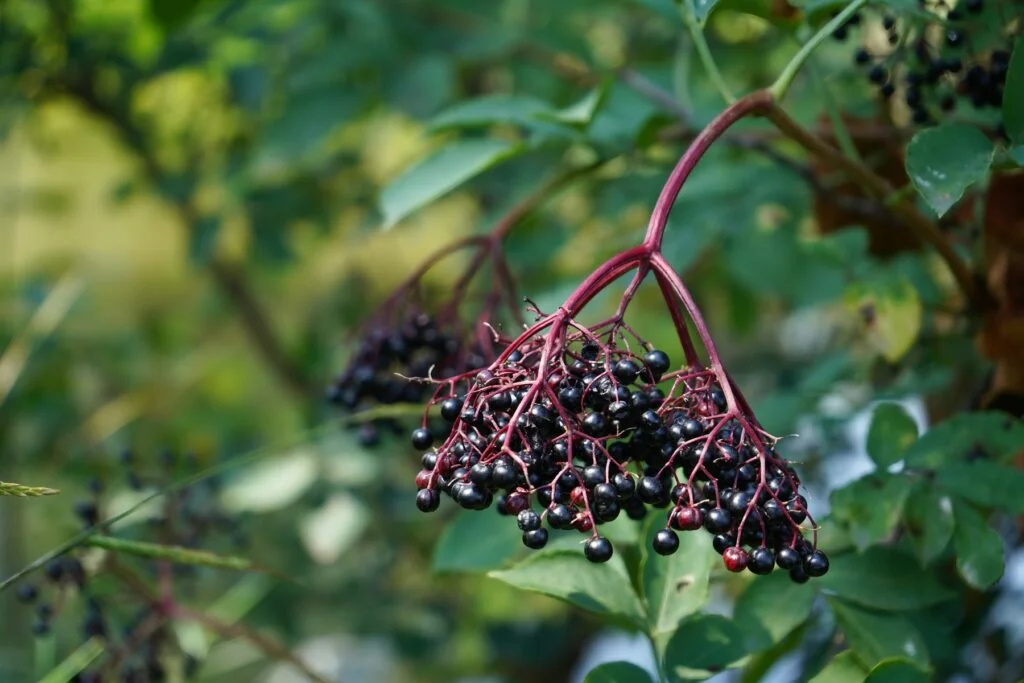
Elder (Sambucus nigra) is a common shrub or small tree in UK hedgerows, woods, scrub and waste ground. It has creamy-white, sweet-smelling flat-topped flower clusters from late May to June, which turn into clusters of small purple-black berries later in the summer.
Ripe elderberries are rich in anthocyanins, the purple pigments also found in blackcurrants and blueberries. Unripe berries contain a compound called sambunigrin, which can release cyanide; its level falls as the berries ripen.
Elderberry has long been a folk remedy for colds and flu, and today it’s sold as syrups, gummies, lozenges, capsules and teas, often marketed for immunity in the same way as sea moss. But no elderberry health claim is authorised in Great Britain: a claim that elderberry juice helps “strengthen the immune system” is listed as non-authorised on the GB nutrition and health claims register, so products can’t legally say it supports your immunity.
Does elderberry work for colds and flu?
Possibly a little, but the evidence is weak. Here are the main human trials.
- Flu, Norway (2004): 60 adults with flu symptoms for 48 hours or less took 15ml of elderberry syrup or a placebo four times a day for 5 days. Symptoms eased about 4 days sooner in the elderberry group.
- Flu lozenges (2009): 64 adults took lozenges with 175mg of elderberry extract four times a day and reported faster improvement in individual symptoms, though later reviewers couldn’t use its data.
- Air travellers, Australia (2016): 312 economy passengers flying overseas took 300mg elderberry extract capsules or a placebo. Slightly fewer colds in the elderberry group (12 vs 17) was not a significant difference. Among those who did catch a cold, the total cold days were 57 versus 117, and symptoms were milder.
- Emergency department flu trial, USA (2020): 87 people with confirmed flu took elderberry extract or a placebo for 5 days. There was no difference in how quickly they recovered (about 5 days in both groups until symptoms were mild, and 8 to 9 days to full recovery).
A 2019 meta-analysis pooled earlier trials, 180 people in total, and reported a large effect on symptoms. But a more rigorous 2021 systematic review, which used Cochrane methods to judge study quality, concluded that elderberry may not reduce the risk of catching a cold, and that any effect on how long colds or flu last is uncertain. It rated several trials at high risk of bias.
Funding matters too. In that review, four of the five trials were sponsored by companies that make elderberry products, and the fifth didn’t report its funding. The air travel trial was funded by the maker of the extract it tested. The 2020 trial, which was investigator-led, is the one that found nothing.
The NHS says there’s little evidence that supplements such as vitamin C, echinacea or garlic prevent colds, and its cold advice doesn’t include elderberry. For how elderberry compares with other popular remedies, see how to boost your immune system: what actually works.
Elderberry benefits: the evidence by claim
| Claim | What the evidence shows | Verdict |
|---|---|---|
| Prevents colds | One trial in air travellers found no significant drop in the number of colds | Not shown |
| Shortens a cold | One industry-funded trial found shorter, milder colds; a rigorous review rated this uncertain | Possible, uncertain |
| Shortens flu | Small early trials found faster recovery; a well-designed 2020 trial found none | Conflicting |
| “Boosts” the immune system | Immune claim assessed and non-authorised in GB | Not allowed to be claimed |
| Treats or prevents COVID-19 | The US National Institutes of Health says there is no good evidence | No |
| Skin, hair, gut health, energy, constipation | No good human trials | Unknown |
| Antioxidant content | Ripe berries are rich in anthocyanins, but that doesn’t prove a health benefit | True of the fruit, not a proven benefit |
Elderberry syrup, gummies, lozenges and tea
Each trial tested one specific extract, and products on sale vary widely in strength, so a result from one doesn’t carry over to another.
- Syrup: the form used in most flu trials. Many are high in sugar.
- Gummies: convenient, but no trials have tested elderberry gummies. They look like sweets, so store them out of children’s reach.
- Lozenges: tested in one small flu trial. A soothing lozenge can help a sore throat whatever is in it; see sore throat remedies.
- Capsules: used in the air travel trial. Usually the lowest in sugar.
- Tea: comforting, but untested in trials.
If you try elderberry, choose a commercial product, start when symptoms begin, follow the label’s dose and age limits, and stop if it upsets your stomach. Only short-term use (around 5 days) has been studied. Homemade syrup is only safe if the berries are fully ripe, stripped from every stem and thoroughly cooked.
Side effects and foraging safety
Commercial elderberry products appear to cause few side effects when used for a few days, with occasional stomach upset. The bigger risk is the raw plant. The US National Center for Complementary and Integrative Health says raw or unripe elderberries, and the leaves and stems, contain cyanide-producing substances that can cause nausea, vomiting and severe diarrhoea, and that cooking eliminates the toxin.
A real example: in 1983 in California, a group pressed wild elderberries together with their leaves and branches to make juice. Within 15 minutes of drinking it, 11 of 25 people had nausea and vomiting, and eight were flown to hospital. Everyone recovered, and the more juice people drank, the sicker they were.
Foraging and safety checklist
- Be 100% sure it’s elder. Look for a woody shrub or tree with leaves of five or seven toothed leaflets in opposite pairs, flat-topped creamy flower heads in late May and June, and drooping clusters of purple-black berries later in summer.
- Know the lookalike. Dwarf elder (Sambucus ebulus) grows in UK hedgerows and roadsides. It is a non-woody plant about 1m tall with straight, unbranched stems, and it flowers later, in July and August. Its berries contain a toxic protein and must not be eaten.
- Pick only fully ripe, dark berries. Leave green or red ones on the bush.
- Strip off every stem. Never crush or cook leaves, stems or bark with the berries.
- Always cook the berries before eating or drinking them. Never eat them raw.
- Avoid roadsides with heavy traffic, and only pick where you have permission.
- If in doubt, leave it. If someone feels ill after eating any part of an elder, call NHS 111. Call 999 if they’re very unwell.
Who should avoid elderberry
Ask a GP or pharmacist before taking elderberry if any of these apply. Much of the interaction advice is based on how elderberry may act in the body rather than reported harms, but it’s sensible to check.
- Pregnancy and breastfeeding: little is known about its safety, so it’s best avoided.
- Children: only use a product made for children’s use, at the age and dose on the label, and speak to a pharmacist or GP first. Never give children homemade or raw elderberry.
- Autoimmune conditions such as rheumatoid arthritis or lupus: elderberry may stimulate the immune system.
- Immunosuppressant medicines, including after an organ transplant, or steroid tablets such as prednisolone: elderberry may work against them.
- Diabetes medicines: elderberry may lower blood sugar, which could add to their effect.
- Diuretics (water tablets) and laxatives: elderberry may have similar effects.
- Theophylline (for asthma or COPD) and chemotherapy: check with your specialist.
For how supplements and medicines can interact more generally, see will CBD interact with my medication?
Elderflower vs elderberry
Both come from the same elder tree, but they are used differently.
| Elderflower | Elderberry | |
|---|---|---|
| Season | Late May to June | Late summer into early autumn |
| Common uses | Cordial, tea, fritters | Syrup, gummies, jam, pies, wine |
| Cold evidence | No clinical trials; the European Medicines Agency accepts elderflower tea and liquid extracts as a traditional herbal remedy for early cold symptoms, based on long use | A few small trials with mixed results |
| Age | Traditional herbal medicines: adults and children over 12 | Follow the label; check with a pharmacist |
| Raw safety | Raw flowers are mildly toxic; cordial is made with hot water or syrup | Raw or unripe berries can cause vomiting; always cook |
The Woodland Trust notes that the flowers and berries are the only edible parts of the plant, and both should be cooked or steeped in hot liquid before use.
What actually helps with a cold or flu
Colds usually get better on their own in 1 to 2 weeks. The NHS self-care advice is simple:
- Rest and sleep. See how to sleep with a cold.
- Drink plenty of fluids, such as water, to avoid dehydration.
- Take paracetamol or ibuprofen for aches or a high temperature, but don’t combine them with cold remedies that contain the same medicines. Never give aspirin to under-16s.
- Gargle salt water or try hot lemon and honey for a sore throat (not honey for babies under 12 months).
- Breathe in steam for a blocked nose (never let children use a bowl of hot water), and ask a pharmacist about decongestants. Night-time coughs? See cough at night.
- Stay at home if you have a high temperature or feel too unwell to do normal activities.
Not sure which you have? Read cold or flu: how to tell the difference. Antibiotics don’t work on these viruses; the NHS flu vaccine is the best protection against flu if you’re eligible.
For supplements with better evidence, taking vitamin C regularly slightly shortens colds in adults, and zinc lozenges may shorten them, though the results vary. See our guides to vitamin C and zinc.
See a GP or call 111 if
Symptoms don’t improve after 10 days (cold) or 7 days (flu), or get worse; you have a high temperature for more than 3 days, a cough for more than 3 weeks, or shortness of breath; or you have a long-term condition, a weakened immune system, are 65 or over, or pregnant. Call 999 for sudden chest pain, severe difficulty breathing or coughing up blood.
Vitamin D in winter
The one supplement the NHS advises for everyone in autumn and winter is vitamin D: 10 micrograms a day from October to March, and no more than 100 micrograms a day. See vitamin D in winter, the best time to take vitamin D and our winter wellness guide.
If you already use CBD oil, our Evolabs Mint CBD Oil with vitamin D3 adds 5 micrograms of vegan, algae-based vitamin D3 per half pipette to broad spectrum CBD. Vitamin D contributes to the normal function of the immune system. CBD isn’t a treatment for colds or flu, and we don’t claim the CBD supports your immunity. Read why we added algae-based D3 to our mint oil.
It’s for adults (18+) only. We don’t recommend our products during pregnancy or breastfeeding; take a plain vitamin D supplement instead, as the NHS advises.
The FSA’s 10mg a day figure is precautionary advice rather than a legal limit, set while longer-term safety research continues. At Evopure we think it is a very cautious figure, and many adults use more. If you go above it, increase slowly, and check with your GP or pharmacist first if you take any medication.
Related guides
- For the evidence on the other popular herbal remedy, see our guide to echinacea.
- Garlic for colds and immunity.
- Manuka honey benefits, MGO and UMF explained.
FAQs
Is elderberry good for colds?
It might shorten a cold slightly, but the evidence is small, uncertain and mostly industry funded. One trial found it didn’t reduce how many colds people caught. The NHS doesn’t recommend it.
Can you eat raw elderberries?
No. Raw or unripe elderberries, and the leaves, stems and seeds, contain substances that can cause nausea, vomiting and diarrhoea. Always remove the stems and cook ripe berries before eating them.
Is it safe to take elderberry every day?
Trials mostly used elderberry for around 5 days during an illness, and long-term daily use hasn’t been well studied. There’s no good evidence that taking it daily prevents colds.
Can children take elderberry?
Only use a product made for children, at the age and dose on the label, and speak to a pharmacist or GP first. Never give children homemade or raw elderberry.
Is elderberry safe in pregnancy or when breastfeeding?
Little is known about its safety in pregnancy or breastfeeding, so it’s best avoided. Speak to your midwife, GP or pharmacist before taking any herbal remedy.
What’s the difference between elderflower and elderberry?
Both come from the elder tree. Elderflowers bloom in late May and June and are used for cordial and tea; the berries follow later in summer and are used for syrups and jams.
Does elderberry interact with medication?
It may. Check with a pharmacist first if you take immunosuppressants, steroid tablets, diabetes medicines, diuretics, laxatives or theophylline, or if you have an autoimmune condition.
Sources
- Wieland LS et al. Elderberry for prevention and treatment of viral respiratory illnesses: a systematic review. BMC Complement Med Ther, 2021.
- Tiralongo E et al. Elderberry supplementation reduces cold duration and symptoms in air-travellers. Nutrients, 2016.
- Hawkins J et al. Black elderberry supplementation and upper respiratory symptoms: a meta-analysis. Complement Ther Med, 2019.
- Zakay-Rones Z et al. Randomized study of oral elderberry extract in influenza A and B. J Int Med Res, 2004.
- Macknin M et al. Elderberry extract outpatient influenza treatment for emergency room patients. J Gen Intern Med, 2020.
- NCCIH. Elderberry: usefulness and safety.
- CDC MMWR. Poisoning from elderberry juice, California. 1984.
- NHS. Common cold, Flu and Vitamin D.
- European Medicines Agency. Sambuci flos (elder flower).
- Jiménez P et al. Toxicity of lectin ebulin f present in dwarf elderberry (Sambucus ebulus). Toxicon, 2013.
- Woodland Trust. How to identify elder.
- GOV.UK. Great Britain nutrition and health claims register.
This guide is general information, not medical advice. Evopure doesn’t sell elderberry products. Evopure makes the Evolabs Mint CBD Oil with vitamin D3.