Last updated: October 2026
Sea moss (Irish moss, Chondrus crispus) is a red seaweed sold as gel, powder and gummies. It contains iodine and some other minerals, but there’s little human evidence for the skin, weight loss or immunity claims. Its iodine content varies hugely, so too much can upset your thyroid. Be especially careful if you have a thyroid condition.
Below: what the evidence shows, the iodine and heavy metal risks, who should avoid it, and how to use sea moss gel safely.
The short version: sea moss is a food, not a cure. Most claimed benefits come from lab studies or marketing, and you usually can’t tell how much iodine a product contains.
What is sea moss?
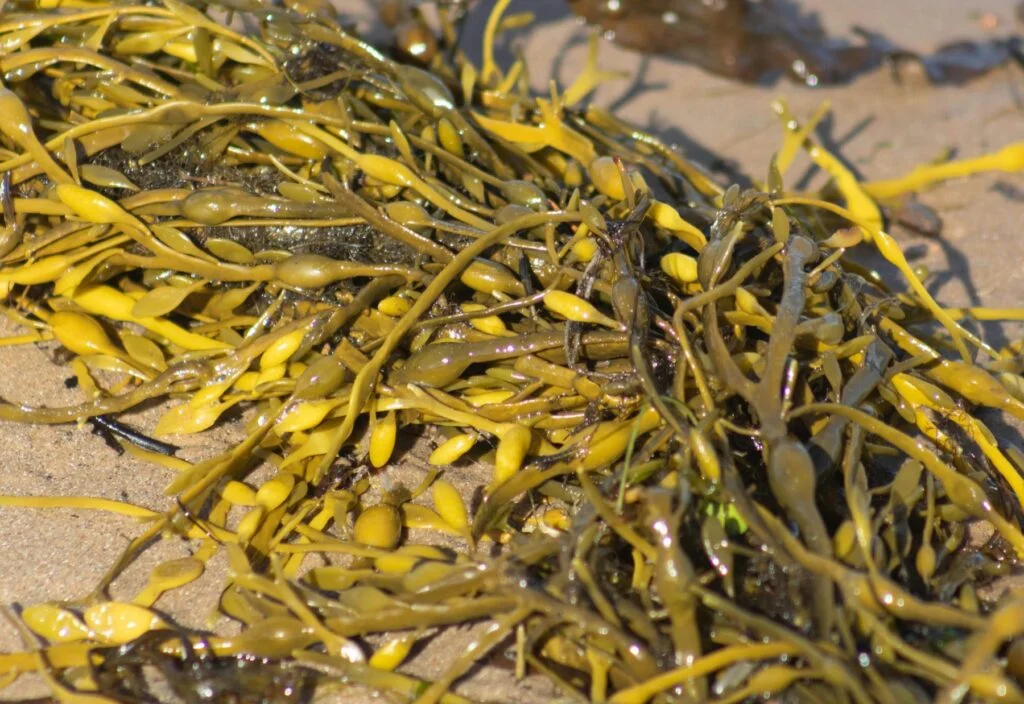
True sea moss, or Irish moss, is Chondrus crispus: a small, bushy red seaweed of the North Atlantic. It has long been used as a food and as a traditional remedy, although no medicinal value has been proven.
“Sea moss” is a loose shop name, though. Several other red seaweeds are sold or described as sea moss, including warm-water species such as Gracilaria and Kappaphycus (sometimes called elkhorn sea moss). They can differ in mineral content, so check the Latin name on the label.
Irish moss contains carrageenan, the thickener used in many foods.
What’s in sea moss (and the “92 minerals” claim)
Sea moss contains fibre-like carbohydrates, a little protein and a range of minerals, including iodine, calcium, iron and zinc. A 2025 lab analysis found 100g of dried red seaweed, including Irish moss, could supply a large share of daily calcium, iron and zinc. But nobody eats 100g, and gel is mostly water, so a spoonful gives you little.
You’ll often see the claim that sea moss contains “92 of the 102 minerals your body needs”. We could find no published analysis that supports that figure. Containing a trace of something isn’t the same as being a useful source of it. For everyday minerals, food is more reliable: see foods high in magnesium and iron-rich foods.
Sea moss benefits: what the evidence shows
A 2024 review of the Chondrus genus found plenty of interesting results in cell and animal studies, but concluded that data from clinical studies in people are limited. Here’s how the popular claims stack up.
| Claim | What the research shows | Strength of evidence |
|---|---|---|
| Skin (gel, masks, eczema) | No human trials of sea moss on skin. Claims rest on its moisture-holding gel texture and lab studies | Very weak |
| Gut health and prebiotic | A lab model of human gut bacteria found red seaweeds, including Irish moss, increased some beneficial bacteria. Not yet tested in people | Weak (lab only) |
| Weight loss | No trials of sea moss for weight. The idea comes from its fibre-like carbohydrates | Very weak |
| Immunity | Effects on immune cells in lab and animal studies only | Weak (lab and animal) |
| Hair growth | No studies in people | None |
| Thyroid | Iodine is needed to make thyroid hormones, but too much can disrupt the thyroid. Sea moss isn’t a reliable or measured iodine source | A risk as much as a benefit |
If your real goal is better skin, gut, immunity or hair, the basics matter more than any single food. See our guides to gut health, supplements for digestion, how to boost your immune system, stress and hair loss and CBD and skincare. For weight, see what minerals can and can’t do for weight loss and our honest look at berberine, another trending supplement.
Iodine: the main risk with sea moss
The NHS says adults need 140 micrograms of iodine a day, which most people get from milk and dairy, eggs, sea fish and shellfish. It warns that high doses taken for long periods could change the way your thyroid works, and that 0.5mg (500 micrograms) a day or less from supplements is unlikely to cause harm. The British Dietetic Association gives a rough adult upper guide of 600 micrograms a day.
The problem with seaweed is that you can’t see the dose:
- Labels rarely say. A University of Glasgow survey of 224 seaweed foods and supplements on sale in the UK found only 10% stated their iodine content.
- The range is huge. Where iodine could be estimated, a typical serving supplied a median of 585 micrograms, with the middle half of products ranging from about 105 to 2,520 micrograms.
- Species and source matter. A Spanish study of red seaweed samples found Irish moss averaged 3.86mg of iodine per kg dried, fairly low for a seaweed. But “sea moss” products may be other species or blends.
The BDA says seaweed or kelp supplements should not be used as an iodine source, and advises not eating brown seaweed or kelp more than once a week, especially in pregnancy. The NHS notes extra iodine can make the thyroid produce too much hormone. If you have thyroid symptoms, see a GP rather than self-treating: see underactive thyroid symptoms explains the signs and tests.
Heavy metals and bacteria in sea moss
Seaweed absorbs what is in the water around it. The US LactMed database notes sea moss can contain arsenic, lead, cadmium and mercury, depending on where it grew.
A 2026 Cornell University study tested 66 sea moss products bought online in the US. Arsenic, cobalt and mercury were detected in the dried sea moss, while the gels had lower levels. Bacteria were found in both, including Salmonella and Cronobacter in some samples.
If you buy sea moss, choose a seller who names the species and harvest area and can show lab tests for heavy metals, microbes and iodine.
Who should avoid sea moss or check first
- Anyone with a thyroid condition, overactive or underactive, including Hashimoto’s or Graves’ disease. Speak to your GP or specialist before taking sea moss.
- People taking levothyroxine or other thyroid medicines. The NHS asks you to tell your doctor about herbal remedies and supplements; ask your pharmacist first.
- People taking amiodarone, a heart medicine that already contains iodine.
- Pregnancy and breastfeeding. The British Nutrition Foundation advises against eating seaweed more than once a week, especially during pregnancy or breastfeeding. LactMed says to avoid sea moss while breastfeeding unless its iodine and heavy metals are shown to be low, as excess iodine from seaweed has suppressed the thyroid in breastfed babies. Ask your midwife or GP about iodine. We don’t recommend our products during pregnancy or breastfeeding either.
- Children. We don’t recommend sea moss supplements or gummies for children. Their iodine needs are lower and the dose in sea moss is unpredictable. Ask a GP or health visitor if you’re worried about your child’s diet.
- People on blood thinners such as warfarin. Lab studies report anticoagulant activity from Chondrus compounds. It’s unknown whether that matters in people, so check with your pharmacist first.
How to use sea moss gel safely
Most people make gel from dried sea moss:
- Rinse dried sea moss thoroughly in cold water to remove sand and debris.
- Soak it in fresh water in the fridge for 12 to 24 hours until it swells and softens.
- Drain and rinse again, then blend with fresh water until smooth.
- Chill in a clean, sealed jar. It sets into a gel.
People stir a spoonful into smoothies, porridge or soups, mostly as a thickener. Gel is very wet and its acidity varies, so bacteria can grow in it. The Food Standards Agency says your fridge should be between 0 and 5°C and leftovers eaten within 48 hours or frozen, so freeze small portions in an ice cube tray. Throw it away if it smells sour or grows mould.
Keep amounts small and occasional. A Spanish risk assessment found that 4g a day of the dried Irish moss it tested didn’t pose an iodine risk, but other products can contain far more.
Sea moss vs seaweed, spirulina, moringa and shilajit
| What it is | Main thing to know | |
|---|---|---|
| Sea moss | Red seaweed (Chondrus crispus, or similar species) | Unpredictable iodine; human evidence for benefits is limited |
| Kelp | Brown seaweed | Very high iodine; the BDA advises no more than once a week |
| Nori | Red seaweed used in sushi | Lower in iodine than most seaweeds |
| Spirulina | A blue-green alga (cyanobacterium), not a seaweed | Rich in protein; poor-quality products can carry toxins called microcystins |
| Moringa | Leaf powder from the moringa tree | Only a handful of small human studies; products are not standardised |
| Shilajit | A tar-like resin from mountain rock | Relatively few well-controlled human studies |
None of these has an authorised GB health claim of its own. For options ranked by evidence, see the best supplements for energy, natural supplements worth taking and brain foods.
Minerals with clear UK health claims
Some minerals have health claims authorised in the UK because the evidence is strong. Magnesium is one: magnesium contributes to the reduction of tiredness and fatigue, to normal functioning of the nervous system and to normal muscle function. See signs of magnesium deficiency.
Our Magnesium Glycinate Sleep Complex is a berry-flavoured evening drink with magnesium bisglycinate and citrate (148mg of magnesium per serving), plus glycine, L-theanine, chamomile, passionflower, hops and oat straw. Unlike sea moss, the label tells you exactly what you’re getting. Vegan, UK-made, adults only.
For gut products with stronger evidence, see probiotics: an honest, brand-free guide.
FAQs
Does sea moss actually work?
There’s little human evidence that it improves skin, weight, immunity or hair. Most research is in lab cells or animals.
How much sea moss is safe to take a day?
There’s no official safe amount, because iodine varies so much. One study found 4g a day of the dried Irish moss it tested was within iodine limits. Keep amounts small and occasional.
Is sea moss good for skin and hair growth?
There are no human studies showing sea moss improves skin or makes hair grow. If hair loss is new, sudden or patchy, see a GP to find the cause.
Does sea moss really have 92 minerals?
There’s no published evidence for that figure. A spoonful of gel provides only small amounts of most minerals.
Can sea moss help an underactive thyroid?
No. In the UK the main cause of an underactive thyroid is Hashimoto’s disease, and low iodine is rare. Too much iodine can disrupt the thyroid, so talk to your GP before taking sea moss.
Is sea moss safe for children or in pregnancy?
We don’t recommend sea moss supplements for children, or in pregnancy or breastfeeding, because the iodine dose is unpredictable. Ask your GP or midwife.
Sources
- NHS. Vitamins and minerals: iodine.
- NHS. Overactive thyroid: causes and Underactive thyroid.
- British Dietetic Association. Iodine: food fact sheet.
- British Nutrition Foundation. Vegetarian and vegan diets during pregnancy.
- Bouga M, Combet E. Emergence of seaweed and seaweed-containing foods in the UK: focus on labeling, iodine content, toxicity and nutrition. Foods, 2015. PMID 28231201.
- Drugs and Lactation Database (LactMed). Sea moss. 2026. PMID 41730053.
- Rejuso A, et al. Microbial and heavy metal analyses of commercially available sea moss and sea moss products. J Food Prot, 2026. PMID 42710593.
- Park SJ, et al. An update on the chemical constituents and biological properties of selected species of red algae: Chondrus. Mar Drugs, 2024. PMID 38248672.
Also referenced: Darias-Rosales J, et al. Risk assessment of iodine intake from red seaweeds, 2020 (PMID 32803579); López-Santamarina A, et al. Red seaweeds and the human gut microbiota in vitro, 2025 (PMID 39987804); Food Standards Agency, How to chill, freeze and defrost food safely (gov.uk).
This guide is general information, not medical advice. Evopure does not sell sea moss. Evopure makes the Magnesium Glycinate Sleep Complex.