






Last updated: October 2026
Small trials in men link ashwagandha root extract to modest rises in testosterone, sperm counts and strength gains, plus lower stress scores, but most were short, small and funded or supplied by extract makers. It has no authorised health claims in Great Britain, is under UK safety review, and isn’t for men with liver, thyroid or hormone-sensitive conditions.
Below: the evidence by outcome, doses and timing used in trials, side effects, and where the UK review stands.
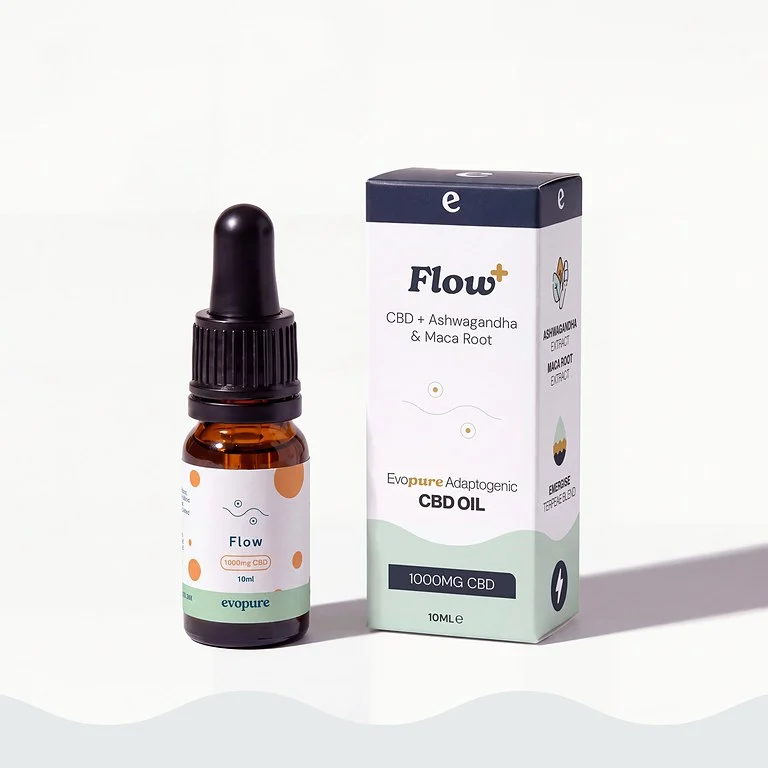
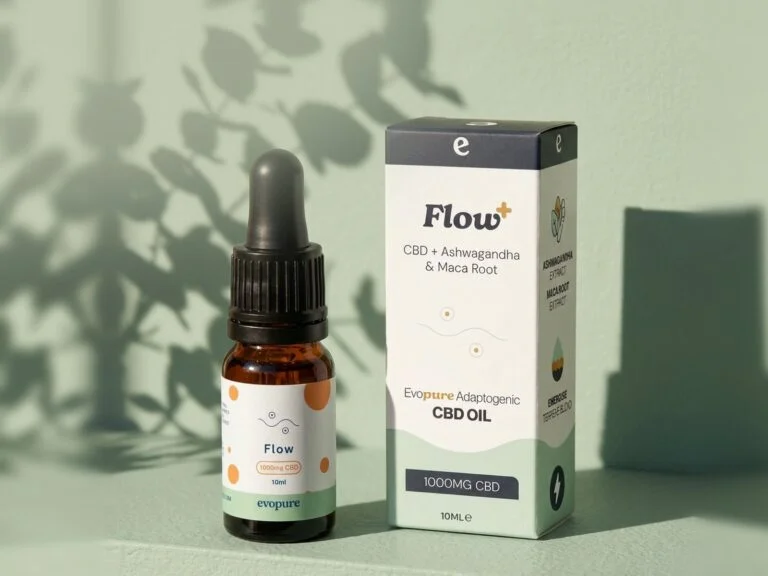
Ashwagandha in our range: our Flow CBD Oil combines broad spectrum CBD with ashwagandha and maca in MCT oil, in 500mg or 1,000mg (10ml). It’s for adults only, and the cautions in this guide apply to it too: skip it if you have a thyroid, liver or autoimmune condition, and check with your GP or pharmacist first if you take any medication.
Ashwagandha for men: what the trials show
Ashwagandha (Withania somnifera) is a shrub used in Ayurvedic practice, sold as root or root and leaf extracts. Here are the key trials in men, with who paid for them. The certainty column is our own rating.
| Outcome | Key study | Men, length, dose | Funding | Result | Certainty |
|---|---|---|---|---|---|
| Testosterone | Lopresti 2019, Australia | 57 overweight men aged 40 to 70; 8 weeks; root and leaf extract (21mg withanolide glycosides a day) | Funded by the extract maker | Testosterone rose 14.7% more than on placebo; no difference in fatigue, vigour or sexual wellbeing | Low |
| Sexual wellbeing | Chauhan 2022, India | 50 men with low sexual desire; 8 weeks; 300mg root extract twice a day | Extract supplied by its maker; some authors paid by a distributor | Higher sexual function scores and testosterone than placebo | Low |
| Erection problems | Mamidi 2011, India | 86 men with stress-related erectile dysfunction; 60 days; root powder | Academic | No difference from placebo | Low |
| Sperm quality | Ambiye 2013, India | 46 men with low sperm counts; 90 days; 675mg root extract a day | Extract supplied by its maker | Sperm count rose 167% from baseline, with little change on placebo; pregnancies not measured | Low |
| Strength with training | Wankhede 2015, India; Ziegenfuss 2018, US | 57 men new to weights (8 weeks, 300mg twice a day); 38 active men (12 weeks, 500mg root and leaf extract) | Extract supplied by its maker; funded by the extract maker | Bigger strength gains than placebo in both | Low to moderate |
| Stress and cortisol | Lopresti 2019, India (men and women) | 60 stressed adults; 60 days; 240mg extract a day | Independently managed | Lower anxiety scores and morning cortisol than placebo | Moderate for stress scores (mostly mixed-sex trials) |
| Sleep | Cheah 2021 review (men and women) | 5 trials, 400 adults | Academic review | Small but significant improvement, clearer in insomnia | Moderate |
| Weight and body fat | Zhu 2026 review (men and women) | 20 trials, 1,249 adults | Academic review | No significant effect on body weight or body fat percentage | Low (no clear effect) |
Most trials in men ran for 8 to 12 weeks with fewer than 60 men, and many used branded extracts supplied or paid for by their makers. That doesn’t make the results wrong, but treat them as early findings.
Does ashwagandha increase testosterone?
In trials, often a little. The 2026 Fornalik meta-analysis pooled 23 randomised trials with 1,706 people and found testosterone rose in men by an average of about 57 ng/dL more than on placebo, but not in women. A separate 2026 meta-analysis of 20 trials also found a small rise in testosterone.
A 2021 review of 32 trials of herbs and testosterone found positive results for ashwagandha and fenugreek, but only 6 trials were at low risk of bias.
A blood result moving isn’t the same as feeling different. In the Australian trial of men aged 40 to 70, testosterone rose 14.7% more than on placebo and stayed within the normal range, yet fatigue, vigour and sexual wellbeing didn’t differ from placebo.
It also matters why testosterone might be low. The NHS says testosterone falls by about 1% a year from around age 30 to 40, which isn’t expected to cause problems on its own. Symptoms such as low sex drive, erection problems and mood swings are often linked to stress, depression, poor sleep, heavy drinking or lack of exercise. Genuinely low testosterone (late-onset hypogonadism) is uncommon, is more likely with obesity or type 2 diabetes, and is diagnosed with blood tests and treated by doctors.
Ashwagandha isn’t a treatment for low testosterone: if you have symptoms, see your GP rather than self-treating. Our guide to supplements for men over 40 covers testosterone boosters.
Sperm quality and fertility
The studies are interesting but thin.
- Ambiye 2013: 46 men with low sperm counts took 675mg of root extract a day or placebo for 90 days. Average sperm count went from about 9.6 to 25.6 million per ml, with smaller rises in semen volume and motility. Little changed on placebo.
- Ahmad 2010 and Nasimi Doost Azgomi 2018: studies in 75 and 100 infertile men reported better sperm measures, but neither had a placebo group.
A 2018 systematic review found only one randomised controlled trial among the studies of ashwagandha and male infertility, and concluded the data were too limited to be robust. The US National Center for Complementary and Integrative Health (NCCIH) says limited evidence suggests 2 to 4 months of ashwagandha may increase testosterone and sperm quality.
None of this shows that ashwagandha helps couples have a baby. The NHS says around 1 in 7 couples may have difficulty conceiving, and suggests seeing a GP after a year of trying, or sooner if the woman is 36 or over or you know of a fertility problem. It notes that smoking can reduce semen quality. If you’re having fertility tests or treatment, tell your clinic before taking any supplement.
Libido and erection problems
The two trials point in different directions. In Chauhan 2022, 50 men with low sexual desire took 300mg of root extract twice a day after meals, or placebo, for 8 weeks, and reported higher sexual function scores. In Mamidi 2011, 86 men with stress-related erectile dysfunction took ashwagandha root powder or placebo for 60 days, and there was no difference between the groups.
The NHS says erection problems are usually caused by stress, tiredness or drinking too much alcohol, and can be a side effect of some medicines. If they keep happening, see a GP or a sexual health clinic, as they can be a sign of a treatable condition such as high blood pressure or diabetes.
Maca is the other herb often mentioned here; see our guide to maca root benefits. Shilajit gets similar claims, with extra heavy metal concerns: read shilajit benefits and risks.
Strength, muscle and the gym
This is the most consistent area of research in men, always alongside a training programme.
- Wankhede 2015: 57 men aged 18 to 50 with little weight-training experience trained for 8 weeks and took 300mg of root extract twice a day or placebo. Bench press strength rose by 46kg against 26.4kg on placebo, with bigger gains in arm and chest size.
- Ziegenfuss 2018: 38 recreationally active men followed a 12-week programme and took 500mg of a root and leaf extract or placebo. Squat gains were 19.1kg against 10kg on placebo.
A 2021 meta-analysis of 12 trials found ashwagandha did better than placebo on physical performance measures, though two of its authors have links to supplement companies. The 2026 meta-analysis found strength gains in physically active people but not in untrained groups.
Either way, the training programme does the heavy lifting.
Stress, cortisol and sleep
Stress is where ashwagandha has the most research overall, though most trials mixed men and women. A 2026 meta-analysis of 22 randomised trials found lower stress, anxiety and depression scores than placebo, and called for better-quality trials. A 2025 meta-analysis found lower cortisol, the main stress hormone, but no significant difference in how stressed people said they felt.
For sleep, a 2021 review of 5 trials (400 adults) found a small but significant effect, clearer in people with insomnia and at 600mg a day or more.
Does ashwagandha make you sleepy? It can. The NCCIH lists drowsiness among its possible side effects, which is one reason some people take it in the evening. Avoid driving or operating machinery until you know how it affects you, and don’t combine it with sedatives or sleeping tablets.
For more, read stress in men, how to lower cortisol naturally, ashwagandha for anxiety and ashwagandha for sleep.
Weight loss and body fat
Ashwagandha isn’t a weight loss supplement. The 2026 meta-analysis of 20 trials found no significant effect on body weight or body fat percentage. The trial often quoted for weight was in 52 stressed adults; its main outcomes were stress and food cravings, with weight measured as a side outcome.
One gym trial reported a larger drop in body fat (3.5% against 1.5% on placebo), but in men on a new training plan. And on height: no trials have looked at it, and it’s for adults only.
How much ashwagandha did trials in men use?
There’s no official or proven “best dose” for men. Trials used different extracts, so these figures aren’t interchangeable.
| Trial | Form | Daily amount |
|---|---|---|
| Wankhede 2015 (strength) | Root extract | 600mg (300mg twice a day) |
| Chauhan 2022 (sexual wellbeing) | Root extract | 600mg (300mg twice a day) |
| Ambiye 2013 (sperm) | Root extract | 675mg in three doses |
| Ziegenfuss 2018 (strength) | Root and leaf extract | 500mg once a day |
| Lopresti 2019 (stress, mixed) | Extract | 240mg |
| Nasimi Doost Azgomi 2018 (fertility) | Root powder | 5g |
Root extracts at 240mg to 675mg a day were most common. If you try it, use one product that states the plant part and amount per serving, and don’t exceed its label dose.
When to take it and how long trials lasted
Trials didn’t agree on timing: after waking and before bed (Wankhede 2015), each morning (Ziegenfuss 2018), once a day after dinner, away from food (Lopresti 2019, older men), or twice a day after meals (Chauhan 2022).
A practical approach: take it with food if it upsets your stomach, and in the evening if it makes you drowsy. Our guide to when to take ashwagandha goes into more detail.
How long? Most trials in men lasted 8 to 12 weeks, and the sperm trial 90 days. The NCCIH says ashwagandha may be safe for up to 3 months, but there isn’t enough information on long-term safety. If you notice nothing after 8 weeks, stop. If you want to continue past 3 months, talk to your GP or pharmacist first.
Ashwagandha for men vs women
The biggest difference in the research is testosterone: the 2026 hormone meta-analysis found it rose in men but not in women, and found no effect on oestradiol in either sex. Stress and sleep trials mostly mixed men and women, so those findings apply to both.
The cautions differ too: prostate cancer and fertility treatment for men, pregnancy and trying to conceive for women. Read ashwagandha for women for the female side, or our main guide, what does ashwagandha do?
Ashwagandha side effects for men, and who should avoid it
In short: in trials, side effects were mostly mild and uncommon. The NCCIH says it may cause drowsiness, stomach upset, diarrhoea and vomiting. A 2026 review of 23 trials in 2,317 healthy adults, at 125mg to 600mg a day for up to 180 days, found liver, kidney, hormone and heart blood markers stayed within normal ranges, and mild side effects such as stomach discomfort, headache and passing drowsiness turned up in placebo groups too. Two of its authors have worked for supplement companies, and there is little data beyond six months.
The concerns that matter more for men are rarer: liver injury, changes in thyroid hormones, interactions with medicines, and testosterone. Testosterone rose a little in trials but stayed within the normal range. Those trials were small and short and often funded by extract makers, and a rise is a reason to avoid ashwagandha if you have hormone-sensitive prostate cancer.
Liver. Liver injury is rare but serious. A 2020 case series described 5 people, 3 of them men, who developed jaundice 2 to 12 weeks after starting ashwagandha supplements. None developed liver failure, and liver tests returned to normal within 1 to 5 months in the four who were followed up. Stop and see your GP urgently if you notice yellow skin or eyes, dark urine, pale stools, persistent itching or pain under your right ribs.
Thyroid. In an 8-week trial in people with a mildly underactive thyroid, 600mg a day changed thyroid blood tests (TSH, T3 and T4). Don’t use it to treat a thyroid problem yourself. See underactive thyroid symptoms.
Prostate. There’s no good evidence that ashwagandha benefits prostate health. Because it may raise testosterone, the NCCIH says people with hormone-sensitive prostate cancer should avoid it.
Avoid ashwagandha, or speak to your GP or pharmacist first, if you:
- have liver disease or have had liver problems
- have a thyroid condition or take thyroid medicine
- have an autoimmune condition, or take immunosuppressants
- have hormone-sensitive prostate cancer, or are having fertility treatment
- take sedatives, sleeping tablets, anti-seizure, diabetes or blood pressure medicines
- are due to have surgery (the NCCIH doesn’t recommend it before surgery)
- are under 18
Some men describe feeling flat or “emotionally numb”, which hasn’t been studied in trials; stop if your mood drops. See our full guide to ashwagandha side effects.
Is ashwagandha safe in the UK?
Ashwagandha is legal to sell as a food supplement in the UK, but it has no authorised health claims in Great Britain and its safety is under review.
- Call for evidence: the Food Standards Agency (FSA) asked for safety data in 2024. Its June 2026 summary says a risk assessment will follow and be published.
- Committee on Toxicity (COT): the FSA’s independent experts discussed a third draft statement on 8 September 2026; it isn’t public yet.
- Current advice: the FSA hasn’t published formal advice yet, but while the COT review continues it told Which? in June 2026 that it would advise people with pre-existing liver conditions and pregnant women to avoid ashwagandha supplements.
For the full timeline, including Denmark’s ban, read our ashwagandha UK safety review.
Ashwagandha in Evopure products
Our Flow CBD Oil combines broad spectrum CBD with ashwagandha and maca in MCT oil. It comes in 500mg and 1,000mg strengths (10ml), contains 0% THC, and is vegan, alcohol-free, made in the UK and third-party lab tested.
Everything in this guide applies to Flow too, because it contains ashwagandha. Don’t take it if you have a thyroid, liver or autoimmune condition, and don’t combine it with another ashwagandha supplement. Check with your GP or pharmacist first if you take any medication. Our products are for adults (18+) only. We don’t recommend our products during pregnancy or breastfeeding.
The FSA’s 10mg a day figure is precautionary advice rather than a legal limit, set while longer-term safety research continues. At Evopure we think it is a very cautious figure, and many adults use more. If you go above it, increase slowly, and check with your GP or pharmacist first if you take any medication.
Taking CBD and ashwagandha together? Read can you take CBD and ashwagandha together? If you’d rather avoid ashwagandha, see ashwagandha vs magnesium.
When to see a GP
Don’t self-treat with supplements. See your GP if you have:
- low sex drive, or erection problems that keep happening (a sexual health clinic is another option)
- symptoms that could mean low testosterone, such as low mood, tiredness, loss of muscle or poor concentration
- concerns about fertility, or you haven’t conceived after a year of trying
- stress, low mood or poor sleep that’s affecting your daily life
Stop ashwagandha and get urgent medical advice if you notice yellow skin or eyes, dark urine or pale stools.
If you’re comparing supplements, our guide to magnesium for men looks just as honestly at the testosterone research.
FAQs
Does ashwagandha increase testosterone in men?
Small trials suggest a modest rise: a 2026 meta-analysis found about 57 ng/dL more than placebo. It isn’t a treatment for low testosterone, so see your GP if you have symptoms.
Is ashwagandha good for male fertility?
Small studies in men with low sperm counts reported better sperm measures, but a 2018 review found the evidence too limited. See your GP if you haven’t conceived after a year of trying.
How much ashwagandha should a man take a day?
There’s no proven best dose. Trials in men mostly used 240mg to 675mg of root extract a day, often 300mg twice a day. Follow your product’s label and don’t take more than it says.
How long does ashwagandha take to work for men?
Trials in men measured results after 8 to 12 weeks. The NCCIH says it may be safe for up to 3 months, but long-term safety isn’t known.
What are the side effects of ashwagandha for men?
In trials they were mostly mild and uncommon: drowsiness, stomach upset, loose stools and headache. Rarer concerns are liver injury, changes in thyroid hormones and interactions with medicines such as thyroid medicines, sedatives, immunosuppressants, and diabetes or blood pressure medicines. Avoid it if you have hormone-sensitive prostate cancer, as it may raise testosterone.
Does ashwagandha make you sleepy?
It can. Drowsiness is a listed side effect, so some people take it in the evening. Don’t combine it with sedatives or sleeping tablets.
Is ashwagandha bad for the prostate?
There’s no good evidence that it helps prostate health. Because it may raise testosterone, the NCCIH says people with hormone-sensitive prostate cancer should avoid it.
Does ashwagandha help with weight loss?
No good evidence says so. A 2026 meta-analysis of 20 trials found no significant effect on body weight or body fat percentage.
Sources
- NHS. The ‘male menopause’.
- NHS. Erection problems (erectile dysfunction).
- NHS. Infertility.
- NCCIH. Ashwagandha. Updated March 2023.
- FSA. Summary of responses to call for evidence on ashwagandha, June 2026.
- Committee on Toxicity. Draft minutes of the 8 September 2026 COT meeting.
- Which? Ashwagandha: stress buster or health risk? June 2026.
- Fornalik M et al (2026). Hormonal modulation with Withania somnifera: systematic review and meta-analysis of randomized-controlled trials. Planta Med.
- Zhu X et al (2026). Effects of ashwagandha on cognitive and physical function in adults: a systematic review and meta-analysis. Front Pharmacol.
- Smith SJ et al (2021). Examining the effects of herbs on testosterone concentrations in men: a systematic review. Adv Nutr.
- Lopresti AL et al (2019). Hormonal and vitality effects of ashwagandha in aging, overweight males. Am J Mens Health.
- Chauhan S et al (2022). Standardized root extract of ashwagandha on well-being and sexual performance in adult males. Health Sci Rep.
- Mamidi P, Thakar AB (2011). Efficacy of ashwagandha in the management of psychogenic erectile dysfunction. Ayu.
- Ambiye VR et al (2013). Spermatogenic activity of ashwagandha root extract in oligospermic males: a pilot study. Evid Based Complement Alternat Med.
- Ahmad MK et al (2010). Withania somnifera improves semen quality in infertile males. Fertil Steril.
- Nasimi Doost Azgomi R et al (2018). Withania somnifera vs pentoxifylline on sperm parameters in idiopathic male infertility. Andrologia.
- Durg S et al (2018). Withania somnifera in male infertility: systematic review and meta-analysis. Phytomedicine.
- Wankhede S et al (2015). Effect of Withania somnifera on muscle strength and recovery: a randomized controlled trial. J Int Soc Sports Nutr.
- Ziegenfuss TN et al (2018). Withania somnifera on strength training adaptations and recovery: the STAR trial. Nutrients.
- Bonilla DA et al (2021). Effects of ashwagandha on physical performance: systematic review and Bayesian meta-analysis. J Funct Morphol Kinesiol.
- Lopresti AL et al (2019). Stress-relieving and pharmacological actions of an ashwagandha extract. Medicine.
- Alsanie SA et al (2026). Ashwagandha and mental health in adults: dose-response meta-analysis. Complement Ther Med.
- Albalawi AA (2025). Cortisol reduction but no effects on perceived stress: meta-analysis. Nutr Health.
- Cheah KL et al (2021). Effect of ashwagandha extract on sleep: a systematic review and meta-analysis. PLoS One.
- Choudhary D et al (2017). Body weight management in adults under chronic stress with ashwagandha root extract. J Evid Based Complementary Altern Med.
- Coope OC et al (2026). Safety and tolerability of standardised ashwagandha root extract in healthy adults: a systematic review of biomarkers and adverse events. Pharmaceuticals.
- Björnsson HK et al (2020). Ashwagandha-induced liver injury: a case series. Liver Int.
- Sharma AK et al (2018). Ashwagandha root extract in subclinical hypothyroid patients. J Altern Complement Med.
This guide is general information, not medical advice. Ashwagandha has no authorised health claims in the UK. Evopure makes Flow CBD Oil, which contains ashwagandha.