Last updated: 11 November 2026
Ashwagandha and antidepressants have hardly been studied together, so nobody can say the mix is safe. There is one reported case of serotonin syndrome with escitalopram, side-effect reports with sertraline and other SSRIs, and both can make you drowsy. Ask your GP, prescriber or pharmacist before starting ashwagandha, and never stop an antidepressant yourself.
Below: what is known for each common antidepressant, the warning signs to know, the UK safety review and what to ask. This is general information, not medical advice.
Can you take ashwagandha with antidepressants?
Only after checking with the person who prescribes your antidepressant or a pharmacist. The research is very thin: one small trial in people already on SSRIs reported no side effects, but a published case of serotonin syndrome and a set of Polish side-effect reports point the other way. Drowsiness, stomach upset and mood changes can add up.
Ashwagandha (Withania somnifera) is sold in the UK as a food supplement, not a medicine, and it has no authorised health claims. Its safety is being reviewed by the UK’s Committee on Toxicity (see ashwagandha safety in the UK). For a full list of its side effects, see ashwagandha side effects.
How ashwagandha and antidepressants could affect each other
Nobody has measured antidepressant levels in people taking ashwagandha, so the possible routes are mostly theory and lab work:
- Side effects adding together. Ashwagandha’s most common side effects in trials are drowsiness, stomach upset, loose stools and headaches. Antidepressants list many of the same, so taking both may make them more noticeable.
- Changes in how your antidepressant is broken down. Lab studies of ashwagandha extracts on liver enzymes such as CYP3A4 and CYP2D6, which process many antidepressants, give mixed results. Some suggest slowing, some suggest speeding up, and some show little effect. Lab results often don’t match what happens in people.
- Effects on the brain. In animal and lab studies, ashwagandha acts on GABA and serotonin signalling. How much this matters at supplement amounts in people is unknown.
- Effects on the thyroid. Ashwagandha can raise thyroid hormone levels in some people, and thyroid problems can affect mood, sleep and anxiety. See ashwagandha and thyroid medication.
The US National Institutes of Health also notes that ashwagandha may add to the effect of sedatives such as benzodiazepines, which some people take alongside an antidepressant.
Antidepressants and ashwagandha: what is known
Case reports are single patients or reports to a safety scheme, which can’t prove that ashwagandha caused the problem. “No reports” doesn’t mean safe.
| Antidepressant | What has been reported with ashwagandha | Evidence | What to do |
|---|---|---|---|
| Escitalopram (Cipralex; Lexapro in the US) | One case of serotonin syndrome after high amounts; four Polish reports of side effects such as muscle pain, vomiting and restless legs | Case reports | Ask your prescriber first |
| Sertraline | One Polish report of severe diarrhoea needing hospital care | Case report | Ask your GP or pharmacist first |
| Paroxetine | One Polish report of muscle pain, eye pain and raised eye pressure | Case report | Ask your GP or pharmacist first |
| Citalopram, fluoxetine | No published reports; same SSRI group | None | Ask your GP or pharmacist first |
| Venlafaxine, duloxetine (SNRIs) | No published reports; also affect serotonin | None | Ask your GP or pharmacist first |
| Mirtazapine, amitriptyline, trazodone | No published reports; drowsiness could add up | None | Ask first; don’t drive until you know how you feel |
The Polish reports come from a 2023 review of side-effect reports sent to a drug safety centre in Kraków. The authors judged these 7 cases as likely linked, but reports like these can’t show cause and effect. This isn’t a complete list of antidepressants.
Can you take ashwagandha with sertraline?
There are no studies of ashwagandha with sertraline. One report to a Polish safety centre describes a 36-year-old man on sertraline who needed hospital care for severe diarrhoea after adding ashwagandha. The NHS says to tell your doctor about any herbal remedies or supplements before taking sertraline. Ask your GP or pharmacist first.
The NHS also says not to take St John’s wort with sertraline (see St John’s wort interactions). Having trouble sleeping on sertraline? See does sertraline cause insomnia?
Ashwagandha and Lexapro (escitalopram)
Lexapro is the US brand name for escitalopram, sold in the UK as Cipralex or as generic escitalopram. It has the clearest warning signal. In a case presented to the American Academy of Neurology in 2025, a 22-year-old woman who had taken escitalopram 10mg a day for two years developed serotonin syndrome two days after taking a 600mg ashwagandha pill and a tea containing 1,520mg.
She had muscle jerks, a fast heartbeat, a fever and vomiting, and was treated in hospital. This is one case, a conference abstract rather than a full paper, and a very large amount of ashwagandha. Four of the Polish reports also involved escitalopram. Ask your prescriber before combining them.
Can ashwagandha cause serotonin syndrome?
On its own, there is no good evidence that it does. With an antidepressant, there is one reported case, involving escitalopram and a large amount of ashwagandha. That doesn’t mean it is common, but it is worth knowing the signs. The NHS lists a fast heartbeat, sweating, shaking, twitching muscles and feeling confused or agitated (see when to get help).
Serotonin syndrome is more often linked to supplements that act directly on serotonin, such as 5-HTP and St John’s wort, combined with antidepressants.
Will ashwagandha make me drowsy on antidepressants?
It might. Drowsiness is the side effect people report most with ashwagandha, and mirtazapine, amitriptyline and trazodone cause it too. Fluoxetine and sertraline make some people tired (see does fluoxetine make you tired?). Notice how you feel before driving, and go easy on alcohol, which adds to drowsiness.
A few people also feel flat, restless or more anxious on ashwagandha. If your mood gets worse, stop it and tell your GP.
Is there any research on ashwagandha with SSRIs?
Very little. In a 2016 Iranian trial, 30 adults with obsessive-compulsive disorder who were already taking SSRIs added either 120mg a day of ashwagandha extract or a placebo for six weeks. No side effects were reported in either group, but the trial was far too small and short to rule out rarer problems.
Most other ashwagandha trials exclude people on psychiatric medicines, so they tell us little about this question. For the research on ashwagandha and anxiety itself, see ashwagandha for anxiety.
Ashwagandha safety in the UK
Ashwagandha is legal to sell as a food supplement in the UK, but there is no set safe level. After a rise in incident reports, the Food Standards Agency (FSA) asked its Committee on Toxicity (COT) to review its safety. The COT discussed a third draft statement in September 2026, and no formal advice had been published by November 2026.
While the review continues, the FSA has said it would advise people with liver conditions and pregnant women to avoid ashwagandha supplements. It is also usually advised against if you are breastfeeding or have a thyroid or autoimmune condition. The full timeline is in our UK ashwagandha safety review.
Should I stop my antidepressant to try ashwagandha?
No. Never stop or cut down an antidepressant without your prescriber. The NHS warns that stopping suddenly can cause withdrawal symptoms, and coming off is usually done by reducing the dose slowly over weeks or months. Ashwagandha isn’t a treatment for depression or anxiety, and it isn’t a replacement for prescribed medicine.
If your antidepressant isn’t suiting you, talk to your GP about other options. Our guide to anxiety medication in the UK explains the common choices.
What to ask your GP or pharmacist
iA pharmacist can check this free in a few minutes. Take the supplement, or a photo of its label showing the amount of ashwagandha, and ask:
- Is ashwagandha reasonable with my antidepressant, and at what amount?
- Which side effects should I watch for, and should I avoid driving at first?
- Does anything else I take, such as sleeping tablets or thyroid medicine, change the answer?
If you then take it, keep the amount steady, don’t add a second ashwagandha product, and tell your prescriber if you start, stop or change it. Suspected side effects can be reported to the MHRA Yellow Card scheme.
Wondering about CBD too? See CBD and antidepressants and CBD and ashwagandha together.
When to get help
Stop ashwagandha and call NHS 111 if you get a fast heartbeat, sweating, shaking, twitching, agitation or confusion (possible serotonin syndrome), or yellowing skin or eyes, dark pee or itchy skin (possible liver problems). Call 999 for a very high temperature, a fit, fainting or chest pain.
If you have thoughts of harming yourself, call 999 or go to A&E if you’re in danger now, or call NHS 111 and choose the mental health option. You can also call Samaritans free on 116 123, day or night.
If your GP or pharmacist says ashwagandha is OK
Many ashwagandha supplements contain 300mg to 600mg of root extract a day, the amounts used in most trials. If you have the all-clear, a low, fixed amount that you can tell your prescriber about is the simplest place to start.
Next step
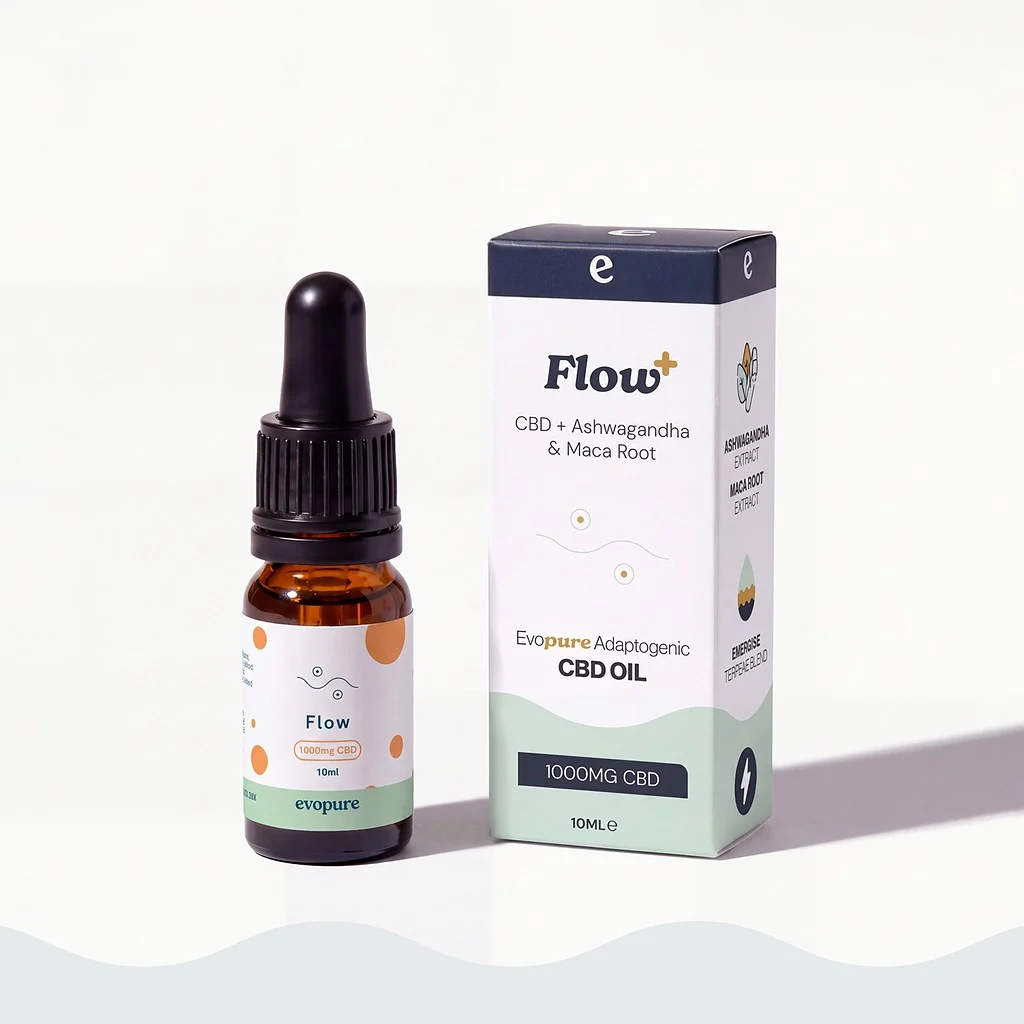
Flow CBD Oil With Ashwagandha & Maca
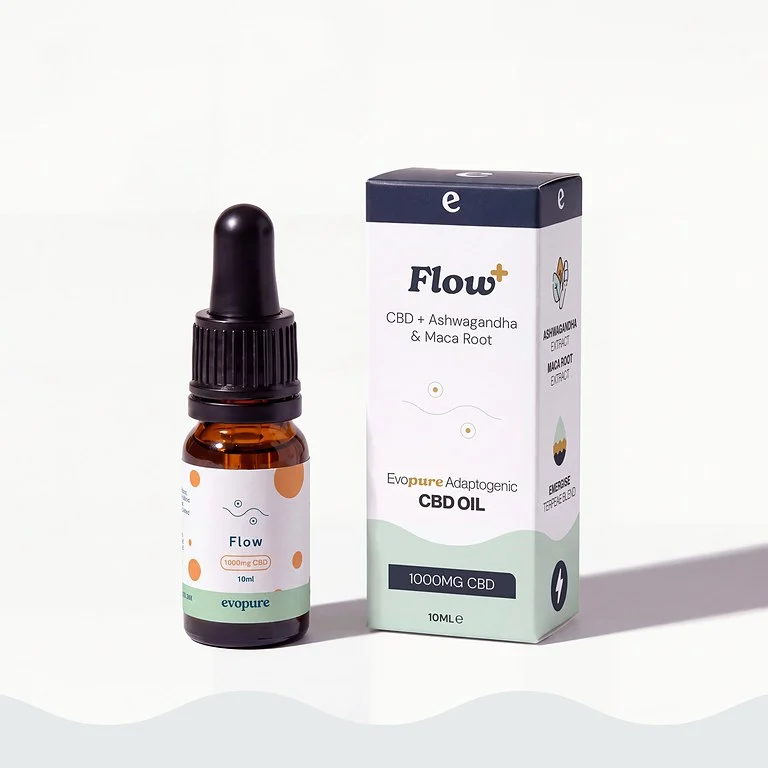
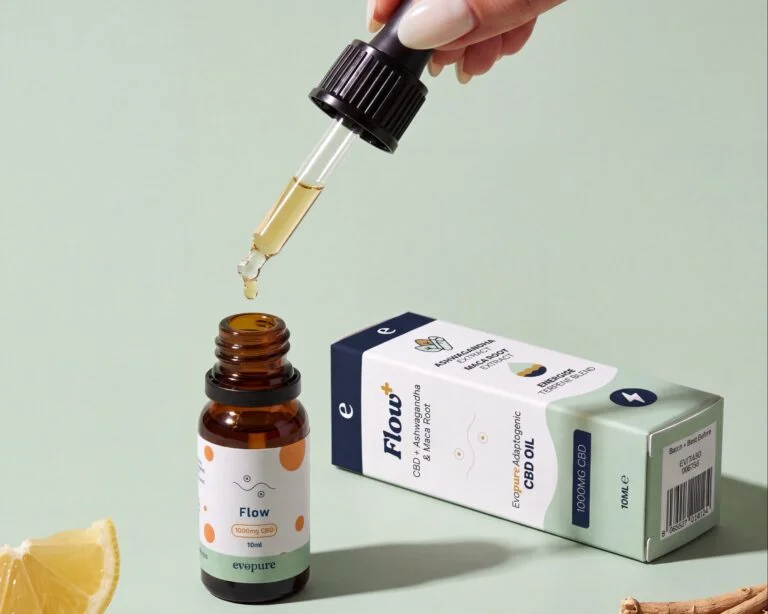
Only with your GP’s, prescriber’s or pharmacist’s OK: Flow CBD Oil is our daytime oil, broad spectrum CBD with 35mg of ashwagandha root extract and 35mg of maca root extract per half pipette. 10mg of CBD is about 0.2ml of the 500mg oil. Not for anyone with a thyroid, liver or autoimmune condition, and don’t add a second ashwagandha supplement.
Add Flow CBD Oil 500mg to bag or choose another strength
The FSA’s 10mg a day figure is precautionary advice rather than a legal limit, set while longer-term safety research continues. At Evopure we think it is a very cautious figure, and many adults use more. If you go above it, increase slowly, and check with your GP or pharmacist first if you take any medication.
Flow contains CBD as well as ashwagandha, so ask about both (see CBD and antidepressants). Broad spectrum with 0% THC, every batch third-party lab tested, on the FSA public list and made in the UK. Adults only. We don’t recommend our products during pregnancy or breastfeeding. Subscribe and save 25% on your first order, then 20%. New to Evopure? Join our emails for 20% off a one-off first order. Free UK delivery over £40.
Subscribe from £22.49One-off from £29.99
View productSources 9
- Siwek M et al. Harder, better, faster, stronger? Retrospective chart review of adverse events of interactions between adaptogens and antidepressant drugs. Front Pharmacol, 2023.
- Hanly-Jorda FM et al. Serotonin syndrome induced by the pharmacological interaction of Withania somnifera and escitalopram: a case report. American Academy of Neurology annual meeting abstract, 2025.
- Jahanbakhsh SP et al. Evaluation of the efficacy of Withania somnifera (ashwagandha) root extract in patients with obsessive-compulsive disorder: a randomized double-blind placebo-controlled trial. Complement Ther Med, 2016.
- NIH Office of Dietary Supplements. Ashwagandha: fact sheet for health professionals.
- NHS. Sertraline.
- NHS. Antidepressants.
- FSA (GOV.UK). Summary of responses to call for evidence on ashwagandha, June 2026.
- COT (GOV.UK). Draft minutes of the 8 September 2026 COT meeting (third draft statement on ashwagandha).
- MHRA. Yellow Card scheme.