Last updated: November 2026
Normal blood pressure for adults is between 90/60mmHg and 120/80mmHg, according to Blood Pressure UK. The NHS counts 140/90 or higher at a clinic, or 135/85 or higher at home, as high. The same numbers apply to men and women at every age, although readings tend to rise as you get older.
Below: a UK chart, readings by age and for men and women, home checks, free checks and how to lower it.
Need help now? Call 999 if you have sudden chest pain that doesn’t go away, chest pain that spreads to your arm, neck, jaw, stomach or back, or chest pain with sweating, feeling sick, light-headedness or breathlessness. See when blood pressure is an emergency.
What is normal blood pressure?
Normal blood pressure is a reading between 90/60mmHg and 120/80mmHg, which Blood Pressure UK calls ideal. A reading from 120/80 up to 140/90 is “high-normal”, 140/90 or more at a clinic suggests high blood pressure, and 90/60 or lower suggests low blood pressure. Only one of the two numbers needs to be outside the range: the top (systolic) number is the pressure as your heart beats, the bottom (diastolic) as it relaxes.
What is a good blood pressure reading?
A good blood pressure reading for most adults is below 120/80mmHg and above 90/60mmHg. If you’re already being treated for high blood pressure, NICE sets the target at below 140/90 in a clinic (below 135/85 at home) if you’re under 80, and below 150/90 (145/85 at home) if you’re 80 or over.

Our pick
Magnesium Glycinate Sleep Complex
No supplement lowers blood pressure, and NICE tells doctors not to offer magnesium for it. If tiredness is part of the picture, Evopure’s Magnesium Glycinate Sleep Complex is a caffeine-free berry evening drink with 290mg of magnesium (77% NRV) per 4.75g serving. Magnesium contributes to a reduction of tiredness and fatigue.
Add Magnesium Glycinate Sleep Complex to bag See ingredients and reviews
If you take blood pressure medicines or any regular medicines, check with your GP or pharmacist first. Subscribe and save 25% on your first order, then 20%. New to Evopure? Join our emails for 20% off a one-off first order. Free UK delivery over £45.
Subscribe £22.49One-off £29.99
View productBlood pressure chart (UK)
This chart combines Blood Pressure UK’s bands with the NHS and NICE thresholds. Home readings are about 5mmHg lower than clinic readings, so the high cut-off at home is 135/85.
| Reading (mmHg) | What it means | What to do |
|---|---|---|
| 90/60 or lower | Low blood pressure | Usually fine if you feel well; see a GP if you keep feeling dizzy or faint |
| 90/60 to 120/80 | Ideal (normal) | Keep up healthy habits; recheck every 5 years from 40 |
| 120/80 to 140/90 | High-normal | Not high yet: a good time to cut salt, move more and drink less |
| 140/90 or higher at a clinic (135/85 at home) | High blood pressure (hypertension) | See a GP or nurse to confirm it with home or 24-hour readings |
| 180/120 or higher | Severe hypertension (NICE) | Rest and recheck; if it stays this high, contact your GP or NHS 111 today. Call 999 with chest pain, breathlessness, confusion or vision changes |
One high reading isn’t a diagnosis: NICE asks doctors to confirm a raised clinic reading with 24-hour or home monitoring first. Low readings? See low blood pressure.
Normal blood pressure by age
Normal blood pressure is the same at every adult age: 90/60 to 120/80mmHg. Blood Pressure UK says the cut-off for high blood pressure doesn’t change with age. What changes is how common high readings are. In the Health Survey for England 2022, untreated high blood pressure rose from 3% of adults aged 16 to 34 to 21% of those aged 75 and over.
The NHS suggests a check at least every 5 years from 40. For older adults, the difference is the treatment target:
| If you’re treated for high blood pressure | Clinic target | Home target |
|---|---|---|
| Under 80 | Below 140/90 | Below 135/85 |
| 80 and over | Below 150/90 | Below 145/85 |
See also sleep as you get older and magnesium for older adults.
Average blood pressure for men and women
The healthy range for men is the same as for women: 90/60 to 120/80mmHg, but men are more likely to run high. The Health Survey for England 2022 found high blood pressure in 34% of men and 27% of women, and the average adult reading in England was about 126/74mmHg in 2021, according to an analysis of the survey published in BMJ Medicine.
- Men: undiagnosed high blood pressure peaked at 19% of men aged 55 to 64. See Movember and men’s health and supplements for men over 40.
- Women: undiagnosed high blood pressure peaked at 20% of women aged 75 and over.
What is a dangerously low blood pressure for a woman?
There is no separate number for women. The NHS calls a reading under 90/60mmHg low, and many women run that low with no problem. It becomes a worry when it comes with dizziness, fainting, blurred vision or confusion. Our low blood pressure guide explains what to do if you feel faint and when to call 999.
What does high blood pressure feel like?
High blood pressure usually doesn’t feel like anything. The NHS says it does not usually cause symptoms, and the only way to know is to have it checked. Rarely it can cause headaches, blurred vision or chest pain. That is why about 1 in 9 adults in England has high blood pressure without knowing it (Health Survey for England 2022).
The NHS lists getting older, a family history, a Black African, Black Caribbean or South Asian background, a salty diet, being overweight, smoking, heavy drinking and long-term stress as things that raise your risk. Palpitations have many causes: see heart palpitations. For headaches, see what your headache location can mean, and for stress, stress symptoms.
How to check your blood pressure at home
To check your blood pressure at home, sit quietly with your back supported and feet flat, rest your arm on a table, and use an upper arm monitor. Take 2 readings at least 1 minute apart, morning and evening. NICE uses 4 to 7 days of these readings, ignoring day one, to confirm high blood pressure.
| Step | What to do |
|---|---|
| Position | Relax first; back against the chair, feet flat, arm resting on a table, no thick sleeve |
| Cuff | On the bare upper arm, snug enough that 2 fingers fit underneath |
| During | Stay still and don’t talk while the cuff inflates |
| Repeat | Take a second reading 1 to 2 minutes later; take a third if they differ a lot |
| Record | Write down both numbers, the date and time, for your GP or nurse |
Blood pressure monitors for home use: what to look for
The British Heart Foundation advises an upper arm monitor rather than a wrist one, checked against the British and Irish Hypertension Society (BIHS) validated list or the STRIDE BP list. Pick the right cuff size for your arm, since most come with a medium cuff. Monitors are sold in most pharmacies and larger supermarkets, and the BHF suggests servicing them at least every 2 years.
Where can I get a free blood pressure check?
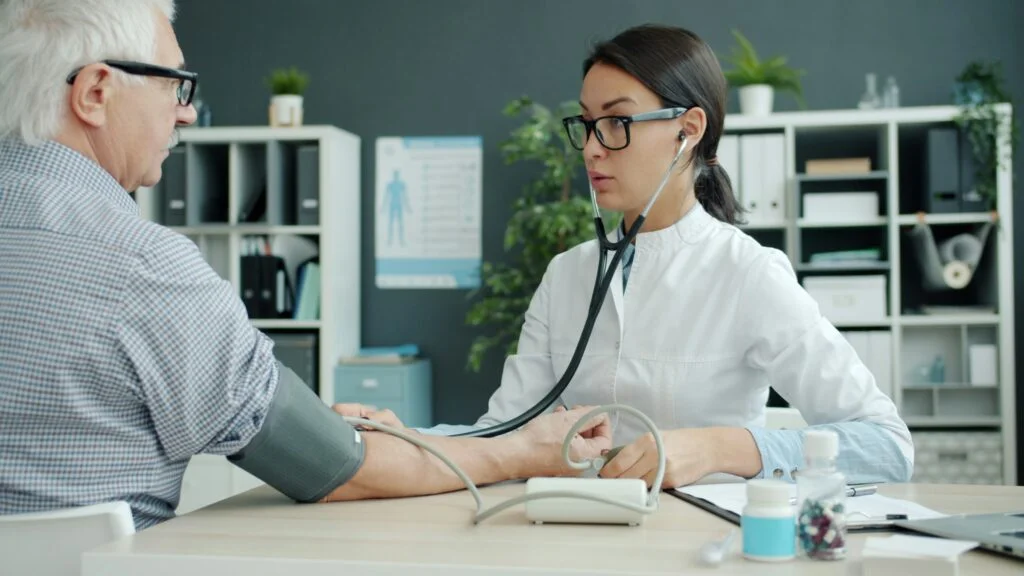
iMany pharmacies offer a free blood pressure check if you’re 40 or over, the NHS says. You can also get a check at your GP surgery, and the NHS Health Check, offered every 5 years to adults aged 40 to 74 without certain conditions, includes a blood pressure test.
The NHS website has a pharmacy finder, and some workplaces offer checks too.
How to lower your blood pressure
The NHS says you can lower your blood pressure by eating less salt, being active for at least 150 minutes a week, keeping to 14 units of alcohol a week or less, cutting down on caffeine, losing weight if you need to and stopping smoking. Adults should have no more than 6g of salt a day, about 1 level teaspoon.
- Salt: much of it is already in everyday foods, ready meals and takeaways, so check labels.
- Move more: brisk walking counts. See how many steps a day you really need and Japanese walking.
- Alcohol: drinking less helps blood pressure and sleep: see alcohol and sleep.
- Caffeine: NICE asks doctors to discourage heavy coffee and caffeine intake. See how long caffeine lasts.
- Sleep and snoring: loud snoring with pauses in breathing can be sleep apnoea, which the NHS says can lead to high blood pressure. See sleep apnoea.
- Salt substitutes: NICE warns that potassium-based salt substitutes are not suitable for older people, people with diabetes or kidney disease, or people on some blood pressure medicines, such as ACE inhibitors.
iIf you’re prescribed blood pressure tablets, don’t stop them without your GP, and mention side effects (see do beta blockers make you tired?). Beetroot juice, garlic and dark chocolate are often promoted for blood pressure, but none replaces treatment.
Can magnesium lower blood pressure?
Magnesium isn’t a way to lower blood pressure in the UK. NICE’s hypertension guideline (NG136) tells doctors not to offer calcium, magnesium or potassium supplements to reduce blood pressure, and there is no authorised GB health claim linking magnesium to blood pressure. Read more in magnesium taurate and heart health claims.
When is blood pressure an emergency?
Call 999 if you have:
- sudden chest pain that doesn’t go away
- chest pain that spreads to your arm, neck, jaw, stomach or back
- chest pain with sweating, feeling sick, light-headedness or shortness of breath
- a face drooping on one side, weakness in one arm or slurred speech (possible stroke)
Do not drive yourself to A&E.
Contact NHS 111 if you often get headaches or blurred vision, have chest pain that comes and goes, or have a home reading of 180/120 or higher that stays high after resting (NHS, NICE).
Where our products fit (honestly)
None of our products lowers blood pressure or replaces blood pressure medicines. The Magnesium Glycinate Sleep Complex (290mg magnesium per 4.75g, plus glycine and L-theanine) and the Reishi Mushroom Adaptogenic Complex (0.5g reishi, 0.5g maca and 0.3g cinnamon per 8g; a little natural caffeine from the cocoa) can sit alongside a calmer evening: see reishi cacao instead of alcohol.
iIf you take blood pressure medicines or any regular medicines, check with your GP or pharmacist first; magnesium isn’t suitable for everyone, for example with kidney disease. We don’t recommend our products during pregnancy or breastfeeding. Adults only.
Next step
Get your blood pressure checked if it’s been 5 years, cut back on salt and move a little more each day. For your evenings, the Magnesium Glycinate Sleep Complex gives 290mg of magnesium per 4.75g, or swap a nightcap for the Reishi Cacao (a little natural caffeine from the cocoa).
Add Magnesium Glycinate Sleep Complex to bag Add Reishi Cacao to bag
Check with your GP or pharmacist first if you take blood pressure medicines. Subscribe and save 25% on your first order, then 20%. New to Evopure? Join our emails for 20% off a one-off first order. Free UK delivery over £45.
Sources 10
- NHS. High blood pressure (reviewed 19 July 2024).
- NHS. Blood pressure test (reviewed 25 November 2025).
- NHS. Low blood pressure (hypotension).
- NHS. NHS Health Check.
- NHS. Salt in your diet.
- Blood Pressure UK. What do the numbers mean?
- NICE. Hypertension in adults: diagnosis and management (NG136).
- British Heart Foundation. How to measure your blood pressure at home.
- NHS England. Health Survey for England 2022, Part 2: Adults’ health.
- Graham C, et al. Trends in hypertension prevalence, control, and antihypertensive use in England from 2003 to 2021. BMJ Medicine, 2025. PMID 41333849.
iThis guide is general information, not medical advice. If you’re worried about your blood pressure, speak to a GP, nurse or pharmacist. Evopure makes the Magnesium Glycinate Sleep Complex and the Reishi Mushroom Adaptogenic Complex.