
Last updated: October 2026
Saffron is the dried red stigma of the Crocus sativus flower. Small trials using about 30mg of saffron extract a day suggest it may help with low mood, sleep quality and PMS symptoms, with early findings for eye health. The research is promising but limited, saffron is not a treatment for depression, and large doses are unsafe.
Below: what saffron is, an honest table of what the studies show, the doses researchers used versus cooking amounts, how to avoid fake saffron, how it compares with St John’s wort and 5-HTP, and who should avoid saffron supplements.
If you’re struggling with your mood: saffron is not a substitute for proper support. Please speak to your GP, and never stop or change prescribed antidepressants without talking to your doctor first. Adults in England can refer themselves to NHS Talking Therapies. If you feel unable to cope or have thoughts of harming yourself, call Samaritans free on 116 123 (any time, day or night), NHS 111, or 999 in an emergency.
What is saffron?
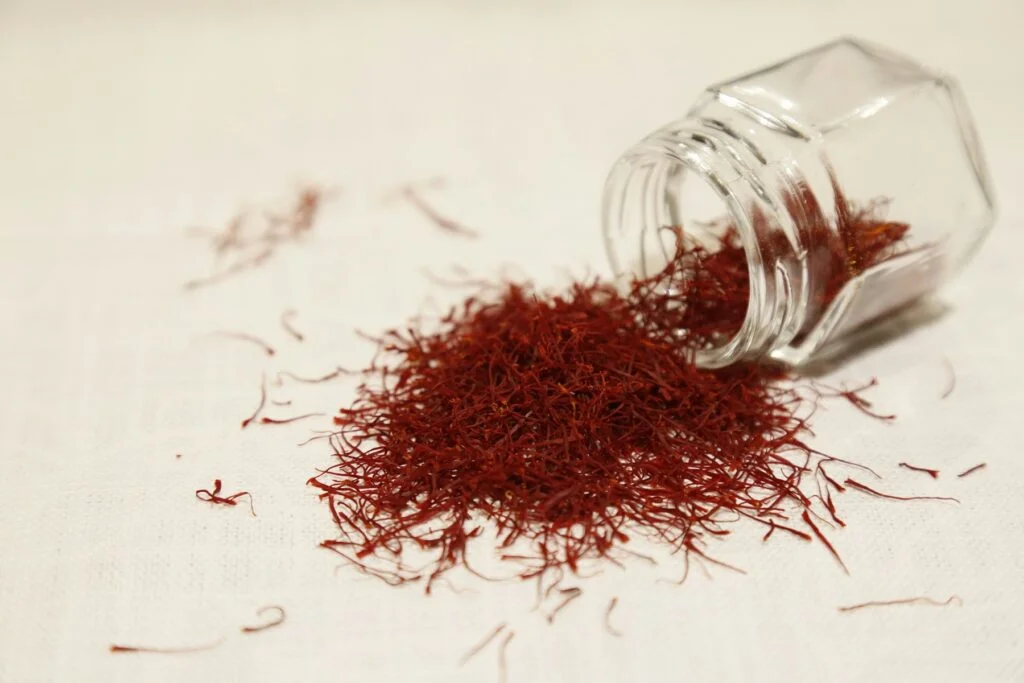
Saffron comes from the saffron crocus, Crocus sativus, grown in countries such as Iran, Spain and India. The spice is only the flower’s dried red stigmas, the thin threads at its centre, which is why it takes so many flowers to make a small amount and why saffron is often called the world’s most valuable spice.
Three natural compounds give saffron its character and are the focus of most research:
- Crocin: the pigment behind saffron’s golden colour, and the usual measure of grade.
- Safranal: the main source of its distinctive aroma.
- Picrocrocin: responsible for its slightly bitter taste.
Supplements use concentrated saffron extracts standardised to these compounds, which is very different from the few threads you add to a paella or risotto.
Saffron benefits: what the evidence shows
An honest summary. Most trials are small, short (often 6 to 12 weeks) and many come from Iran, which limits how far the results apply to everyone.
| Claim | What the studies found | Our verdict |
|---|---|---|
| Low mood and mild to moderate depression | Two 2019 meta-analyses found saffron extract beat placebo, and performed similarly to some antidepressants in head-to-head trials | Promising, but small trials and signs of publication bias |
| Anxiety symptoms | Improvements versus placebo in the same 2019 review, from fewer trials | Early |
| Sleep quality | Two 28-day Australian trials in adults with poor sleep found better self-rated sleep | Promising, short and industry-funded |
| PMS | Lower PMS symptom scores versus placebo over two cycles; a 2025 meta-analysis agreed | Promising, small trials |
| Period pain | A smaller effect in the same meta-analysis | Uncertain |
| Eyes (age-related macular degeneration) | Small improvements in eye tests in one 100-person trial and its follow-up | Modest and early |
| Appetite and snacking | One 8-week trial in 60 women found less snacking | Weak |
| Sexual function | A review of six small trials found better erectile function scores | Weak, mixed quality |
| Blood sugar, cholesterol, blood pressure | Small changes in an overview of 19 meta-analyses, most of low quality | Uncertain |
A 2021 overview of saffron meta-analyses concluded that larger, better trials in more countries are needed before firm conclusions can be drawn.
Saffron for mood, depression and anxiety
This is where most saffron research sits. A 2019 meta-analysis of 23 randomised trials reported large improvements in depression and anxiety scores with saffron compared with placebo. A second 2019 analysis, limited to mild to moderate depression, found saffron more effective than placebo and not clearly worse than the antidepressants it was compared with.
The catches matter. Both reviews flagged small, short trials, and the authors of the larger review found evidence of publication bias and a lack of regional diversity. In 2025, the largest trial so far (202 Australian adults with low mood, 28mg a day for 12 weeks) found a modest benefit on its main depression score, with a large placebo response and no difference on most other measures. It was funded by the extract’s maker.
So saffron is an interesting area of research, not a treatment for depression. If low mood has lasted more than two weeks, read low mood vs depression and talk to your GP. For everyday foundations, see food and mood and how to boost serotonin naturally, and for other herbs, our guide to natural supplements for anxiety.
Saffron for sleep
Two Australian trials tested a saffron extract in adults with poor sleep. In the first (63 adults, 14mg twice a day for 28 days), sleep scores improved more than with placebo. In the second (120 adults, 14mg or 28mg an hour before bed), sleep quality ratings and mood on waking improved and evening melatonin rose, though most other sleep measures didn’t change.
Both trials were short, relied on questionnaires and were funded by the extract’s maker. Good sleep habits come first; see natural sleep aids that actually work.
Saffron for PMS and period pain
A 2008 trial of women aged 20 to 45 used 15mg of saffron twice a day for two menstrual cycles and found lower PMS symptom and depression scores than placebo. A 2025 meta-analysis of randomised trials reported a moderate effect on PMS symptoms and a smaller, borderline effect on period pain.
The trials were small and mostly from one region, so treat this as early evidence. See PMS symptoms, magnesium for PMS and insomnia before your period. If you feel very low before your period, read our guide to PMDD and speak to your GP.
Saffron for your eyes
The eye research is about age-related macular degeneration (AMD), a common cause of central vision loss in older adults. In a 2019 trial, 100 adults over 50 with mild to moderate AMD took 20mg of saffron a day for three months. Vision improved by less than one letter on an eye chart on average, a very small change. A 12-month follow-up found some improvement in retinal function tests but no gain in sharpness of vision.
Saffron is not a treatment for AMD, and the trials weren’t about everyday problems such as dry eyes. Any change in your central vision needs an optician or GP promptly.
Appetite, libido and ADHD
- Appetite: one French trial in 60 mildly overweight women found fewer snacking episodes and more weight loss than placebo over 8 weeks. One small study isn’t enough to rely on; see sugar cravings.
- Libido and sexual function: a 2018 review of six small trials found better erectile function scores with saffron, but no consistent effect on sperm, and the authors called the trials flawed and varied.
- ADHD: the best-known study is a 6-week pilot in 54 children that found saffron and methylphenidate performed similarly. That is far too small and short to change care. Never give a supplement to a child, or swap ADHD medication, without the child’s doctor.
How much saffron? Supplements vs cooking
Most mood, sleep and PMS trials used about 28 to 30mg of standardised saffron extract a day, often split into 15mg morning and evening. The sleep trials gave it an hour before bed, and the eye trials used 20mg a day.
| Saffron in cooking | Saffron supplements | |
|---|---|---|
| What it is | Whole dried threads or powder | Concentrated extract, standardised to crocin or safranal |
| Typical amount | A pinch shared across a dish; a 2026 safety review puts usual food intake below 30mg a day | 20 to 30mg of extract a day in most trials |
| Studied for mood, sleep or PMS? | No | Yes, in small trials |
| Safety | Long history of safe use in food | Generally well tolerated short term; some people should avoid it (see below) |
Saffron tea made from a few threads is pleasant, but it hasn’t been tested in trials and its strength varies. There are no authorised health claims for saffron on the Great Britain nutrition and health claims register (we checked in October 2026), so be wary of products promising to lift your mood.
Cost and fake saffron
Because saffron is so expensive, it is one of the most faked foods. A 2025 systematic review estimated that 20 to 30% of commercial saffron worldwide is adulterated, with much lower rates in regulated EU markets. Common tricks include swapping in safflower, marigold or turmeric, bulking with other plant material, and adding synthetic dyes.
It happens in the UK too. In 2025 the Food Standards Agency’s National Food Crime Unit issued an alert to industry about dye-adulterated saffron on the UK market. A few practical tips:
- Buy from a reputable retailer and be wary of prices that look too good to be true.
- Whole threads are harder to fake than powder.
- For supplements, look for a stated amount of saffron extract per capsule and a company that will share its lab testing.
Saffron vs St John’s wort and 5-HTP
People researching saffron for mood often look at these too. All three can interact with medicines, so none should be added to an antidepressant without your doctor’s agreement.
| Saffron | St John’s wort | 5-HTP | |
|---|---|---|---|
| What it is | Crocus flower stigma extract | Herbal remedy from Hypericum perforatum | Compound extracted from Griffonia seeds |
| Evidence for mood | Small, short trials | Widely used for mild to moderate depression | Weak, mostly older trials |
| Main interaction concerns | Blood thinners, blood pressure medicines | Antidepressants and other medicines; the NHS says not to use it with sertraline | Antidepressants and other serotonin-raising medicines |
For more detail, see our guides to 5-HTP and tryptophan.
Saffron side effects and who should avoid it
A 2026 review of 102 clinical trials found saffron generally well tolerated at usual doses, with side effects in roughly 17.5% of people taking it, mostly mild stomach upsets. Others reported in trials include dry mouth, nausea, dizziness, headache, changes in appetite, restlessness and anxiety.
Large amounts are dangerous. Doses measured in grams rather than milligrams are a different matter: 1.2 to 2 grams has been linked with nausea, vomiting, diarrhoea and bleeding, and 12 to 20 grams can be fatal. Never take more than the label says.
Avoid saffron supplements, or check with your GP or pharmacist first, if you:
- Are pregnant or breastfeeding. High amounts may make the womb contract, and exposure to large amounts has been linked with a higher miscarriage rate. Normal cooking amounts are a different matter, but skip supplements. We don’t recommend our products during pregnancy or breastfeeding.
- Have bipolar disorder. Hypomania was reported in several trials, and there is concern that saffron might trigger excitability or mania in people with bipolar disorder.
- Take blood thinners or antiplatelet medicines, such as warfarin, apixaban, rivaroxaban or clopidogrel. An acute bleeding episode was reported in a man taking rivaroxaban with a saffron supplement.
- Take blood pressure medicines or have low blood pressure, as saffron might lower it further.
- Take antidepressants or any other mental health medicine. Don’t add saffron without your doctor’s agreement, and never stop an antidepressant suddenly.
- Are older and take several medicines, or are buying for a child.
If you take any medicine at all, a pharmacist can check interactions for free. If your mood dips as the days shorten, see seasonal affective disorder.
A different approach for your evenings
Evopure doesn’t sell saffron. If you’re building a calmer evening routine, our Magnesium Glycinate Sleep Complex is a berry-flavoured drink with magnesium bisglycinate and citrate (148mg magnesium per serving), plus glycine, L-theanine, chamomile, passionflower, hops and oat straw. Magnesium contributes to normal psychological function and the normal functioning of the nervous system.
It isn’t a substitute for any medicine. If you take an antidepressant or other prescribed medicine, check with your GP or pharmacist before adding any supplement, including ours.
When to get help
See your GP if you’ve felt low or lost interest in things for more than two weeks, if mood, sleep or PMS is affecting daily life, or if you notice changes in your central vision. Adults in England can refer themselves to NHS Talking Therapies. If you feel unable to cope or have thoughts of harming yourself, call Samaritans free on 116 123, NHS 111, or 999 in an emergency.
FAQs
What are the main benefits of saffron?
Small trials suggest saffron extract may support low mood, sleep quality and PMS symptoms, with early research on eye health in macular degeneration. Most studies are small and short, and there are no authorised health claims for saffron in Great Britain.
Is saffron good for anxiety and depression?
Research on mild to moderate depression and anxiety symptoms is promising but limited by small, short trials. Saffron is not a treatment for depression. If your mood has been low for more than two weeks, speak to your GP.
How much saffron should I take a day?
Most trials used about 28 to 30mg of standardised saffron extract a day, often split into two doses. Never take more than the label says, as large amounts are unsafe.
Can I take saffron with antidepressants?
Only if your doctor agrees. Saffron affects mood and may interact with some medicines, including blood thinners and blood pressure medicines. Never stop or change an antidepressant without talking to your doctor.
Is saffron safe in pregnancy?
Normal cooking amounts are a different matter from supplements. Large amounts may make the womb contract, so avoid saffron supplements while pregnant or breastfeeding and ask your midwife or GP if you’re unsure.
Does saffron help you sleep?
Two short Australian trials in adults with poor sleep found better self-rated sleep quality with 14 to 28mg of saffron extract a day. Larger, longer studies are needed.
What are the side effects of saffron?
Usually mild: stomach upset, dry mouth, nausea, dizziness, headache and changes in appetite. Hypomania has been reported, and very large amounts can be toxic.
Sources
- Marx W et al (2019). Effect of saffron supplementation on symptoms of depression and anxiety: a systematic review and meta-analysis. Nutrition Reviews.
- Tóth B et al (2019). The efficacy of saffron in the treatment of mild to moderate depression: a meta-analysis. Planta Medica.
- Hasheminasab FS et al (2026). Adverse events of saffron (Crocus sativus L.): systematic review of current evidence. Health Science Reports.
- Food Standards Agency. National Food Crime Unit annual update (2025 alert on dye-adulterated saffron).
- NHS. Depression in adults and Antidepressants.
- Department of Health and Social Care. Great Britain nutrition and health claims (NHC) register.
Other studies mentioned (PubMed IDs): Lopresti AL et al, Journal of Clinical Sleep Medicine 2020 (32056539); Lopresti AL et al, Sleep Medicine 2021 (34438361); Lopresti AL et al, Journal of Nutrition 2025 (40414301); Agha-Hosseini M et al, BJOG 2008 (18271889); Mohammadi MM and Karimi Z, Korean Journal of Family Medicine 2025 (41151539); Broadhead GK et al, Graefe’s Archive for Clinical and Experimental Ophthalmology 2019 (30343354); Broadhead GK et al, BMJ Open Ophthalmology 2024 (38485112); Gout B et al, Nutrition Research 2010 (20579522); Maleki-Saghooni N et al, Avicenna Journal of Phytomedicine 2018 (29881706); Baziar S et al, Journal of Child and Adolescent Psychopharmacology 2019 (30741567); Lu C et al, Phytomedicine 2021 (34419735); Bostan HB et al, Iranian Journal of Basic Medical Sciences 2017 (28293386); Mehdizadeh M et al, Critical Reviews in Food Science and Nutrition 2025 (40792566). Also: NHS, Taking sertraline with other medicines and herbal supplements; RxList, Saffron (precautions and interactions).
This guide is general information, not medical advice. Evopure makes the Magnesium Glycinate Sleep Complex.