Last updated: 9 November 2026
Ashwagandha gummies are chewable food supplements containing an ashwagandha root extract, often KSM-66, in a sweet pectin or gelatine base. The UK gummies we checked give 75mg to 150mg of extract per gummy, usually two a day, which is below the 300mg to 600mg a day used in most trials. Ashwagandha’s safety is under review in the UK.
Gummies, liquid tinctures, capsules and powder all contain the same root, but they differ in how much extract you get, how accurately you can dose, and what else comes with it: sugar in gummies, alcohol in many tinctures. No form is proven to absorb better. Below: dose per gummy, a side-by-side comparison, label tips and who should avoid ashwagandha in any form.
How much ashwagandha is in a gummy?
Most ashwagandha gummies sold in the UK contain 75mg to 150mg of root extract each, and the label usually says to take two a day. That gives 150mg to 300mg a day, compared with 600mg a day (300mg twice a day) in most KSM-66 trials. Check the mg of extract, not an “equivalent” figure.
| Product (brand’s own site) | Extract per gummy | Label daily serving | Also in it |
|---|---|---|---|
| Trip Cherry Ashwagandha and Vitamin D Gummies | 150mg KSM-66 | 2 gummies (300mg) | 3.5g sugar per 2 gummies; vitamins D2, B6, B12 |
| Wild Nutrition KSM-66 Ashwagandha Gummies | 100mg KSM-66 | Adults and over-12s: up to 6 a day | Fruit-based, no refined sugar, vegan |
| Novomins KSM-66 Ashwagandha Gummies | 75mg KSM-66 (10:1 extract) | 2 gummies (150mg) | Sugar-free; vitamins B5, B6, D |
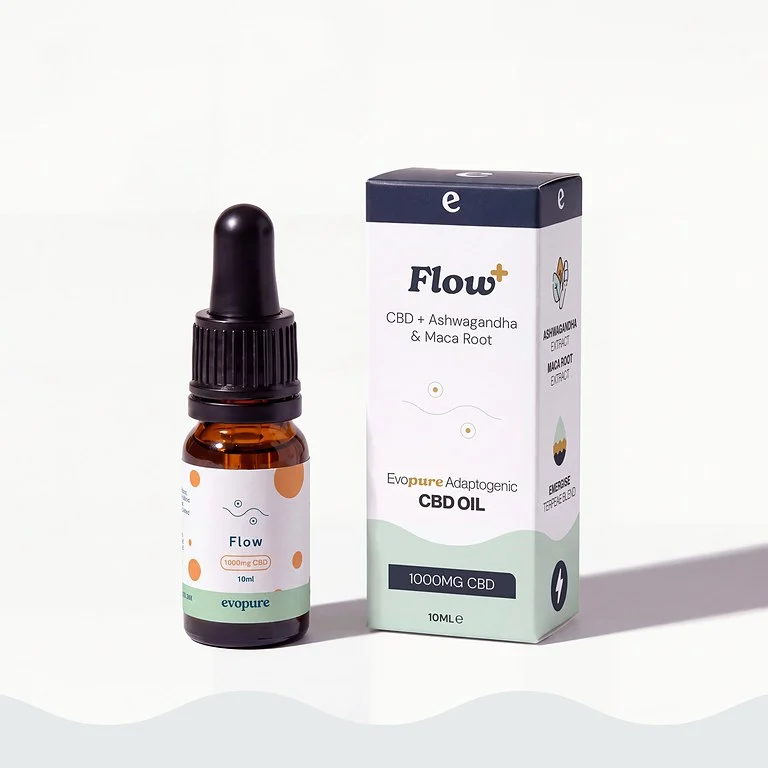
| Evopure Flow CBD Oil (an oil, not a gummy) | 35mg ashwagandha root extract per half pipette | Follow the label | Broad spectrum CBD, maca, MCT oil |
| KSM-66 trials, for comparison | 300mg capsule | Twice a day (600mg) | Capsules, 8 to 10 weeks |
Gummy figures are from each brand’s own website, checked 9 November 2026; labels change, so check the pack you buy. A 10:1 extract means about 10mg of dried root went into each 1mg of extract, which is how a 150mg serving becomes “1,500mg”. Added vitamins count towards your daily total if you also take a multivitamin. For high-street gummies, see ashwagandha at Boots, Superdrug, Tesco and Asda and Holland and Barrett ashwagandha.
Ashwagandha forms compared
| Form | Dose accuracy | Watch for | Suits |
|---|---|---|---|
| Gummies | Fixed per gummy, often low | Sugar or sweeteners, added vitamins | People who won’t take pills |
| Tincture or drops | Rough: drops and ratios | Alcohol base, bitter taste | People who prefer a liquid |
| Capsules or tablets | Best: mg per capsule | Gelatine shells, mega doses | Matching trial doses |
| Powder | Poor: scoops and spoons | Root powder is much weaker | Traditional milk drinks |
The form matters less than what’s inside it. The trials behind most ashwagandha research used a measured amount of a standardised root extract, usually 300 to 600mg a day, taken for about two months. The closer a product gets to that, the more the research applies to it. Our complete ashwagandha guide covers what those trials found.
Our pick
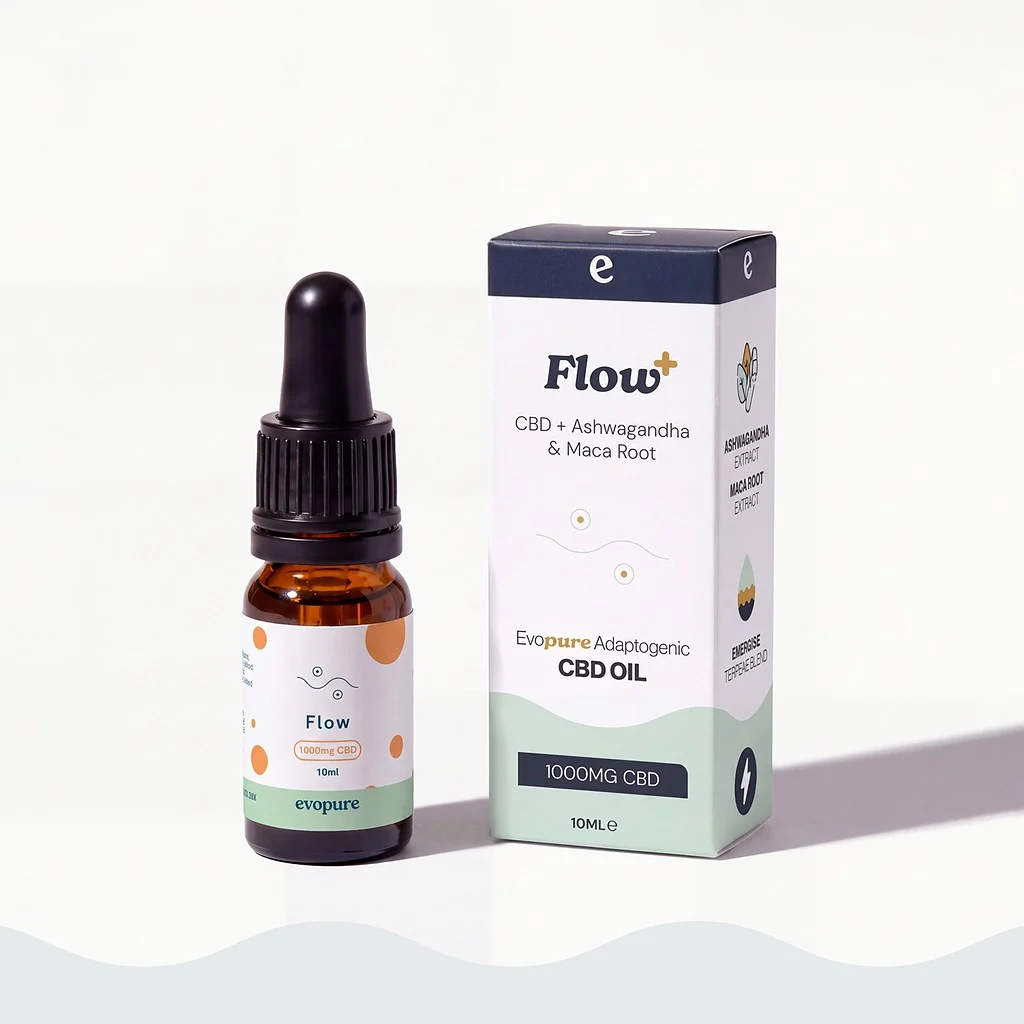
Flow CBD Oil With Ashwagandha & Maca
Flow CBD Oil is broad spectrum CBD with 35mg ashwagandha root extract and 35mg maca root extract per half pipette, for a daytime routine. About 0.2ml of the 500mg gives 10mg CBD. Not for anyone with a thyroid, liver or autoimmune condition.
Add Flow CBD Oil 500mg to bag or choose another strength
Broad spectrum with 0% THC, every batch third-party lab tested, made in the UK. For adults only. We don’t recommend our products during pregnancy or breastfeeding. Subscribe and save 25% on your first order, then 20%. New to Evopure? Join our emails for 20% off a one-off first order. Free UK delivery over £40.
Subscribe from £22.49One-off from £29.99
View productWhich form should you choose?
- You want what the studies used: a capsule of a named extract such as KSM-66, with the milligrams per capsule on the label.
- You can’t swallow pills: gummies or drops. Check the extract amount per serving, not the headline number on the front.
- You avoid alcohol: choose an alcohol-free glycerin tincture, or an oil-based blend.
- You want to cut sugar: skip sugared gummies.
- You like a warm drink: powder works, but plain root powder needs far more by weight than an extract.
Whichever you pick, use one ashwagandha product at a time. Our guides to how much ashwagandha per day and when to take ashwagandha cover dose and timing.
A liquid option: ashwagandha in a CBD oil
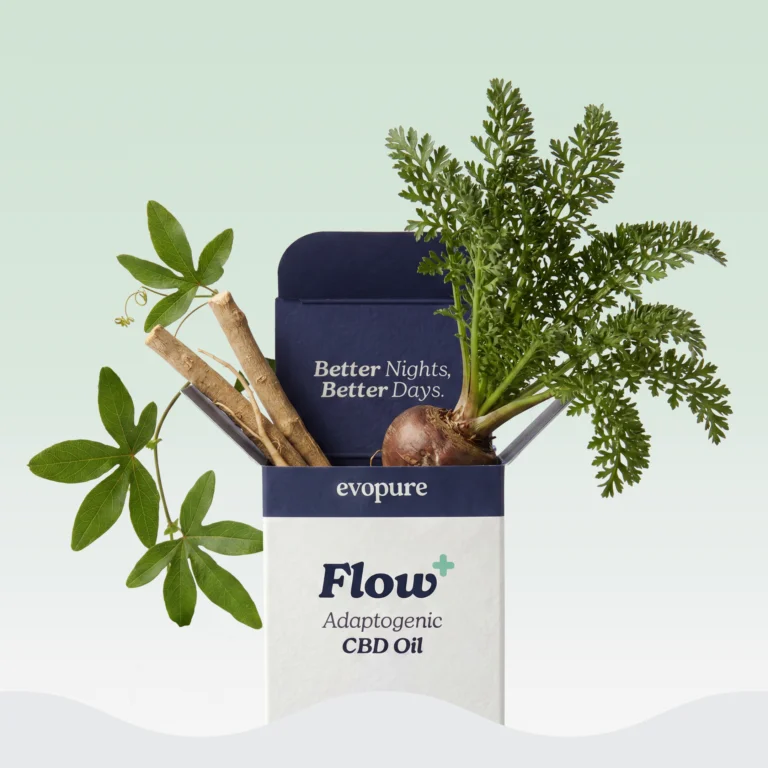
Our Flow CBD Oil with Ashwagandha and Maca is a liquid form: broad spectrum CBD with ashwagandha extract and maca root extract in coconut MCT oil, plus a citrus terpene blend that gives it a honey and lemon taste. If you’re weighing up CBD too, our guide to the best CBD oils for stress sets out what to check before you buy. We make the ashwagandha extract in-house from the whole root, and each half pipette has 35mg of ashwagandha root extract. For CBD, about 0.2ml of the 500mg gives 10mg. It’s alcohol-free, vegan and made in the UK. Flow is a CBD oil with ashwagandha rather than a high-dose ashwagandha supplement, so if your aim is to copy a trial dose, a capsule of a named extract is the closer match. See CBD and ashwagandha together for how the two combine.
The FSA’s 10mg a day figure is precautionary advice rather than a legal limit, set while longer-term safety research continues. At Evopure we think it is a very cautious figure, and many adults use more. If you go above it, increase slowly, and check with your GP or pharmacist first if you take any medication.
If you’d rather not take ashwagandha, our Magnesium Glycinate Sleep Complex contains none. It’s a berry drink powder with magnesium bisglycinate and citrate (290mg magnesium per serving) plus glycine, L-theanine, chamomile, passionflower, hops and oat straw. Magnesium contributes to a reduction of tiredness and fatigue and to normal psychological function. Our Reishi Mushroom Adaptogenic Complex is a reishi hot chocolate with cocoa and maca; it contains a little natural caffeine from the cacao. All our products are for adults (18+). We don’t recommend our products during pregnancy or breastfeeding.
Ashwagandha gummies: do they work?
No trial has tested ashwagandha gummies, so whether one works depends on whether it holds a meaningful amount of a decent extract. When we checked the UK shelf in October 2026, headline amounts ranged from about 500mg to 3,000mg per serving, and some pages didn’t say whether that was extract or an “equivalent” weight of dried root (see our Holland and Barrett ashwagandha check).
- Sugar. Sugared gummies count towards the NHS limit of 30g of free sugars a day for adults. Check the sugars line on the label.
- Sweeteners. Sugar-free gummies often use polyols such as maltitol. UK labels must warn that “excessive consumption may produce laxative effects” when a food contains more than 10% added polyols.
- Added nutrients. Many add vitamins, and some add iodine. If you take a multivitamin or have a thyroid condition, add up the totals.
- They taste like sweets, so keep them out of children’s reach.
The same questions apply to mushroom gummies and CBD gummies vs oil.
Liquid ashwagandha and tinctures
Liquid ashwagandha covers tinctures (root steeped in alcohol and water), glycerites (glycerin instead of alcohol) and oil-based blends. Liquids haven’t been tested in clinical trials either.
- Ratios aren’t milligrams. A label such as 1:2 or 1:5 tells you how much dried root went into the liquid, not how much ashwagandha is in each dose. Look for an amount per ml or per serving.
- Alcohol. Traditional tinctures use alcohol. A dose holds very little, but if you avoid alcohol for health, faith or recovery reasons, choose a glycerin or oil-based product.
- Mother tincture. This is a term from homeopathy, and these products aren’t standardised like the extracts in research.
- Taste. Ashwagandha is earthy and bitter, so many people add drops to a drink.
Drops are less precise than capsules, so start low and don’t exceed the label.
Ashwagandha capsules and tablets
Capsules are the form most trials used. In one widely cited study, adults took a 300mg capsule of root extract twice a day for 60 days. A capsule gives a fixed dose with no taste or sugar, the easiest way to follow a researched amount.
Two things to check: the shell (gelatine is animal-derived; HPMC is vegetarian) and the strength. Very high “2,000mg” or “3,000mg” figures are often root-equivalent numbers, not extract. For brand checks, see Vitabiotics, Wild Nutrition and Home Bargains ashwagandha (October 2026).
Ashwagandha powder
Powder comes in two kinds. Plain root powder (sometimes sold as churna) is dried, ground root; it’s the traditional form, often stirred into warm milk, but it’s far less concentrated than an extract, so a teaspoon isn’t comparable to a 300mg extract capsule. Extract powders, including KSM-66 powder, are concentrated but dosed by tiny scoops.
Powder is cheap and easy to add to drinks, but it’s the hardest form to dose accurately.
Which form absorbs best?
There’s no good evidence that any one form absorbs better. We found no study comparing the forms head to head. Claims that tinctures “bypass digestion” come from sellers, not trials.
What small studies do show is that the extract matters. In a 2025 crossover study of 16 adults, four extracts each delivering 185mg of withanolides produced very different blood levels, depending on how the extract was made. A second 2025 study found similar differences between branded extracts. Both were small, single-dose studies, and one was run with an extract maker, so treat them as early signals. The practical point: a named, standardised extract is a better guide than the format.
How to read an ashwagandha label
- Extract or root? “Root extract” is concentrated; “root powder” isn’t. Root is what most trials used rather than leaf.
- Milligrams per serving of the extract itself, not “equivalent to”.
- Withanolides: often given as a percentage, such as 5%. This shows the extract is standardised.
- Branded extract name (KSM-66, Shoden, Sensoril), which lets you compare with that extract’s research.
- Other ingredients: sugar, polyols, alcohol, added vitamins or iodine.
- Testing: a reputable brand can share third-party lab results. Our guide to reading lab reports explains what they show.
UK safety and who should avoid it
Ashwagandha is legal in the UK as a food supplement, but the Food Standards Agency (FSA) is reviewing its safety. In June 2026 the FSA published a summary of responses to its call for evidence and said its Committee on Toxicity (COT) would carry out a risk assessment, with the outcome to be published. The FSA said earlier reviews had linked ashwagandha with effects on thyroid hormone levels, low blood sugar and possible liver toxicity. The COT discussed a second draft statement in May 2026 and a third in September 2026; it wasn’t on the October 2026 agenda, and no statement had been published by 9 November 2026. Ashwagandha has no authorised health claims in Great Britain. Meanwhile, the FSA told Which? it would advise people with pre-existing liver conditions and pregnant women to avoid ashwagandha supplements.
iThese cautions apply to every form, gummies and drops included. Avoid ashwagandha, or speak to your GP first, if you:
- are pregnant, trying to conceive or breastfeeding
- have a liver condition, or have had liver problems
- have a thyroid condition or take thyroid medicine
- have an autoimmune condition
- take sedatives, sleeping tablets, or medicines for diabetes, blood pressure or the immune system
- are under 18
Rare cases of liver injury have been reported, with symptoms such as yellow skin or eyes, itching, nausea and tiredness. Stop and see a GP if you notice them. If you take any medication, check with your GP or pharmacist. More detail in our UK safety review and ashwagandha side effects guide.
Related guides
- Some gummies combine the two; our guide to taking ashwagandha and magnesium together explains how to avoid doubling up.
- Gummies aren’t faster: see how quickly ashwagandha works in the trials.
- Wondering whether any form works for worry? See does ashwagandha help with anxiety for what the trials found and what isn’t known.
- For the gummies sold on the high street, see Superdrug, Boots and Asda ashwagandha gummies and how much extract each gives.
- Can ashwagandha cause weight gain?
- Gummy vitamins vs pills for the same question across all supplements.
- Sleeping gummies: what UK night-time gummies contain and whether they work.

Next step
If you’d rather not take ashwagandha, our Magnesium Glycinate Sleep Complex contains none: a berry drink with 290mg magnesium (77% NRV) per 4.75g serving. Magnesium contributes to normal psychological function and to a reduction of tiredness and fatigue.
Add Magnesium Sleep Complex to bag See ingredients and reviews
Want ashwagandha in a drop instead of a gummy? Flow CBD Oil has 35mg ashwagandha root extract per half pipette; about 0.2ml of the 500mg gives 10mg CBD. Add Flow CBD Oil 500mg to bag.
Subscribe and save 25% on your first order, then 20%. New to Evopure? Join our emails for 20% off a one-off first order. Free UK delivery over £40. Adults only. If you take any regular medicines, check with your GP or pharmacist first. We don’t recommend our products during pregnancy or breastfeeding.
Sources 12
- FSA. Summary of responses to call for evidence on ashwagandha, 25 June 2026.
- COT. Draft minutes of the 8 September 2026 meeting (item 5: third draft statement on ashwagandha).
- Which? Ashwagandha: stress buster or health risk? (includes the FSA’s statement), 1 June 2026.
- Committee on Toxicity. 19 May 2026 meeting (second draft statement on ashwagandha) and 20 October 2026 meeting.
- Product pages checked 9 November 2026: Trip Cherry Ashwagandha Gummies, Wild Nutrition KSM-66 Ashwagandha Gummies, Novomins KSM-66 Ashwagandha Gummies.
- NHS. Sugar: the facts.
- Retained Regulation (EU) No 1169/2011, Annex III (polyol labelling).
- Akhgarjand C et al (2022). Ashwagandha for anxiety and stress: a systematic review and meta-analysis. Phytother Res.
- Chandrasekhar K et al (2012). Randomised placebo-controlled study of a full-spectrum ashwagandha root extract. Indian J Psychol Med.
- Rathi P, Kim SK (2025). Crossover study comparing the bioavailability of 4 ashwagandha extracts. Curr Ther Res Clin Exp.
- Ramapalaniappan A et al (2025). Comparative oral bioavailability study of ashwagandha formulations. Adv Ther.
- Björnsson HK et al (2020). Ashwagandha-induced liver injury: a case series. Liver Int.
This guide is general information, not medical advice. Evopure isn’t connected with any brand named here. Evopure makes Flow CBD Oil with Ashwagandha and Maca, the Magnesium Glycinate Sleep Complex and the Reishi Mushroom Adaptogenic Complex.