
Last updated: October 2026
Most upper back pain, including pain between the shoulder blades, comes from tense or strained muscles, long spells in one position at a desk or on your phone, or a stiff joint in the spine, and usually settles within a few weeks. Keep moving, use heat and gentle stretches. Call 999 if it comes with chest pain or breathlessness.
Below: causes, what pain between the shoulder blades can mean, an NHS physio stretch routine, desk set-up, sleep, stress and when to get help.
Need help now? Call 999 if upper back pain comes with chest pain, pain spreading to your arm, neck or jaw, sudden breathlessness or sweating (possible heart attack or lung clot), or with weakness or numbness in both legs. Call NHS 111 if you also have a fever or feel shivery and unwell, or the pain is severe and came on suddenly. See all the red flags.
What’s causing my upper back pain?
Your upper and middle back is the thoracic spine: 12 vertebrae, and the only part of the spine joined to the ribcage. It’s common: a systematic review found that, depending on the study, roughly 15 to 28% of people have it over a year. How it started and what makes it worse are the best clues.
| Where or when it hurts | Likely cause | What to do |
|---|---|---|
| Dull ache or tight, knotted feeling across the upper back after hours at a desk, laptop or phone | Muscle tension from staying in one position too long | Move more often: see desk set-up |
| Came on after lifting, twisting, sport, decorating or a long drive | Muscle strain | Keep moving, heat for spasm: see what to do today |
| Stiff and sore on waking, easing as you move | Awkward sleeping position or an unsupportive pillow | See how to sleep |
| Tight shoulders and upper back with headaches or jaw clenching during a stressful patch | Stress and muscle tension | See stress |
| Central stiffness, worse arching or twisting | Stiff joints in the thoracic spine | Gentle mobility stretches |
| Sharp pain beside the spine that catches on a deep breath, cough or twist | An irritated rib joint or muscle where a rib meets the spine (the ribcage and spine move together as you breathe) | Gentle movement; see a GP if it lasts more than a few days |
| Pain from the neck spreading to the shoulder blade or down the arm, sometimes with pins and needles | Referred from the neck | See our stiff neck guide |
Rarer, more serious causes are in the next section. If it hurts mainly in the shoulder joint or when lifting your arm, see shoulder pain. For pain lower down, see lower back pain, which also covers kidney pain.
Pain between the shoulder blades: what it can mean
Most pain between or under the shoulder blades is muscular. It aches or feels knotted, changes as you move, and eases with heat, stretching and a break. Pain that doesn’t change with movement, or comes with other symptoms, needs more thought:
- Heart. The British Heart Foundation lists pain spreading to the arms, neck, jaw, upper back or stomach as a heart attack symptom, usually with chest pain or discomfort, sweating, feeling sick, light-headed or short of breath. The NHS adds that it can feel like indigestion. Call 999. Our anxiety chest pain guide explains the differences, but if in doubt, call.
- Lungs. Severe difficulty breathing with pain in the chest or upper back can be a blood clot in the lung: call 999. Pleurisy causes sharp chest pain on breathing in that may spread to the shoulders and back.
- Gallbladder (right side). Gallstones cause pain in the middle of the tummy or under the right ribs, lasting 30 minutes to several hours, and an inflamed gallbladder can spread pain towards the right shoulder. Call 111 for tummy pain lasting over 30 minutes, or 999 if it spreads to your back and you’re being sick.
- Shingles. A tingling or painful patch of skin, often on one side of the chest or back, comes before a band of rash a few days later. See a pharmacist within 3 days of the rash appearing.
- Osteoporosis. Broken spinal bones are a common osteoporosis injury, causing long-term pain and a stooped posture. Even a cough or sneeze can partly collapse a vertebra.
Which side it’s on tells you less than the company the pain keeps. Indigestion-type discomfort with upper back pain can be reflux (see our acid reflux guide), but because a heart attack can also feel like indigestion, treat it as urgent if it’s new and comes with chest pain, sweating or breathlessness.
What to do today
- Keep moving. The NHS advises carrying on with daily activities as best you can and avoiding long periods in bed. Walking, swimming, yoga and pilates may help.
- Heat for stiffness, ice for a fresh injury. Wrapped in a tea towel: a heat pack or hot water bottle for stiffness or spasm, ice for pain and swelling.
- Painkillers. The NHS says anti-inflammatories such as ibuprofen may help, though they aren’t suitable for everyone, and paracetamol on its own isn’t recommended for back pain. Ask a pharmacist.
- Break up long sitting: get up, roll your shoulders, change position.
- Start the stretches below once the worst has eased, and stop if they make the pain worse.
Wondering about cracking your back? There’s no need to force a click: the gentle mobility moves below are a kinder way to get that sense of release.
Upper back stretches: a 5-minute routine
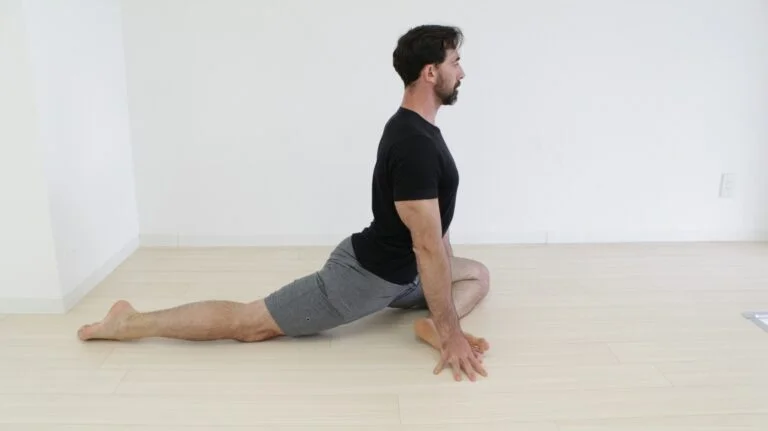
These come from NHS physiotherapy leaflets for the thoracic spine (Wrightington, Wigan and Leigh, Cambridge University Hospitals and Royal Devon). Move slowly and only into mild stretch.
- Seated twist. Sit upright, cross your arms over your chest and hold the opposite shoulders. Turn to one side, back to the middle, then to the other side. 5 each way, twice.
- Backward lean. Sit on a high-backed chair, hands behind your head, and lean gently back so your upper back arches over the top of the chair. 5 to 10 times.
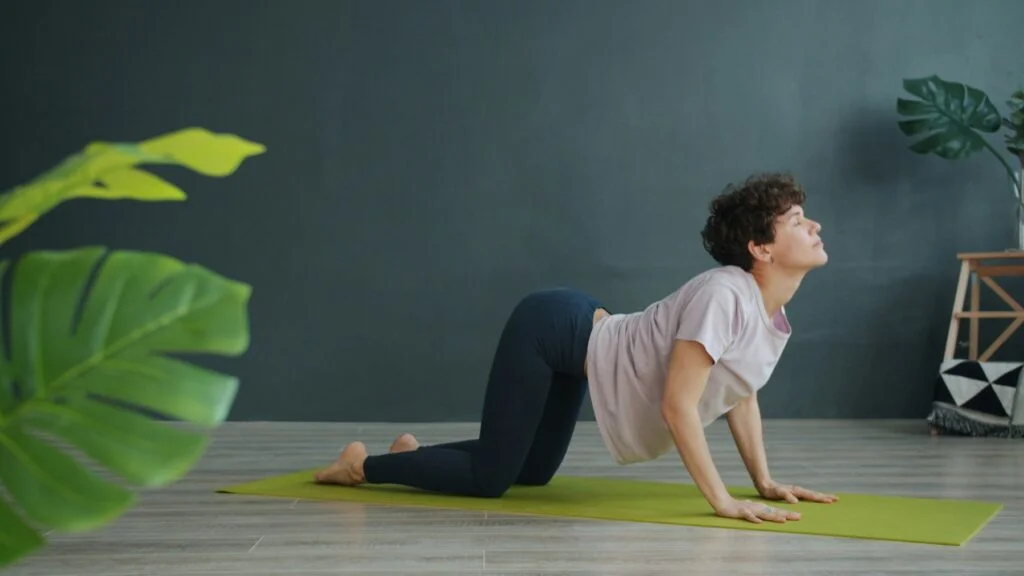
- Cat and camel. On your hands and knees, hands under shoulders and knees under hips, slowly round your back up towards the ceiling, then let it gently hollow. 10 each way, twice.
- Thread the needle (thoracic rotation). On all fours, reach one arm under your body, then sweep it up towards the ceiling, letting your eyes follow your hand. 10 each side, twice.
- Towel roll opener. Lie on your back with a rolled towel along your spine between the shoulder blades, hands behind your neck and elbows pointing up. Breathe in deeply and let your elbows open out towards the floor. 5 to 10 times.
How often, and the pain rule: the Wigan physios suggest 3 to 4 times a week, resting 30 seconds between sets. Some discomfort is normal, but it should ease within 2 hours; if not, do fewer. Royal Devon physios suggest 2 to 3 times a day when you’re stiff. If you have osteoporosis or a scoliosis, ask a physio to adapt the twists first.
The honest evidence: upper back pain has far less research than neck or lower back pain. A review of workplace exercise in office workers found all 7 trials reported less pain, but 6 were at high risk of bias, so no firm conclusions could be drawn. Scans often show “wear and tear” in the thoracic spine, but a 2025 review found too little good research to say how closely those changes link to pain. Gentle movement is still the NHS’s first advice. For another approach to tight spots, see somatic exercises.
Desk and phone set-up
The HSE says poorly set-up workstations can cause pain in the neck, shoulders and back. Its good posture checklist:
- top of the screen level with your eyes, about an arm’s length away
- screen and keyboard straight in front of you, so you don’t twist
- keyboard just below elbow height, mouse in line with your elbow
- shoulders relaxed: sit high enough that you don’t need to shrug
- a chair that supports your lower back, with a 2 to 3cm gap between the seat and the back of your knees
- on a laptop, a separate keyboard and mouse so the screen can sit on a riser
If you use a screen daily for an hour or more at a time, your employer must assess your workstation, including at home. On your phone, lift the screen and look up often. Our posture guide explains why research has found no single “correct” way to sit, and why changing position matters more.
How to sleep with upper back pain
NHS inform suggests a supportive pillow for neck and upper back problems. In practice:
- On your back: one pillow that keeps your head level, not pushed forward.
- On your side: a pillow high enough to fill the gap between ear and shoulder, and a pillow to hug so your top shoulder doesn’t roll forward.
- On your front: your neck stays twisted to one side for hours, so try to move off it, using pillows to stop you rolling over.
Heat before bed can ease stiffness. See our best sleeping position guide, and if pain keeps waking you, how to stay asleep. Pain that’s worse at night, and doesn’t ease when you change position, should be checked by a GP.
Stress and upper back tension
The NHS lists muscle tension or pain among the physical signs of stress, and NHS inform lists anxiety and depression among causes of neck problems, which can spread to the upper back. Many of us brace our shoulders under pressure, often with tension headaches or jaw pain alongside.
What helps: slow, controlled breathing (an NHS tip for stress), progressive muscle relaxation, which tenses and releases the shoulders on purpose, and regular movement breaks. If work is the trigger, see stress at work.
How long does upper back pain last?
The NHS says back pain usually improves within a few weeks, though it can last longer or come back. Most strains feel better after 2 weeks. NHS inform says new neck problems, which can spread to the upper back, should begin to settle within 8 weeks. Aches linked to long sitting or stress often come and go until the cause changes. Pain that lasts for months or keeps getting worse should be checked.
Red flags: when to call 999 or 111
Call 999 or go to A&E if you have upper back pain and:
- chest pain, or pain spreading to your arm, neck or jaw, with sweating, feeling sick or breathlessness
- sudden or severe difficulty breathing
- pain, tingling, weakness or numbness in both legs
- loss of feeling around your genitals or bottom, or new bladder or bowel problems
- it started after a serious accident, such as a car accident
Don’t drive yourself to A&E.
Call NHS 111 or ask for an urgent GP appointment if:
- you feel hot, cold, shivery or generally unwell
- the pain is severe and started suddenly, or is getting worse quickly
- you have tummy pain under the right ribs lasting more than 30 minutes, or yellow skin or eyes
- you’re pregnant and have back pain in your second or third trimester, or pain in your side under the ribs (contact your midwife or GP)
In pregnancy, your midwife is the right first call for any back pain.
When to see a GP or physio
The NHS lists back pain coming from the top of your back, between your shoulders, as one reason to see a GP. Also see a GP if it hasn’t improved after a few weeks, stops your daily activities, is worse at night or doesn’t ease with rest, gets worse when you cough or sneeze, or comes with unexplained weight loss, a lump or a change in the shape of your back. NHS physios in Glasgow also flag a history of cancer, fever or night sweats, a band of pain or numbness around the chest, and pain after a fall or heavy lifting if you have osteoporosis.
Physio without a GP: in most of England you can refer yourself to NHS community musculoskeletal (MSK) services, including physiotherapy, as long as you’re registered with a GP. Find your local service on the NHS website.
Where our products fit (honestly)
No supplement or balm is a treatment for back pain, and nothing replaces movement and proper medical advice. Here’s how our products can sit alongside a healthy routine.
Our CBD Balm, Muscle and Joint Support is a massage balm made with broad spectrum CBD, peppermint, eucalyptus and juniper. It feels cooling and non-greasy, and some people like to massage it into the shoulders and upper back after a long day or before their stretches. CBD isn’t a treatment for back pain. Read more in our CBD balm guide.
Our Magnesium Glycinate Sleep Complex is an evening drink with magnesium bisglycinate and citrate, glycine and L-theanine, which some people make part of their wind-down. Magnesium contributes to normal muscle function. For more, see magnesium for muscle pain and muscle recovery.
If you also take CBD by mouth, keep the FSA’s advice in mind. The FSA’s 10mg a day figure is precautionary advice rather than a legal limit, set while longer-term safety research continues. At Evopure we think it is a very cautious figure, and many adults use more. If you go above it, increase slowly, and check with your GP or pharmacist first if you take any medication.
Our products are for adults (18+) only. We don’t recommend our products during pregnancy or breastfeeding. If you take prescribed medicines, check with your pharmacist before adding a supplement.
Tight, tender spots that ease with pressure are often called knots: see how to get rid of muscle knots.
FAQs
What causes pain between the shoulder blades?
Usually tense or strained muscles, often from long spells at a desk or on a phone, poor sleep position, stress or a stiff joint in the upper spine. Less often it comes from the heart, lungs, gallbladder or shingles, so watch for other symptoms.
How long does upper back pain last?
Most back pain improves within a few weeks, and most strains feel better after 2 weeks. See a GP if it isn’t improving after a few weeks or is getting worse.
How should I sleep with upper back pain?
On your back or side with a supportive pillow that keeps your head level. On your side, hug a pillow so your top shoulder doesn’t roll forward. Try to avoid sleeping on your front.
Can stress cause upper back pain?
Yes. The NHS lists muscle tension or pain among the physical signs of stress, and many people hold tension in their shoulders and upper back. Slow breathing, relaxation and movement breaks can help.
Is upper back pain a sign of a heart attack?
It can be, alongside chest pain or discomfort, sweating, feeling sick, light-headed or short of breath. The British Heart Foundation lists pain spreading to the upper back as a symptom. Call 999 if you have these.
When should I worry about upper back pain?
Call 999 for chest pain, sudden breathlessness, numbness or weakness in both legs, or bladder or bowel problems. Call 111 for a fever or sudden severe pain. See a GP for pain that isn’t improving, is worse at night, or comes with weight loss.
Sources
- NHS. Back pain.
- NHS. Heart attack, and British Heart Foundation. Heart attack.
- NHS. Pulmonary embolism and Pleurisy.
- NHS. Gallstones and Acute cholecystitis.
- NHS. Shingles and Osteoporosis.
- NHS. Stress.
- NHS. Back pain in pregnancy.
- NHS. Get NHS help for back and joint problems.
- NHS inform. Neck problems.
- NHS Greater Glasgow and Clyde. Self-help and information: upper back.
- Wrightington, Wigan and Leigh NHS FT. Neck and upper back exercises, level 2.
- Cambridge University Hospitals. Thoracic spine exercises.
- Royal Devon University Healthcare NHS FT. Thoracic range of movement exercises.
- HSE. Working safely with display screen equipment and Good posture.
- Briggs AM, et al. Thoracic spine pain in the general population: prevalence, incidence and associated factors. BMC Musculoskelet Disord, 2009. PMID 19563667.
- Tersa-Miralles C, et al. Effectiveness of workplace exercise interventions in the treatment of musculoskeletal disorders in office workers. BMJ Open, 2022. PMID 35105632.
- Arnbak BA, et al. Prevalence of thoracic degenerative MRI findings and association with pain and disability. Skeletal Radiol, 2025. PMID 39821431.
This guide is general information, not medical advice. If you’re worried about upper back pain, speak to a GP, pharmacist or physiotherapist. Evopure makes the CBD Balm, Muscle and Joint Support and the Magnesium Glycinate Sleep Complex.