Last updated: October 2026
Japanese walking is interval walking training (IWT), developed by researchers at Shinshu University in Japan. You alternate 3 minutes of brisk walking with 3 minutes of easy walking, for 5 rounds (30 minutes), at least 4 days a week. In trials of middle-aged and older adults it improved fitness and thigh strength and lowered blood pressure more than steady walking.
Below: exactly how to do it, what the studies really found, how it compares with 10,000 steps and the 12-3-30 workout, what it can and can’t do for weight loss, mood and sleep, a plan for dark UK evenings, who should check with a GP first and a 4-week starter plan.
Japanese walking in one line: 3 minutes fast (you can talk, but only in short phrases), 3 minutes easy (you could chat comfortably), repeat 5 times, 4 or more days a week. Warm up with a few minutes of easy walking first.
What is Japanese walking?
“Japanese walking” is the social media name for interval walking training, or IWT. It isn’t an ancient tradition. It was designed by Hiroshi Nose, Shizue Masuki and colleagues at Shinshu University in Matsumoto as a low-cost, home-based way for middle-aged and older people to build fitness without a gym.
The idea is simple. Steady, comfortable walking is good for you, but for many people it isn’t hard enough to make them fitter. Short blocks of fast walking push your heart, lungs and leg muscles harder, and the easy blocks in between let you recover so you can keep going. Their first big trial was published in 2007, and the team has since studied hundreds more people doing it, some for nearly 2 years.
How to do Japanese walking
| Step | What to do | How it should feel |
|---|---|---|
| Warm up | 3 to 5 minutes of easy walking | Relaxed, loosening up |
| Fast interval | 3 minutes of brisk walking: longer strides, arms swinging | Breathing hard; you can talk in short phrases but not hold a conversation |
| Easy interval | 3 minutes of slower walking | Comfortable; you could chat or sing along |
| Repeat | 5 rounds of fast plus easy | 30 minutes in total |
| Cool down | A few minutes of easy walking, then a gentle stretch | Breathing back to normal |
| How often | At least 4 days a week | About 60 minutes of fast walking a week |
How fast should you walk?
There’s no single speed, because the Shinshu team set the pace for each person. The fast blocks were at 70% or more of that person’s peak walking capacity, and the easy blocks at about 40%. Without a lab, use effort instead. The NHS describes brisk walking as about 3 miles an hour, a pace where you can still talk but can’t sing. For Japanese walking, the fast blocks should feel a step harder than that: somewhat hard, with your breathing clearly faster. The easy blocks should feel like a stroll.
A watch or phone timer that beeps every 3 minutes makes it much easier. On a treadmill, pick a speed for the fast blocks that feels somewhat hard, then drop it right down for the easy blocks. Walking uphill on the fast blocks is a good option if you can’t walk any faster.
Form tips
- Stand tall, look ahead and keep your shoulders relaxed.
- Bend your elbows and swing your arms: it helps you speed up.
- Take quicker steps rather than very long ones, landing on your heel and rolling through.
- Wear comfortable, supportive shoes that don’t rub.
If 3 fast minutes feels too much at first, start with 1 or 2 minutes and build up. The 4-week plan below does exactly that.
What the research shows
Most of the evidence comes from the Shinshu University group, mainly in Japanese adults in their 60s. Here are the key studies, each checked on PubMed.
| Study | Who and how long | Main findings |
|---|---|---|
| Nemoto et al, 2007 | 246 adults, average age 63, 5 months; compared with steady walking (8,000+ steps a day) and no training | IWT group: knee extension strength up 13%, knee flexion up 17%, walking fitness up 9%. All bigger than steady walking, and a larger fall in systolic blood pressure |
| Morikawa et al, 2011 | 666 adults, about 65, 4 months | Fitness and thigh strength rose; weight, body fat, blood pressure and blood glucose fell. The least fit gained the most |
| Masuki et al, 2015 | 696 adults, about 65, 22 months | People completed about 70% of their planned sessions on average. Fitness up 12%, lifestyle-related disease score down 13% |
| Masuki et al, 2019 | 679 adults, about 65, 5 months | Fitness up 14%, disease score down 17%. Benefits grew with fast walking time up to about 50 minutes a week, then levelled off. Slow walking time made no difference |
| Karstoft et al, 2013 (Denmark) | 32 adults with type 2 diabetes, 4 months, 60-minute sessions 5 days a week | Interval walkers: fitness up 16%, body weight and fat (including visceral fat) down, better blood glucose. Steady walkers burning the same energy saw no change in fitness |
| Martyanti et al, 2024 | 234 postmenopausal women, 5 months | Bone density rose slightly (1.8% spine, 1.0% femoral neck) in women who started with lower bone density, but not in those with higher density |
What this means, honestly
- The fast minutes matter most. The 2019 study suggests the gains come from time spent walking fast, not total walking time. Five 3-minute fast blocks, 4 days a week, gives about 60 minutes, just above the point where benefits levelled off.
- It works best for people starting from a low base. The least fit participants improved the most.
- The evidence has limits. Most studies are from one research group, mostly in older Japanese adults, and several had no comparison group. A 2024 review by the Japanese and Danish researchers says long-term studies in real-world settings are still needed, and that sticking with it over the long term is the main challenge.
It’s still a well-studied, low-cost way to get fitter, and you don’t need a gym. If you’d like help building it into your week, see our guide to healthy habits that stick.
Japanese walking vs 10,000 steps, 12-3-30 and steady walking
| Japanese walking (IWT) | 10,000 steps | 12-3-30 | Steady brisk walking | |
|---|---|---|---|---|
| What it is | 3 min fast, 3 min easy, 5 rounds | A daily step target | Treadmill at 12% incline, 3mph, 30 minutes | Walking at a steady brisk pace |
| Time | 30 minutes, 4+ days a week | Builds up through the day | 30 minutes | Flexible |
| Equipment | None (a timer helps) | Step counter | Treadmill with incline | None |
| Evidence | Several trials, mainly older adults | Large observational studies of step counts | Very little published research | Strong evidence for health in general |
| Best for | Building fitness in less time | Moving more all day | Treadmill users who like hills | Easing in, chatting, long walks |
Is Japanese walking better than 10,000 steps?
They do different jobs. The 10,000 figure has little evidence behind it. A 2022 analysis of 15 studies and over 47,000 adults found the risk of dying early kept falling with more daily steps, then levelled off at about 6,000 to 8,000 steps for people over 60 and 8,000 to 10,000 for younger adults. A 2025 review found 7,000 steps a day was linked with a 47% lower risk of early death than 2,000 steps, and said 10,000 is still a fine target for people who are already active.
Japanese walking gets you more fitness per minute; a step count keeps you moving through the day. In the 2007 trial, interval walkers gained more strength and fitness than people doing 8,000 or more steady steps. Doing both is ideal.
Japanese walking vs the 12-3-30 workout
The 12-3-30 workout is a treadmill trend: 12% incline, 3 miles an hour, 30 minutes. A small 2025 lab study of 16 people found that, compared with running for the same calories, it took longer, burned energy more slowly and drew a higher share of its fuel from fat. The researchers noted there’s very little peer-reviewed evidence on it. A higher share of fuel from fat doesn’t mean more fat lost overall. If you try it, build up the incline gradually.
Japanese walking vs steady walking
Any walking is good for you. But in the trials, steady walking at a comfortable pace did less for fitness and leg strength than the same time with fast intervals. If steady walking is what you’ll actually do, do that: the best walk is the one you keep up.
Japanese walking for weight loss
Japanese walking can help, but it isn’t a fat-burning shortcut. In a Shinshu trial of 666 adults, body weight and body fat fell on average over 4 months, and in the Danish diabetes trial interval walkers lost weight and fat while steady walkers didn’t. These were modest changes, though, not dramatic transformations.
A Cochrane review of 43 trials found that exercise on its own led to small weight losses, that exercise plus diet worked better than diet alone, and that higher-intensity exercise led to a little more weight loss. It also found that exercise improved blood pressure and blood glucose even when people lost no weight.
So the honest picture is:
- Japanese walking burns a bit more energy than strolling and builds fitness and leg muscle.
- Weight loss still depends mostly on what and how much you eat.
- Sleep and stress matter too. See cortisol belly: what actually helps.
Mood, stress and sleep
Walking is one of the easiest ways to look after your mind as well as your body. The NHS says regular exercise can boost your mood if you have depression, and that even a brisk 10-minute walk can clear your mind and help you relax. A 2022 review of 15 studies with over 190,000 adults found that people doing half the recommended amount of activity had an 18% lower risk of depression, and those doing the full amount a 25% lower risk.
On stress, the NHS is realistic: exercise won’t make stress disappear, but it can take the edge off the emotional intensity and help you think more clearly. See stress symptoms and how to lower cortisol naturally.
For sleep, a review of 66 studies found regular exercise had small benefits for how long and how efficiently people slept, and a moderate benefit for sleep quality. The NHS insomnia advice is to exercise regularly during the day, but not in the 4 hours before bed. A morning or lunchtime walk outdoors also gets you some daylight, which matters for your body clock. See circadian rhythm, sleep hygiene and deep sleep.
None of this replaces treatment. If low mood, anxiety or poor sleep last more than a couple of weeks, speak to your GP.
Japanese walking in autumn and winter (UK)
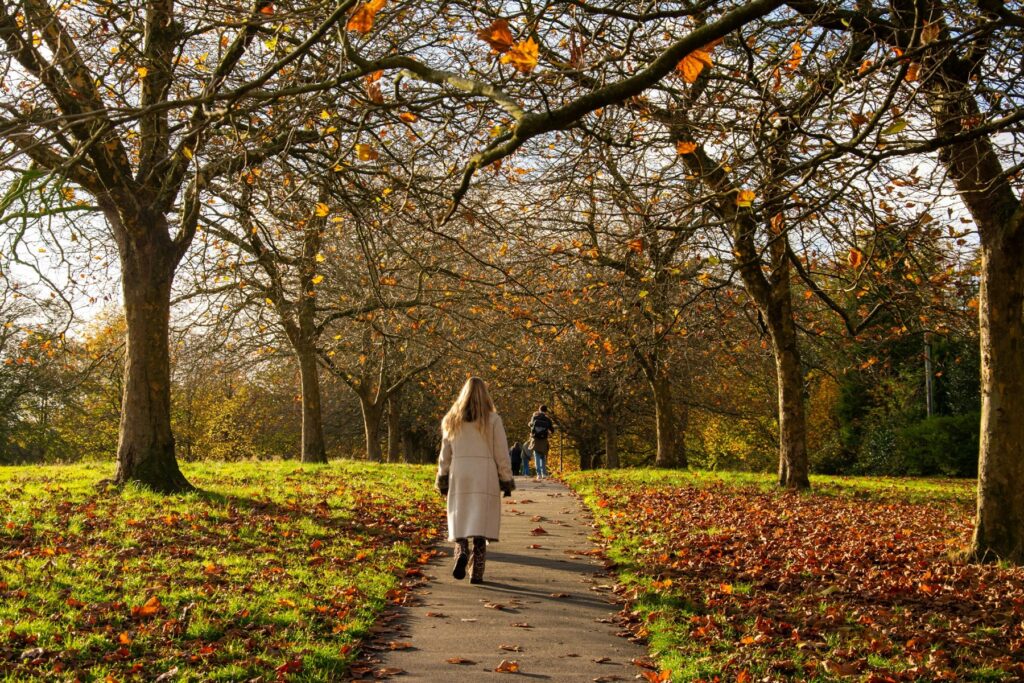
The clocks go back on Sunday 25 October 2026, and after that it’s dark by late afternoon. Cold, wet, dark evenings make it easy to skip a session. A Shinshu study of young women doing IWT through a Japanese winter, with daytime highs averaging about 7°C, still found gains in fitness and leg strength. Here’s how to keep going in a British winter.
- Walk in daylight when you can. A lunchtime session or a morning walk before work gives you light as well as exercise. See tired in winter and a morning routine for energy.
- Be seen in the dark. The Highway Code advises wearing something light-coloured, bright or fluorescent in poor daylight, and reflective materials in the dark. Where there’s no pavement, keep to the right-hand side of the road so you can see oncoming traffic.
- Choose a lit, familiar route. Well-lit streets or a park path you know are safer for fast intervals than uneven ground. Tell someone your route, take your phone, and walk with a friend if you can.
- Layer up. A thin base layer, a warm mid layer and a waterproof jacket you can unzip. You’ll warm up fast on the brisk blocks, so start slightly cool. Add gloves and a hat.
- Watch your footing. On ice or wet leaves, slow the fast blocks down or swap to an indoor session.
- Have an indoor plan. A treadmill, a shopping centre loop or brisk marching on the spot all work for a wet evening.
For more on feeling well through the darker months, see our winter wellness guide.
4-week starter plan
Every session starts with 3 to 5 minutes of easy walking and ends with a few minutes of easy walking. Leave at least one rest day between sessions in weeks 1 and 2.
| Week | Fast block | Easy block | Rounds | Sessions | Tip |
|---|---|---|---|---|---|
| 1 | 2 minutes | 3 minutes | 3 | 3 | Find your “somewhat hard” pace |
| 2 | 3 minutes | 3 minutes | 4 | 3 | Use a timer that beeps every 3 minutes |
| 3 | 3 minutes | 3 minutes | 5 | 4 | You’ve reached the full 30 minutes |
| 4 | 3 minutes | 3 minutes | 5 | 4 | Add a gentle hill to the fast blocks if it feels easy |
From week 5, keep to 4 sessions a week. Four 30-minute sessions give you 120 minutes; the UK Chief Medical Officers advise at least 150 minutes of moderate activity a week plus strength work on 2 days, so add a fifth session, some everyday brisk walks and a little strength training. Struggling to get out of the door? See how to get motivated.
After your walk
Cool down with a few minutes of easy walking, then stretch your calves, thighs and hips. Drink some water, even in winter. If your legs ache at first, take an extra rest day and build up more slowly. See muscle recovery and magnesium for cramps if you get night-time cramps. Some people like to finish with a cold shower or, in winter, a sauna.
A warm drink is a nice way to end a cold-weather walk. Our Magnesium Glycinate Sleep Complex is a berry-flavoured evening drink with magnesium bisglycinate and citrate; magnesium contributes to normal muscle function and to the reduction of tiredness and fatigue. Our Reishi Mushroom Adaptogenic Complex is a reishi hot chocolate made with cacao, which contains a little natural caffeine, so it suits a morning or afternoon walk better than a late one. Neither is a fitness or recovery product: the walking does the work.
Who should check with a GP first
Japanese walking suits most adults: most trial participants were in their 60s, and the bone study reported minimal side effects. But the fast blocks are genuinely hard work, so speak to your GP, practice nurse or specialist team first if:
- You have a heart condition, high blood pressure that isn’t controlled, or you’ve had a heart attack or heart surgery. The British Heart Foundation advises speaking to your doctor before starting physical activity for the first time.
- You have joint problems, such as arthritis, a recent injury or a joint replacement. You may need shorter fast blocks or a softer surface. See joint pain.
- You’re pregnant. The NHS says exercise is safe in pregnancy, but advises against starting a new vigorous activity and suggests talking to your midwife about what’s safe for you. We don’t recommend our products during pregnancy or breastfeeding.
- You have diabetes, especially if you use insulin, as exercise can change your blood sugar.
- You have a lung condition, get dizzy, or haven’t exercised for a long time.
Stop and rest if you get chest pain, palpitations or unusual breathlessness, and speak to your doctor as soon as you can. Call 999 if chest pain doesn’t go away.
Walking is part of the NHS advice for back pain; see our lower back pain guide.
FAQs
What is the Japanese walking method?
It is interval walking training (IWT), developed at Shinshu University in Japan. You alternate 3 minutes of fast walking with 3 minutes of easy walking for 5 rounds, about 30 minutes, at least 4 days a week.
How fast should you walk for Japanese walking?
There is no set speed. The fast blocks should feel somewhat hard, so you can only talk in short phrases. The easy blocks should feel like a comfortable stroll where you could chat.
Is Japanese walking better than 10,000 steps?
They do different jobs. Japanese walking builds more fitness and leg strength per minute, while a daily step count keeps you moving through the day. Research suggests about 7,000 steps a day brings much of the benefit, and doing both is ideal.
Can Japanese walking help you lose weight?
It can help a little. In trials, weight and body fat fell modestly over 4 months, but weight loss depends mostly on diet. Exercise plus diet works better than either alone.
How often should you do Japanese walking?
The studies used at least 4 days a week, with 5 or more rounds per session. Benefits rose with fast walking time up to about 50 minutes a week, so 4 sessions of 5 rounds is a good target.
Can you do Japanese walking on a treadmill or indoors?
Yes. On a treadmill, raise the speed or incline for the 3 fast minutes and lower it for the 3 easy minutes. Indoors, a long corridor, a shopping centre loop or brisk marching on the spot can work.
Is Japanese walking good for older people?
It was designed for middle-aged and older adults, and most trials were in people in their 60s. Check with your GP first if you have a heart, lung or joint condition, and build up slowly.
Sources
- Nemoto K et al (2007). Effects of high-intensity interval walking training on physical fitness and blood pressure in middle-aged and older people. Mayo Clinic Proceedings.
- Morikawa M et al (2011). Physical fitness and indices of lifestyle-related diseases before and after interval walking training in middle-aged and older males and females. British Journal of Sports Medicine.
- Masuki S et al (2015). The factors affecting adherence to a long-term interval walking training program in middle-aged and older people. Journal of Applied Physiology.
- Masuki S et al (2019). High-intensity walking time is a key determinant to increase physical fitness and improve health outcomes after interval walking training. Mayo Clinic Proceedings.
- Karstoft K et al (2013). The effects of free-living interval-walking training on glycemic control, body composition, and physical fitness in type 2 diabetic patients. Diabetes Care.
- Karstoft K et al (2024). Health benefits of interval walking training. Applied Physiology, Nutrition, and Metabolism.
- Martyanti RN et al (2024). Increased response of postmenopausal bone to interval walking training depends on baseline bone mineral density. PLoS One.
- Tanabe A et al (2018). Seasonal influence on adherence to and effects of an interval walking training program. International Journal of Biometeorology.
- Paluch AE et al (2022). Daily steps and all-cause mortality: a meta-analysis of 15 international cohorts. Lancet Public Health.
- Ding D et al (2025). Daily steps and health outcomes in adults: a systematic review and dose-response meta-analysis. Lancet Public Health.
- Wong MWH et al (2025). An exploratory study comparing the metabolic responses between the 12-3-30 treadmill workout and self-paced treadmill running. International Journal of Exercise Science.
- Shaw K et al (2006). Exercise for overweight or obesity. Cochrane Database of Systematic Reviews.
- Pearce M et al (2022). Association between physical activity and risk of depression. JAMA Psychiatry.
- Kredlow MA et al (2015). The effects of physical activity on sleep: a meta-analytic review. Journal of Behavioral Medicine.
- UK Chief Medical Officers. Physical activity guidelines.
- NHS. Walking for health.
- NHS. Exercise for depression.
- NHS. 10 stress busters.
- NHS. Insomnia.
- NHS. Exercise in pregnancy.
- British Heart Foundation. Staying active.
- GOV.UK. The Highway Code: rules for pedestrians.
This guide is general information, not medical advice. Evopure makes the Magnesium Glycinate Sleep Complex and Reishi Mushroom Adaptogenic Complex.