Last updated: October 2026
A body scan is a mindfulness practice where you move your attention slowly through your body, from your toes to your head, noticing sensations without trying to change them. It takes 5 to 30 minutes, lying down or sitting. It’s part of mindfulness programmes linked to lower stress, and many people use it to wind down before sleep.
Below: a 10-minute script and a 3-minute version, how it compares with similar techniques, and what the research really shows.
Try it now (1 minute): close your eyes and feel your feet. Notice whatever is there: warmth, pressure, tingling, or nothing much. Move to your hands, then your shoulders, then your face. You’ve just done a mini body scan.
What is a body scan meditation?
A body scan is one of the core practices in mindfulness-based stress reduction (MBSR) and mindfulness-based cognitive therapy (MBCT), structured courses that usually run over 8 weeks. You rest your attention on one part of the body at a time and simply notice what is there.
The key word is noticing. You’re not trying to relax each part or fix an ache. If your calf feels tight, you notice “tight” and move on. Relaxation often follows, but as a side effect rather than the goal.
New to mindfulness? Our mindfulness for beginners guide covers the basics; this page is the full body scan how-to.
How to do a body scan
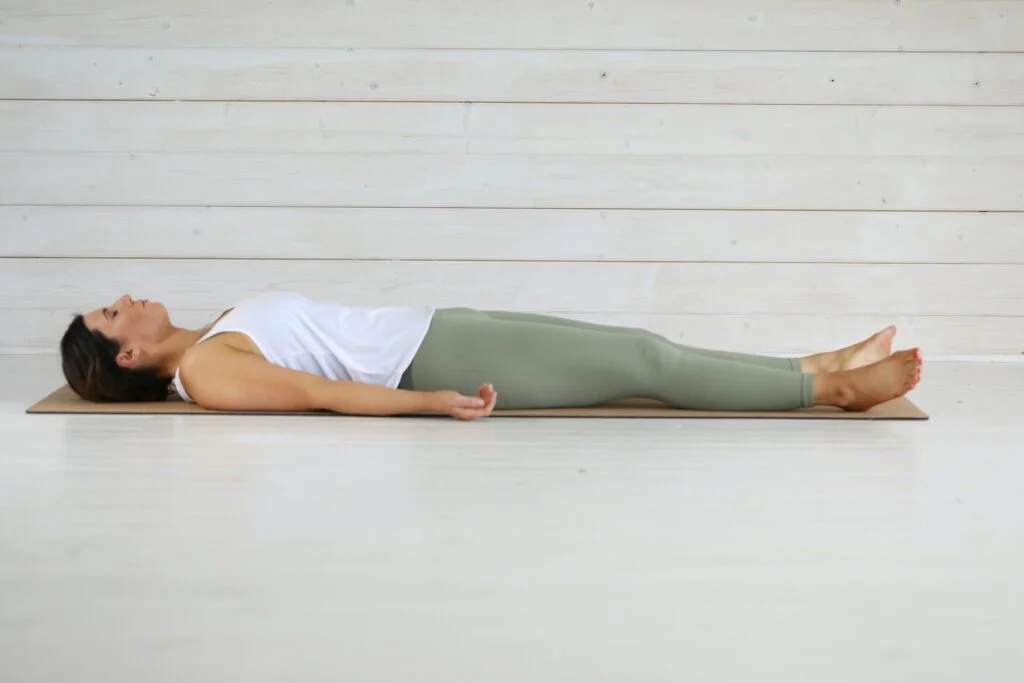
- Position: lie on your back, arms by your sides, legs uncrossed. To stay awake, sit in a chair with your feet flat on the floor.
- Direction: usually toes to head, but head to toes works just as well.
- Pace: a few breaths per area for a 10-minute scan. For a 20 or 30-minute scan, go more slowly: each toe, each finger, each part of the face.
- Attitude: curious rather than critical. “I can’t feel anything in my knee” is a perfectly good observation.
- Guided or not: a recording helps while you learn; later you can guide yourself.
A 10-minute body scan script
Read it through once and follow it from memory, or record yourself reading it slowly.
- Settle (1 minute). Lie or sit comfortably and close your eyes, or rest your gaze on the floor. Take three slow breaths, then let your breathing find its own rhythm. Notice where your body meets the bed, floor or chair.
- Left foot and leg (1.5 minutes). Bring your attention to the toes of your left foot. Notice warmth or coolness, tingling, the touch of your sock or the sheet, or nothing at all. Move to the sole and heel, then slowly up through the ankle, shin, calf, knee and thigh.
- Right foot and leg (1.5 minutes). Do the same on the right side, from the toes to the top of the thigh.
- Hips and lower back (1 minute). Notice your hips and pelvis, and the places where your lower back touches the surface beneath you.
- Belly and chest (1 minute). Feel your belly rise and fall with each breath. Move up to the chest.
- Upper back and shoulders (1 minute). Notice your shoulder blades and shoulders, where many of us hold tension. If they soften on their own, let them. If they don’t, that’s fine too.
- Arms and hands (1 minute). Move down both arms together: upper arms, elbows, forearms, wrists, palms and fingertips.
- Neck, jaw and face (1 minute). Notice your throat and the back of your neck. Then your jaw (are your teeth pressed together?), cheeks, eyes, forehead and the top of your head.
- Whole body (1 minute). Widen your attention to take in your whole body at once, lying here and breathing. Rest in that for a few breaths.
- Finish (30 seconds). Wiggle your fingers and toes and open your eyes. If you’re in bed, simply roll onto your sleeping side and let the practice go.
Whenever your mind wanders, which it will, notice where it went and gently come back to the part of the body you’d reached. Coming back is the practice, not a failure.
A 3-minute body scan
Useful at your desk or on the train. Sitting is fine.
- 30 seconds: take three slow breaths and feel where your body touches the chair and the floor.
- 45 seconds: sweep your attention up from your feet through your legs to your hips.
- 45 seconds: move through your belly, chest, back and shoulders.
- 45 seconds: notice your arms and hands, then your neck, jaw and face.
- 15 seconds: feel your whole body breathing, then open your eyes.
Pair it with box breathing or 4-7-8 breathing if you want something to do with your breath first.
Body scan for sleep
In bed, a body scan gives a busy mind something slow to follow instead of replaying the day. Do it once the lights are off, and don’t worry about finishing: if you drift off by your knees, it has done its job.
It works best as part of a steady wind-down. See our bedtime routine for adults and sleep meditation guides. If you’ve had trouble sleeping for weeks, a body scan is a nice extra but not a substitute for proper help; see insomnia for what the NHS offers.
Body scan for stress and anxiety
Stress often shows up in the body first: tight shoulders, a clenched jaw, shallow breathing. A regular body scan helps you spot those signals earlier, so you can take a break before they build. Use it alongside the ideas in how to relieve stress and nervous system regulation.
If anxiety tends to peak at night, try the 3-minute version as soon as you notice your thoughts racing; see anxiety at night and how to stop overthinking. When anxiety is intense, focusing inwards can feel too much; outward-facing grounding techniques may suit you better then.
If you have a mental health condition, talk to your GP or therapist before starting regular practice.
Body scan vs progressive muscle relaxation vs yoga nidra
| Body scan | Progressive muscle relaxation | Yoga nidra | |
|---|---|---|---|
| What you do | Notice each area without changing it | Tense each muscle group, then let go | Follow a set sequence: intention, rotation through the body, breath, imagery |
| Muscle effort | None | Yes, gentle tensing | None |
| Typical length | 5 to 30 minutes | 10 to 15 minutes | 10 to 40 minutes |
| Position | Lying or sitting | Lying or sitting | Lying down |
| Main aim | Awareness; relaxation is a by-product | Deliberate physical relaxation | Deep rest while staying awake |
| Good for | A daily mindfulness habit, noticing stress early, winding down | People who find it hard to feel tension | A longer, fully guided rest |
If you struggle to feel tension, progressive muscle relaxation is an easier way in, because tensing first makes the release obvious. For a longer guided rest, try yoga nidra. If keeping still is hard, somatic exercises bring the same awareness into slow movement.
Does it work? What the research says
The honest answer: the body scan is well studied as part of full mindfulness programmes, but much less studied on its own.
- As part of mindfulness courses: NICE suggests group MBCT as one option to help prevent depression returning in people at higher risk of relapse, and the NHS says mindfulness can improve mental wellbeing.
- Sleep: a 2019 review of 18 trials with 1,654 people found mindfulness meditation improved sleep quality compared with time-matched control activities, but not compared with established treatments such as CBT for insomnia.
- On its own: a 2022 meta-analysis of 14 randomised trials of the body scan alone found only a small effect on mindfulness compared with doing nothing, and concluded it wasn’t enough by itself to improve health outcomes. The studies were small and low quality.
- Short-term effects: in a UK trial of 55 adults with chronic pain, a 10-minute body scan recording reduced pain-related distress in the clinic compared with a reading about natural history, though the difference didn’t hold at home.
So treat the body scan as one useful tool in a wider routine rather than a fix on its own. It’s free, easy to fit in and many people simply find it pleasant.
Tips and troubleshooting
- “I keep falling asleep.” Fine at bedtime. To stay awake, sit up or practise earlier in the day.
- “My mind won’t stop wandering.” Everyone’s does. Noticing and coming back is the training. Naming each part silently (“left knee”) helps.
- “I can’t feel anything.” Notice the absence, or feel for contact points: heels on the bed, clothes on skin. Many people find they notice more with practice.
- “It hurts there.” If you live with pain, you can rest on a painful area briefly and kindly, or skip it and move to a comfortable part. See tension headaches for tension-related pain.
- “It brings up difficult feelings.” For some people, especially those who have experienced trauma, close attention to the body can stir up distressing feelings or memories. A 2020 review of 83 studies found unwanted effects, most often anxiety, were reported by around 8% of people who meditated, and sometimes in people with no previous mental health problems. If focusing on your body feels distressing, stop. Open your eyes, look around the room and feel your feet on the floor. Shorter scans with eyes open, starting with neutral areas such as your hands, can help, ideally with support from a trauma-informed therapist.
- For children: keep it to 2 or 3 minutes and make it playful, for example imagining a slow torch beam moving from their toes to their head.
A warm drink can be a nice cue to start your wind-down. Our Magnesium Glycinate Sleep Complex is a berry-flavoured bedtime drink with magnesium bisglycinate and citrate, glycine, L-theanine, chamomile and passionflower. Magnesium contributes to normal psychological function and the normal functioning of the nervous system.
FAQs
What is a body scan meditation?
A mindfulness practice where you move your attention slowly through your body, usually from your toes to your head, noticing sensations without trying to change them.
How long should a body scan take?
Anything from 3 to 30 minutes. Ten minutes is a good place to start, and a 3-minute version works well during the day.
Should I do a body scan lying down or sitting?
Either. Lying down is more relaxing and suits bedtime; sitting up helps you stay awake if you want to practise during the day.
Is it OK to fall asleep during a body scan?
Yes, if you’re using it to wind down at night. If you want to build mindfulness, sit up or practise earlier in the day so you stay awake.
Can a body scan help with anxiety?
It’s part of mindfulness programmes linked to lower stress and anxiety, though evidence for the body scan on its own is limited. If focusing on your body makes you feel more anxious, stop and try an outward-facing grounding exercise instead, and talk to your GP if anxiety is affecting your life.
What’s the difference between a body scan and progressive muscle relaxation?
In a body scan you only notice each area without changing it. In progressive muscle relaxation you deliberately tense each muscle group and then let it go.
Sources
- NHS. Mindfulness.
- NICE (2022). Depression in adults: treatment and management (NG222), recommendation 1.8.5.
- Gan R, Zhang L, Chen S (2022). The effects of body scan meditation: a systematic review and meta-analysis. Applied Psychology: Health and Well-Being.
- Rusch HL et al (2019). The effect of mindfulness meditation on sleep quality: a systematic review and meta-analysis of randomized controlled trials. Annals of the New York Academy of Sciences.
- Ussher M et al (2014). Immediate effects of a brief mindfulness-based body scan on patients with chronic pain. Journal of Behavioral Medicine.
- Farias M et al (2020). Adverse events in meditation practices and meditation-based therapies: a systematic review. Acta Psychiatrica Scandinavica.
This guide is general information, not medical advice. Evopure makes the Magnesium Glycinate Sleep Complex.