
Last updated: October 2026
Plantar fasciitis is the most common cause of pain under the heel: a sharp ache in the heel and arch that is worst with your first steps in the morning or after sitting. It usually gets better on its own. The NHS advice is rest, ice, supportive shoes, insoles, painkillers and stretches, and most people improve within a year.
Below: what it feels like and why it happens, a table of heel pain that isn’t plantar fasciitis, NHS self-care, the stretches and strength exercise with the best evidence, an honest look at insoles, night splints, injections and shockwave therapy, how long it lasts, footwear tips and exactly when to get help.
Need help now? Call NHS 111 if you have severe heel pain after an injury, heard a snap, grinding or popping noise when it happened, can’t walk or stand on tiptoe, your foot has changed shape, or the pain makes you feel faint, dizzy or sick. If you have diabetes and notice anything new on your foot, contact your GP or foot protection team straight away. See all the red flags.
What is plantar fasciitis? Symptoms
The plantar fascia is a thick band of tissue that runs along the sole of your foot, connecting your heel bone to your toes. It supports your arch and takes the strain every time you push off to take a step. Plantar fasciitis is pain where that band joins the heel.
According to the NHS, it’s likely to be plantar fasciitis if:
- you have pain on the bottom of your foot, around your heel and arch
- the pain is worst when you take your first steps after sleeping or resting, eases as you move about, then comes back after long spells of standing, walking or running
- it hurts to stretch the sole of your foot, for example when you raise your toes or climb stairs
That “first steps in the morning” pain is the classic sign. It can affect one foot or both.
It is common. NICE’s clinical summary describes it as the most commonly recognised cause of heel pain under the foot in adults, with a lifetime incidence of about 10%. A UK survey of over 5,000 adults aged 50 and over found that 9.6% had heel pain under the foot at the time.
What causes plantar fasciitis? Risk factors
The NHS says it happens when the plantar fascia is strained, although it’s often not clear why. Repeated overload is thought to cause tiny tears where the fascia joins the heel bone. Under a microscope, long-standing cases look more like worn, degenerated tissue than inflammation, which is why you may also see it called plantar heel pain or plantar fasciopathy.
You’re more likely to get it if you:
- are aged 40 to 60, when it is most common
- have recently started exercising on hard surfaces, or suddenly increased how much you stand, walk or run
- spend a lot of time on your feet, for work or exercise
- have a tight calf or Achilles tendon, flat feet or high arches
- wear shoes with poor cushioning or support
- are overweight: a review of 25 studies found a strong link between higher BMI and long-lasting heel pain in people who aren’t athletes
Runners get it too: it is estimated to account for about 8% of running injuries. If you’ve just stepped up your daily count, our guide to how many steps a day you really need may help you build up more gradually.
Heel pain that isn’t plantar fasciitis
Plantar fasciitis is the usual cause of pain under the heel, but not the only one. The NHS advises against diagnosing yourself, so use this table as a guide to what to do next.
| Clues | Possible cause | What to do |
|---|---|---|
| Pain at the back of the heel, sometimes spreading to the ankle and calf, worse on tiptoe | Achilles tendinopathy | Ease off running and jumping; GP or physio if not better in 2 weeks |
| Deep ache in the middle of the heel pad, worse barefoot or on hard floors | Heel fat pad thinning (fat pad atrophy) | Cushioned shoes and heel pads; see a GP or podiatrist |
| Pain that builds slowly after a big increase in running, marching or walking | Stress fracture of the heel bone | Rest it and see a GP: it may need an X-ray or scan |
| Burning, tingling or numbness in the heel or sole | A trapped or irritated nerve (such as tarsal tunnel syndrome), nerve damage, or a nerve problem starting in the back | See a GP. More in pins and needles and lower back pain |
| Heel pain with stiff, swollen joints, back stiffness or psoriasis | Inflammatory arthritis (such as psoriatic or rheumatoid arthritis, or spondyloarthritis) | See a GP. Our joint pain guide covers more |
| Redness, swelling and a dull ache around the heel | Bursitis | Rest, ice and padding; GP if it doesn’t settle |
| Sudden pain and bruising in the arch after a “pop” | Plantar fascia tear | See a GP promptly, or call 111 if you can’t walk |
| Sudden sharp pain after an injury, a snap or pop, swelling, can’t walk | Broken heel bone or ruptured Achilles tendon | Call 111 now |
What helps: NHS self-care for plantar fasciitis
Most people can manage plantar fasciitis at home. The NHS suggests you:
- Rest and raise your foot when you can, and avoid long periods of walking or standing.
- Use ice: an ice pack or a bag of frozen peas wrapped in a towel, for up to 20 minutes every 2 to 3 hours. Never put ice straight on your skin, and take care if you have poor circulation or reduced feeling in your feet.
- Wear shoes with cushioned heels and good arch support, and add insoles or heel pads.
- Stretch regularly: gentle stretches for the sole and heel (below).
- Choose low-impact exercise, such as swimming, while it settles.
- Take painkillers if you need them: paracetamol, or ibuprofen as a gel or tablets. Ibuprofen isn’t suitable for everyone, so ask a pharmacist, especially if you take other medicines.
- Lose weight if you’re overweight. The link between weight and heel pain is strong, although trials of weight loss for foot pain are few. Our guide to sleep and weight loss covers one often-missed piece of the puzzle.
And avoid high heels or tight, pointed shoes, flip-flops and backless slippers, and walking barefoot on hard surfaces.
Is walking good for plantar fasciitis? Don’t stop moving altogether, but cut back on long walks and long spells on your feet until the pain eases, and swap some for swimming or cycling. When you return, build up slowly. Japanese walking is an easy interval plan that lets you do shorter bouts.
NICE’s clinical summary suggests doing sole and calf stretches regularly for 4 to 6 weeks. A pharmacist can advise on painkillers, insoles and heel pads.
Plantar fasciitis stretches and exercises
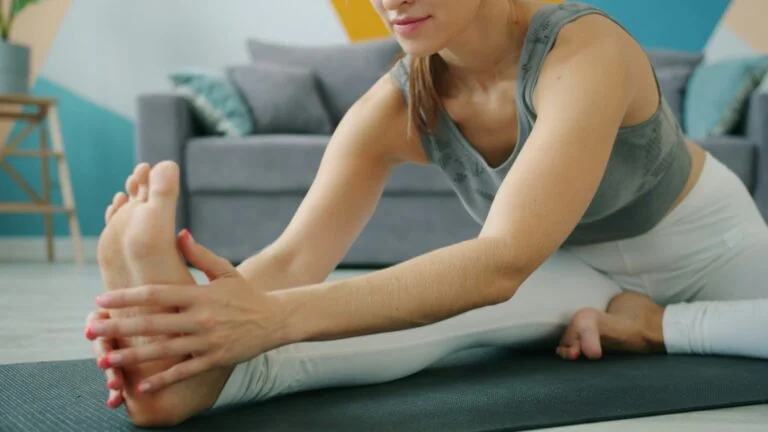
Stretching the sole and calf is the backbone of treatment. These four come from the Arthritis UK plantar heel pain exercise sheet. Start with a few of each, adjust the position so it’s comfortable, and gradually do more.
- Sitting plantar fascia stretch. Sit and cross one foot over your knee. Hold the base of your toes and pull them back towards you until you feel a comfortable stretch along the sole. Hold for 15 to 20 seconds and repeat 3 times. This is a good one to do before you get out of bed or stand up after sitting.
- Arch roll. Sitting down, rest the arch of your foot on a round object such as a tin of beans and roll it in all directions for a few minutes. Do this at least twice a day.
- Towel stretch. Sit with your leg straight, loop a towel around the ball of your foot and pull your toes towards you. Hold for 30 seconds and repeat 3 times on each foot.
- Wall calf stretch. Face a wall with your hands on it at shoulder height, one foot about 30cm from the wall and the other behind. Keeping the back knee straight, bend the front knee towards the wall until the back calf feels tight. Relax and repeat 10 times. Then bring the back foot forward a little so the back knee is slightly bent, and repeat 10 times.
Does stretching work? In a US trial of 101 people who had had plantar fasciitis for at least 10 months, a stretch that targets the sole (like number 1) improved worst pain and first-step pain after 8 weeks more than a standard calf stretch did. A 2021 best practice guide, led from Queen Mary University of London, found plantar fascia stretching was one of the treatments with the best evidence for first-step pain in the short term.
Add strength: the towel heel raise
A Danish trial compared stretching with high-load strength training in 48 people (both groups also had shoe inserts). The strength exercise was a single-leg heel raise with a rolled towel under the toes, done every other day and made progressively harder. At 3 months the strength group reported clearly better foot function. By 6 and 12 months both groups were doing equally well, so strength work may speed things up rather than change the end result.
To try it, stand on one foot with a rolled-up towel under your toes, holding something steady for balance. Rise slowly onto your toes, then lower slowly. Start with a few and build up over the weeks. A physio can show you how to add load safely, and it’s worth asking for if stretching alone isn’t helping. Expect some discomfort, but stop if the pain is sharp or worse the next morning.
Keep going once the pain goes: Arthritis UK suggests carrying on with the exercises to reduce the chance of it coming back. For rest days and food, see muscle recovery, and for aches elsewhere, our guides to knee pain and body aches.
Insoles, night splints and taping: do they work?
The shelves are full of products for heel pain. Here’s what the research says.
| Option | What the evidence shows |
|---|---|
| Off-the-shelf insoles and heel pads | Recommended by the NHS and NICE’s summary as part of self-care. But a 2018 review of 20 trials found ready-made insoles relieved pain no better than sham (fake) insoles in the short term |
| Custom-made insoles | The same review found custom insoles were no better than ready-made or sham ones for short-term pain. The 2021 best practice guide suggests them only as a later step if other treatments haven’t worked |
| Full-length contoured insoles vs heel cups | A 2020 review of 43 studies found full-length contoured insoles worked better than heel cups |
| Night splints | Worn in bed to hold the foot and ankle in a gently stretched position. The 2020 review found they worked better combined with insoles than either alone. A podiatrist can advise |
| Taping | The 2020 review and the 2021 best practice guide both found taping can ease pain in the short term. A physio or podiatrist can show you how |
The honest summary: a supportive shoe with a simple cushioned or contoured insole is a sensible, cheap first step, and there’s no strong reason to pay for custom insoles straight away. None of these replaces stretching and gradually reloading the foot.
Steroid injections and shockwave therapy
If self-care hasn’t helped, a GP may refer you to a physiotherapist or podiatrist. In many areas you can refer yourself to NHS community musculoskeletal (MSK) services. Podiatry isn’t always free on the NHS. If those treatments don’t work, the next options are:
- Steroid injections. A 2017 Cochrane review of 39 studies (2,492 adults) found low-quality evidence that an injection may slightly reduce heel pain for up to a month, but not after that. NICE’s clinical summary warns that the injection can be very painful, soreness afterwards can last several days, symptoms may return within a month, and there is a rare risk of the heel fat pad thinning or the fascia tearing.
- Extracorporeal shockwave therapy (ESWT). This uses high-energy sound waves on the heel. NICE’s guidance (HTG200, first published as IPG311) found no major safety concerns but inconsistent evidence that it works, so it should only be used with special arrangements for consent, audit or research. The 2021 best practice guide was more positive and suggests shockwave for people who haven’t improved with stretching, taping and advice. Availability on the NHS varies by area.
- Surgery. Rarely, if symptoms are severe and nothing else has worked, you may be referred to a specialist to discuss surgery. NICE’s summary suggests referral to an orthopaedic surgeon can be considered if symptoms last 3 to 6 months despite treatment.
How long does plantar fasciitis last?
Usually months rather than weeks, and the figures vary a lot between studies.
- Most people improve within a year. Review articles quoted in NICE’s clinical summary say about 80% of people improve within 12 months with non-surgical treatment, and more than 90% get relief within 3 to 6 months of treatment.
- A minority have it much longer. In a Danish study of 174 people diagnosed at hospital (likely the more stubborn cases), 81% still had symptoms a year after they started and half did after 5 years. In those whose pain did clear, it had lasted about 2 years on average. Women and people with pain in both feet were more likely to have it for longer.
- Heel spurs don’t seem to matter. In the same study, having a heel spur on the scan made no difference to how quickly people got better.
The NHS says to see a GP if your heel hasn’t improved after 2 weeks of self-care. NICE’s summary suggests keeping up the stretches for 4 to 6 weeks, so start early and stick with them.
Footwear tips for plantar fasciitis
- Choose support and cushioning: NICE’s summary suggests comfortable shoes with good arch support and a small heel, such as laced trainers.
- Avoid flimsy or unsupportive shoes: the NHS advises against flip-flops, backless slippers, high heels and tight, pointed shoes.
- Don’t go barefoot on hard floors, including at home. Keep a pair of supportive shoes or slippers by the bed for those first steps.
- Replace worn-out shoes, especially running shoes, when the cushioning has gone.
- Build up gradually when you start a new sport, change surfaces or step up your mileage.
In winter, cold, tight footwear brings its own problems: see cold feet and chilblains.
Red flags and when to see a GP
Call NHS 111 or use 111 online if:
- you have severe heel pain after an injury
- you heard a snap, grinding or popping noise at the time of injury
- you can’t walk, walk on tiptoe or walk up stairs
- your foot or ankle has changed shape or is at an odd angle
- you have swelling and bruising in your calf and ankle
- the pain makes you feel faint, dizzy or sick
Don’t try to treat a possible broken bone yourself.
Ask for an urgent GP appointment or call 111 if your heel is painful, swollen, red and warm and you have a very high temperature, feel hot, cold or shivery, or feel generally unwell. That can be a sign of infection.
If you have diabetes, foot problems can be more serious. Diabetes UK advises calling your GP or foot protection team straight away if you notice anything new that worries you, such as a cut or blister, and calling 111 if you can’t get through.
See a GP if:
- the pain is severe or stops you doing normal activities
- it is getting worse or keeps coming back
- it hasn’t improved after 2 weeks of treating it at home
- you have tingling or loss of feeling in your foot, or your feet feel weak
- you have diabetes and foot pain
A GP can usually diagnose plantar fasciitis from your symptoms and an examination. Scans are only needed if the pain persists or another cause is suspected.
Where our products fit (honestly)
No supplement or balm is a treatment for plantar fasciitis. Supportive shoes, stretching, strength work and proper advice do the heavy lifting. Here’s how our products can sit alongside that routine.
Our CBD Balm, Muscle and Joint Support is a massage balm made with broad spectrum CBD, peppermint, eucalyptus and juniper. It feels cooling and non-greasy, and some people like to use it for a slow foot massage after their stretches or arch rolls. CBD isn’t a treatment for plantar fasciitis or heel pain; see CBD for pain for what the trials actually show, and our CBD balm guide for how to use a balm. Don’t use it on broken or irritated skin, and if you have diabetes or reduced feeling in your feet, ask your GP or foot protection team before using any new product on them.
Our Magnesium Glycinate Sleep Complex is a caffeine-free evening drink with magnesium bisglycinate and citrate, glycine and L-theanine. Magnesium contributes to normal muscle function. It won’t fix a sore heel, but if calf or foot cramps also bother you at night, read leg cramps at night, magnesium for cramps and magnesium for muscle pain.
If you also take CBD by mouth, keep the FSA’s advice in mind. The FSA’s 10mg a day figure is precautionary advice rather than a legal limit, set while longer-term safety research continues. At Evopure we think it is a very cautious figure, and many adults use more. If you go above it, increase slowly, and check with your GP or pharmacist first if you take any medication.
Our products are for adults (18+) only. We don’t recommend our products during pregnancy or breastfeeding. If you take prescribed medicines, check with your pharmacist before adding a supplement.
FAQs
What is the fastest way to get rid of plantar fasciitis?
There’s no quick fix. Combine daily sole and calf stretches, supportive shoes with an insole, ice and painkillers if needed, and less time on your feet. Adding heavy heel raises may speed up early improvement.
How long does plantar fasciitis last?
Most people improve within 12 months, and many within 3 to 6 months of treatment. A minority have symptoms for several years. See a GP if it hasn’t improved after 2 weeks of self-care.
Is walking good for plantar fasciitis?
Keep moving, but cut back on long walks and long spells standing until it settles, and swap some activity for swimming or cycling. Build back up gradually in supportive shoes.
Why is plantar fasciitis worse in the morning?
Pain with your first steps after sleeping or resting is the classic sign, and it usually eases as you move about. Stretching your sole before you stand and wearing supportive footwear for those first steps can help.
Is a heel spur the same as plantar fasciitis?
No. A heel spur is a bony growth on the heel bone that can show up on an X-ray. In a long-term study, having a spur made no difference to how quickly plantar fasciitis got better.
Can CBD balm help plantar fasciitis?
CBD isn’t a treatment for plantar fasciitis. A massage balm can be a pleasant part of a foot-care routine, but stretching, footwear and strength exercises are what help.
When should I see a GP about heel pain?
See a GP if the pain is severe, getting worse, hasn’t improved after 2 weeks, or comes with tingling or numbness, or if you have diabetes. Call 111 after an injury if you can’t walk.
Sources
- NHS. Plantar fasciitis.
- NHS. Heel pain and Pain in the bottom of the foot.
- NICE Clinical Knowledge Summaries. Plantar fasciitis: prevalence, causes and risk factors, prognosis, differential diagnosis and management. Revised December 2024.
- NICE. Extracorporeal shockwave therapy for refractory plantar fasciitis (HTG200, formerly IPG311). 2009.
- Arthritis UK. Plantar heel pain: information and exercise sheet (PDF).
- Diabetes UK. Diabetes and foot problems.
- NHS. Osteomyelitis.
- Hansen L, et al. Long-term prognosis of plantar fasciitis: a 5- to 15-year follow-up study of 174 patients with ultrasound examination. Orthop J Sports Med, 2018. PMID 29536022.
- Rathleff MS, et al. High-load strength training improves outcome in patients with plantar fasciitis: a randomized controlled trial with 12-month follow-up. Scand J Med Sci Sports, 2015. PMID 25145882.
- DiGiovanni BF, et al. Tissue-specific plantar fascia-stretching exercise enhances outcomes in patients with chronic heel pain. J Bone Joint Surg Am, 2003. PMID 12851352.
- Morrissey D, et al. Management of plantar heel pain: a best practice guide informed by a systematic review, expert clinical reasoning and patient values. Br J Sports Med, 2021. PMID 33785535.
- Rasenberg N, et al. Efficacy of foot orthoses for the treatment of plantar heel pain: a systematic review and meta-analysis. Br J Sports Med, 2018. PMID 29555795.
- Schuitema D, et al. Effectiveness of mechanical treatment for plantar fasciitis: a systematic review. J Sport Rehabil, 2020. PMID 31629333.
- David JA, et al. Injected corticosteroids for treating plantar heel pain in adults. Cochrane, 2017. PMID 28602048.
- Butterworth PA, et al. The association between body mass index and musculoskeletal foot disorders: a systematic review. Obes Rev, 2012. PMID 22498495.
This guide is general information, not medical advice. If you’re worried about heel pain, speak to a GP, pharmacist, physiotherapist or podiatrist. Evopure makes the CBD Balm, Muscle and Joint Support and the Magnesium Glycinate Sleep Complex.