

















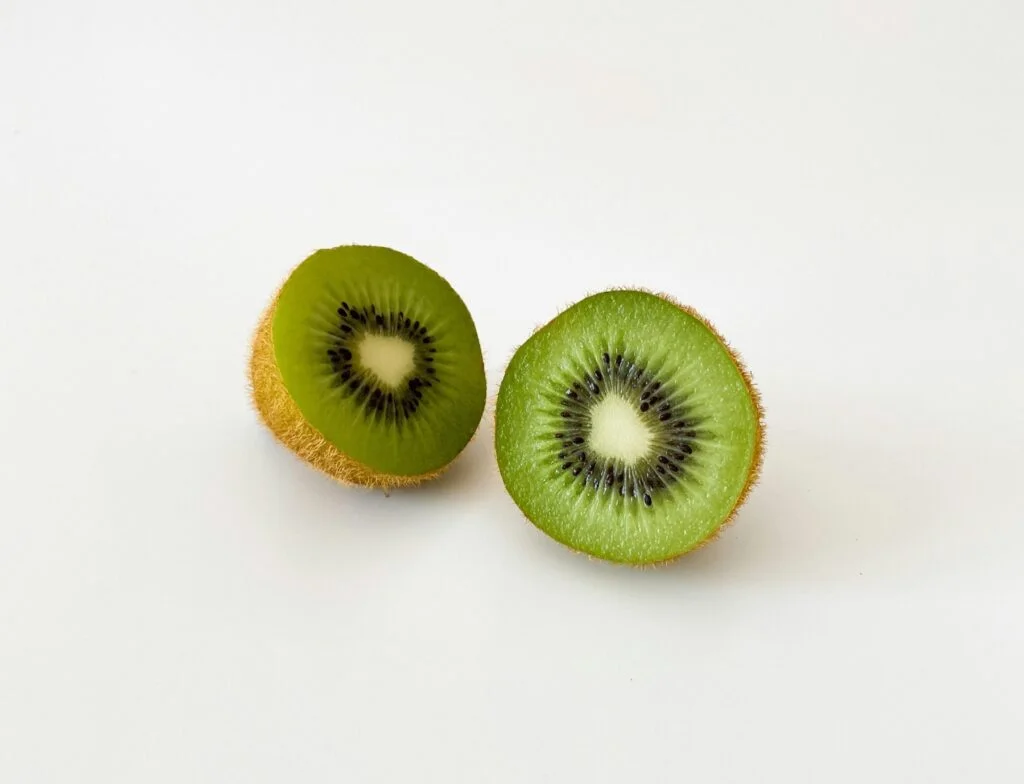
Last updated: October 2026
Eating two kiwis about an hour before bed may help you fall asleep a little faster and sleep slightly longer, but the evidence is thin. The best-known study had just 24 adults and no comparison group. Kiwi is cheap, healthy and safe for most people to try for four weeks, unless you’re allergic to it.
Below: what each study actually found, how strong the evidence is, why kiwi might help, how many to eat and when, green vs gold, and how kiwi compares with the other TikTok sleep foods.
How to try it: eat two medium green kiwis about an hour before bed, every night for four weeks, and keep a simple sleep diary. That is the routine used in the studies. One kiwi on one night is not a fair test.
What the studies show
The viral “two kiwis an hour before bed” advice comes straight from one study. Here is every human study we could find on PubMed.
| Study | Who | What they did | What happened |
|---|---|---|---|
| Taipei, 2011 | 24 adults with sleep problems (22 women) | 2 kiwis 1 hour before bed, 4 weeks, no comparison group | Fell asleep 35% faster, 29% less time awake in the night, 13% more total sleep |
| Elite athletes, 2023 | 15 national squad sailors and runners | 2 green kiwis 1 hour before bed, 4 weeks, no comparison group | About 50 minutes more sleep a night (self-reported), better sleep quality scores, fewer awakenings |
| New Zealand, 2023 | 24 young men, half poor sleepers | One evening of fresh kiwi, dried kiwi powder or water, in random order | Dried kiwi improved morning alertness; poor sleepers woke up more easily; watch-measured sleep mostly unchanged |
| Children, 2025 | 36 children aged 8 to 12 with overweight and sleep problems | Football 2 to 3 times a week, with or without 2 kiwis 1 hour before bed, 4 weeks | The kiwi and football group slept better than the football-only and control groups |
The 2011 Taipei study is the one everyone quotes. Volunteers wore a wrist sleep tracker, kept a sleep diary and rated their sleep quality about 42% better after four weeks. Striking, but everyone knew they were eating kiwi to help their sleep.
The 2023 athletes study copied the routine. Total sleep rose from about 7.6 to 8.6 hours, but there was no control group and sleep was measured by diary only, because of lockdown.
The 2023 New Zealand study was the best designed, with a water comparison in random order, but it tested a single evening only.
A 2026 review of 19 studies on melatonin-containing foods, including kiwi and tart cherries, found possible benefits, mostly in poor sleepers, but mixed results. Our guide to foods that help you sleep ranks the rest.
How strong is the evidence?
Our honest verdict: promising, but early.
- Small: 15 to 36 people per study.
- Mostly uncontrolled: the two four-week adult studies had no comparison group, so expectation, a new bedtime ritual or simply paying attention to sleep could explain part of the effect.
- Mostly self-reported: when sleep was measured with a watch in the controlled study, most measures didn’t change.
- Industry links: one trial had in-kind support from the kiwi industry. The athletes study reported no external funding.
- No big trial yet: nobody has run a large, placebo-controlled kiwi trial in adults with insomnia.
Still, the downside is close to zero for most people. Two kiwis are a light, low-calorie, fibre-rich snack. That makes kiwi a reasonable thing to try, as long as you don’t expect it to work like a sleeping pill.
Why might kiwi help sleep?
Nobody knows for sure. These are the main theories, with the catch for each.
- Serotonin. Kiwi contains serotonin, and in the New Zealand study eating kiwi raised a serotonin breakdown product in urine. Serotonin is a building block of melatonin. The catch: no one has shown kiwi changes serotonin in the brain. See how to boost serotonin naturally.
- Melatonin. Kiwi is grouped with tart cherries and tomatoes as a food that naturally contains some melatonin. The catch: the melatonin marker in urine didn’t rise after kiwi, so it’s unlikely to act like a tablet.
- Vitamin C and antioxidants. Green kiwi has roughly 70 to 90mg of vitamin C per 100g, depending on the fruit and the data source, and the Taipei researchers suggested antioxidants might play a part. The catch: the studies didn’t test this.
- Folate and B vitamins. Kiwi provides some folate, and in the New Zealand study poor sleepers had lower levels of some B vitamins than good sleepers. The catch: that is a link, not proof that topping them up helps.
- A light, regular bedtime snack. Two kiwis may simply replace biscuits or a heavier late meal, and a set ritual helps your body wind down. See is eating before bed bad?
How many kiwis for sleep, and when?
- How many: two medium kiwis. That’s what every study used.
- When: about one hour before bed. The New Zealand study gave kiwi with an evening meal instead, so the exact timing probably matters less than eating them regularly.
- How long: four weeks. The Taipei and athlete results were measured after a month, not after one night.
- Skin on or off: the studies used the flesh of fresh kiwis. The dried powder in the New Zealand study included the skin. Either is fine if you wash it well.
- Track it: note roughly how long it takes to fall asleep and how you feel in the morning, then compare week one with week four.
Kiwi works best on top of the basics: a regular wake-up time, a dark, cool bedroom and no caffeine late in the day. Our bedtime routine for adults and sleep hygiene habits cover these. If your problem is mainly getting to sleep, try the techniques in how to fall asleep fast.
Kiwi won’t give you anything like a melatonin tablet’s dose. In the UK, melatonin is a prescription-only medicine; see melatonin in the UK for why, and the alternatives.
Green vs gold kiwi for sleep
Every sleep study in people used green kiwi, so green is the one with evidence. Gold kiwi is sweeter, with more vitamin C and less fibre. Per 100g:
| Per 100g | Green kiwi | Gold kiwi |
|---|---|---|
| Vitamin C | 93mg | 161mg |
| Fibre | 3g | 1.4g |
| Total sugars | 9g | 12.3g |
| Folate | 25µg | 31µg |
| Energy | 61kcal | 63kcal |
| Taste | Tangy, sweet and sour | Sweet, tropical |
| Used in sleep studies? | Yes | No |
A mouse study found extracts from both green and gold kiwi peel lengthened sleep, but that tells us little about eating the fruit. If you prefer gold, it’s still a healthy snack; just know it hasn’t been tested for sleep.
Kiwi for sleep and constipation
Kiwi’s evidence for constipation is actually stronger than for sleep. In a 2022 randomised trial, two gold kiwis a day for four weeks worked as well as fibre-matched psyllium, and the researchers noted that two green or three gold kiwis a day is a typical approach. The British Dietetic Association’s 2025 guidelines on chronic constipation include whole kiwifruit, finding it increased bowel movements at least as well as psyllium.
So two kiwis in the evening may do double duty. If you’re not used to much fibre, start with one and build up. For more, see magnesium for constipation.
Kiwi vs other bedtime foods
TikTok has a long list of “sleepy” foods and drinks. Here’s how kiwi stacks up, based on the human studies we could find.
| Food or drink | Best evidence | Evidence level |
|---|---|---|
| Kiwi | Small studies; two of three without a comparison group | Early but promising |
| Tart cherry juice | Placebo-controlled: 20 adults slept longer and had higher melatonin after a week; 15 older adults with insomnia had less time awake only | Small, but the best of the bunch |
| Banana | We found no trials of bananas for sleep | None |
| Warm milk | A 2025 review pooled 4 trials of milk and dairy and found better self-reported sleep quality | Limited |
| Oats and carbs | No oat trials. In 12 men, a high-carb rice meal 4 hours before bed cut the time to fall asleep from about 17 to 9 minutes | Very limited |
| Chamomile tea | A review of 12 trials found better sleep quality, but the one insomnia trial showed no change | Limited |
| Sleepy girl mocktail | No trials of the drink; it borrows from tart cherry and magnesium research | None for the drink itself |
Banana vs kiwi: kiwi wins, simply because it has been studied for sleep and banana hasn’t. Cherries vs kiwi: tart cherry juice has the better-controlled studies, but it can be high in sugar, so dilute it. Read more in our guides to tart cherry for sleep, the sleepy girl mocktail, chamomile tea and the best tea for sleep.
Who should be careful
- Kiwi allergy. Kiwi is a common food allergen. If kiwi has ever made your mouth, lips or throat itch or swell, don’t use it as a sleep aid.
- Hay fever and pollen food syndrome. Allergy UK says pollen food syndrome affects about 2% of UK adults, and kiwi is one of the most common triggers. Symptoms usually start within 5 to 10 minutes and settle within an hour. Anaphylaxis UK says this is the most common cause of kiwi reactions in UK adults, and many people can eat cooked kiwi without a problem.
- Latex allergy. People allergic to latex may also react to kiwi, avocado, banana and chestnut (latex-food syndrome).
- Serious reactions. Rarely, kiwi causes a severe reaction with breathing problems or dizziness. Call 999 if this happens. Reactions not linked to pollen are more common in children.
If you think you react to kiwi, see your GP, who can refer you to an allergy service if needed.
Kiwi as part of a wind-down
Food is one small part of sleep; a calm hour before bed and a consistent routine do more of the heavy lifting. Some people pair their evening kiwi with a drink.
Our Magnesium Glycinate Sleep Complex is a berry-flavoured powder you mix into a drink, with magnesium bisglycinate and citrate, glycine, L-theanine, chamomile, passionflower, hops and oat straw. Magnesium contributes to normal psychological function and to the reduction of tiredness and fatigue. Read more in magnesium for sleep and glycine for sleep.
If you’d rather have something warm, our Reishi Mushroom Adaptogenic Complex is a reishi hot chocolate made with cacao, maca and coconut milk powder. Cacao contains a little natural caffeine, so if you’re sensitive to caffeine, have it earlier in the evening and see how you get on.
When to see a GP about insomnia
Most adults need 7 to 9 hours of sleep a night. The NHS advises seeing a GP if changing your sleeping habits hasn’t helped, if you’ve had trouble sleeping for months, or if poor sleep is affecting your daily life in a way that makes it hard to cope. A GP will look for an underlying cause and may offer cognitive behavioural therapy (CBT), in person or through an online programme. Sleeping pills are rarely prescribed. Read more in our insomnia guide.
Kiwis are low in tryptophan. For the foods that are high in it, see our tryptophan foods table.
Kiwi is one of the easiest ways to get your daily vitamin C.
FAQs
Does eating kiwi before bed help you sleep?
It may help a little. In small studies, eating two kiwis an hour before bed for four weeks was linked with falling asleep faster and sleeping longer, but most studies had no comparison group, so the evidence is still early.
How many kiwis should I eat for sleep?
Two medium kiwis, about an hour before bed. That’s the amount used in every sleep study, usually for four weeks.
How long does kiwi take to work for sleep?
The main studies measured results after four weeks of eating two kiwis every night. Give it a month before deciding whether it helps you.
Does kiwi contain melatonin?
Kiwi naturally contains small amounts of melatonin and serotonin, but far less than a melatonin tablet. In one controlled study, eating kiwi didn’t raise the melatonin marker in urine.
Is green or gold kiwi better for sleep?
Green kiwi is the one used in the sleep studies. Gold kiwi has more vitamin C and less fibre, but it hasn’t been tested for sleep.
Is kiwi or banana better for sleep?
Kiwi, because it has been studied for sleep and banana hasn’t. Both make a light bedtime snack.
Can kiwi help with sleep and constipation at the same time?
Possibly. Kiwi’s evidence for constipation is stronger than for sleep: two kiwis a day worked as well as psyllium in trials. Start with one if you’re not used to the extra fibre.
Sources
- Lin HH et al. (2011). Effect of kiwifruit consumption on sleep quality in adults with sleep problems. Asia Pac J Clin Nutr.
- Doherty R et al. (2023). The impact of kiwifruit consumption on the sleep and recovery of elite athletes. Nutrients.
- Kanon AP et al. (2023). Acute effects of fresh versus dried green kiwifruit on sleep quality, mood, and sleep-related urinary metabolites. Front Nutr.
- Kerkeni M et al. (2025). 4-week intervention combining kiwifruit consumption and small-sided soccer games improves sleep quality in children. Nutr Health.
- Nisar T et al. (2026). Effectiveness of melatonin-containing foods on promoting sleep: a scoping review. Food Sci Nutr.
- Richardson DP et al. (2018). The nutritional and health attributes of kiwifruit: a review. Eur J Nutr.
- Yang H et al. (2013). Green and gold kiwifruit peel ethanol extracts potentiate pentobarbital-induced sleep in mice. Food Chem.
- Bayer SB et al. (2022). Two gold kiwifruit daily for effective treatment of constipation in adults: a randomized clinical trial. Nutrients.
- Dimidi E et al. (2025). British Dietetic Association guidelines for the dietary management of chronic constipation in adults. J Hum Nutr Diet.
- Howatson G et al. (2012). Effect of tart cherry juice on melatonin levels and enhanced sleep quality. Eur J Nutr.
- Pigeon WR et al. (2010). Effects of a tart cherry juice beverage on the sleep of older adults with insomnia. J Med Food.
- Peres et al. (2025). The consumption of milk or dairy products and sleep quality: a systematic review and meta-analysis. Cureus.
- Afaghi A et al. (2007). High-glycemic-index carbohydrate meals shorten sleep onset. Am J Clin Nutr.
- Hieu TH et al. (2019). Therapeutic efficacy and safety of chamomile for state anxiety, generalized anxiety disorder, insomnia, and sleep quality. Phytother Res.
- Allergy UK. Oral allergy syndrome (pollen food syndrome).
- Anaphylaxis UK. Kiwifruit allergy.
- NHS. Insomnia.
This guide is general information, not medical advice. Evopure makes the Magnesium Glycinate Sleep Complex and the Reishi Mushroom Adaptogenic Complex.






















