Last updated: October 2026
4-7-8 breathing is a slow-breathing relaxation exercise: breathe in quietly through your nose for 4, hold for 7, then breathe out through your mouth for 8, and repeat 4 times. Research on 4-7-8 itself is limited and it isn’t an instant sleep switch, but slow breathing with a long out-breath does calm the body.
Below: the steps, how many cycles to do, what the research says, how to use it for sleep, anxiety and panic, how it compares with box breathing, and who should take care.
How to do 4-7-8 breathing, step by step
These are the steps as described by Dr Andrew Weil, the US doctor who popularised the technique, which draws on the breath practices of yoga.
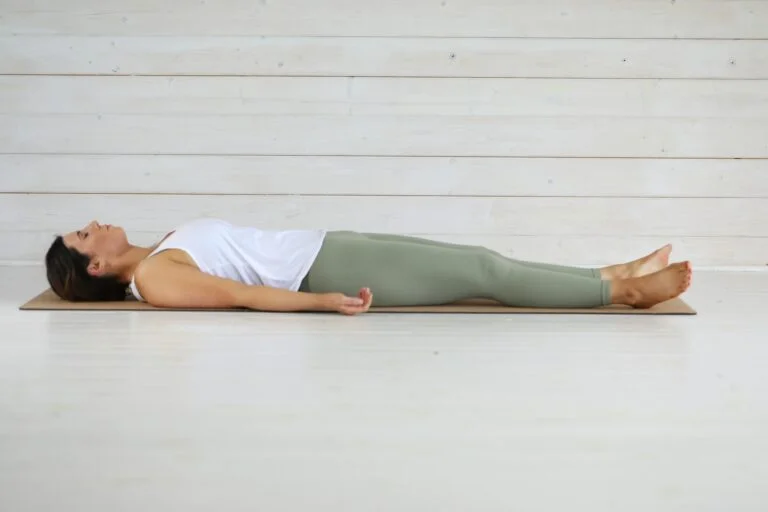
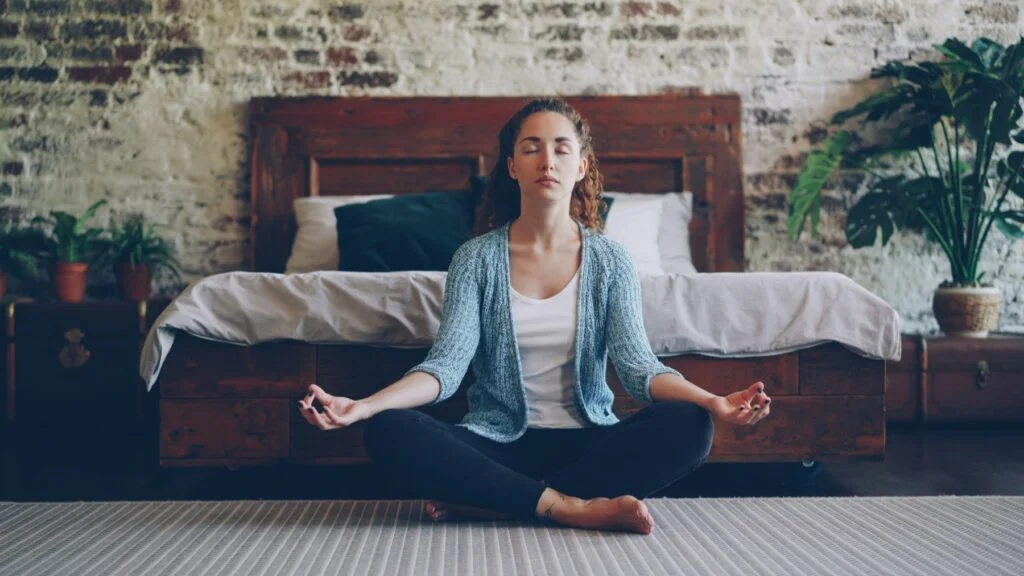
- Get comfortable. Sit with your back straight, or lie down if you’re in bed.
- Place your tongue. Rest the tip of your tongue on the ridge just behind your upper front teeth, and keep it there the whole time.
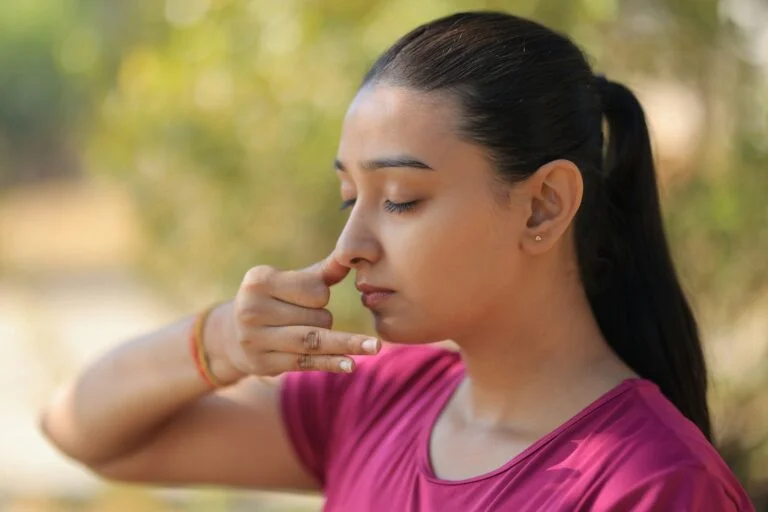
- Breathe out completely through your mouth, around your tongue, with a soft “whoosh”. Purse your lips slightly if that feels awkward.
- Close your mouth and breathe in quietly through your nose for a count of 4.
- Hold your breath for a count of 7, without straining.
- Breathe out through your mouth with a whoosh for a count of 8.
- Repeat 3 more times, so 4 breaths in total. Then breathe normally.
The ratio matters more than the speed. If holding for 7 feels uncomfortable, count faster while keeping the 4:7:8 pattern. Or use a gentler version: a shorter hold (in 4, hold 4, out 8), or no hold at all (in 4, out 6 to 8). The long out-breath matters most.
How many cycles and how often
- How many cycles: 4 breaths at a time. Weil’s handout advises no more than 4 at once for the first month, then up to 8 if you want to.
- How often: at least twice a day, for example when you wake and when you go to bed, plus any time you feel tense.
- How long it takes: one cycle is 19 counts. At roughly a second per count, 4 cycles take a little over a minute.
- Timer or app? You don’t need one. Count in your head, or follow a guided video while you learn the rhythm.
Practising daily when you’re calm makes it more automatic when you need it.
How 4-7-8 breathing works
At a one-second count, 4-7-8 slows you to about 3 breaths a minute, far slower than the usual resting rate. Your heart naturally slows a little on each out-breath, and the vagus nerve drives much of that slowing, so a long exhale works like a gentle brake. That is the link between 4-7-8 and the vagus nerve.
There is also a simpler effect: counting takes enough focus to crowd out racing thoughts. See nervous system regulation.
Does 4-7-8 breathing work? What the research says
Honestly: direct research on 4-7-8 is small, and most of the good evidence is about slow breathing in general.
| Study | Who | What they found |
|---|---|---|
| Vierra et al, 2022 | 43 healthy adults aged 19 to 25 | After 3 sets of 4-7-8 breathing, heart rate and systolic blood pressure dropped straight afterwards. One session, no comparison group. |
| Aktaş and İlgin, 2023 | 90 patients after weight-loss surgery | The 4-7-8 group had lower anxiety scores than the deep breathing and usual-care groups. |
| Marchant et al, 2025 | 84 university students | Breathing at 6 breaths a minute raised heart rate variability more than 4-7-8 or box breathing. None of the patterns meaningfully changed mood or blood pressure in a single session. |
| Kirazli et al, 2026 | 48 people with tinnitus | 6 weeks of 4-7-8 practice lowered insomnia, anxiety and stress scores compared with an information session alone. |
The wider picture is more solid. A 2022 review pooled 223 studies and found slow breathing raises heart rate variability, a marker of the “rest and digest” system, during practice, straight after one session and after programmes lasting weeks. In a month-long Stanford trial published in 2023, 5 minutes a day of breathing exercises improved mood, and cyclic sighing, which uses a long out-breath, did best.
So 4-7-8 is a reasonable way to slow down, but there’s no proof it beats other slow-breathing patterns. Pick the one you’ll keep doing.
4-7-8 breathing for sleep
You’ll see claims that 4-7-8 makes you “fall asleep in 60 seconds”. That is anecdotal: no study has tested it, and 4 cycles take longer than a minute anyway. What it can do is help you relax in bed, which the NHS recommends as part of winding down before sleep.
- Lights off, lying down. Do 4 cycles, breathe normally, and repeat once or twice if you like.
- If you wake in the night, use the gentler no-hold version so you don’t wake yourself up further. See anxiety at night.
- If your mind is racing, pair it with writing a to-do list before bed. See how to stop overthinking.
- Still awake after about 20 minutes? Get up, sit somewhere dim and calm, and go back to bed when you feel sleepy.
For more techniques, including the military method, see how to fall asleep fast and our sleep hygiene guide. The NHS says to see a GP if you’ve had trouble sleeping for months or it’s affecting your daily life. See insomnia.
4-7-8 breathing for anxiety and panic attacks
Everyday anxiety and stress. Use 4 cycles when you notice tension rising or before a difficult meeting. It works best as a habit, not just an emergency tool. For more ideas, see how to relieve stress and how to deal with anxiety.
During a panic attack. Holding your breath for 7 can feel impossible when your chest is tight. Skip the hold and breathe slowly in through your nose for 4 and out through your mouth for 6 to 8. The NHS advice is to stay where you are, breathe slowly and deeply, and remind yourself the attack will pass. See how to stop a panic attack.
It isn’t a treatment. Breathing exercises support treatment rather than replace it. If you have regular panic attacks, see a GP: the NHS lists talking therapies and medicine as the main treatments for panic disorder. The same goes for high blood pressure: keep taking any prescribed medicine and talk to your GP.
4-7-8 vs box breathing vs the physiological sigh
| Technique | How | Good for | Watch out for |
|---|---|---|---|
| 4-7-8 breathing | In 4 through the nose, hold 7, out 8 through the mouth, 4 times | Winding down at bedtime | The long hold can feel hard at first |
| Box breathing | In 4, hold 4, out 4, hold 4, for a few minutes | Staying focused and steady under pressure | Two holds per breath |
| Physiological sigh (cyclic sighing) | Two breaths in through the nose, one long breath out through the mouth | Quick calm, low mood | Keep it slow so you don’t over-breathe |
| Gentle slow breathing | In 4, out 6, about 6 breaths a minute | Panic, beginners, anyone who dislikes holds | Very little |
If you want to go beyond breathing, progressive muscle relaxation, yoga nidra, somatic exercises and mindfulness all pair well with it.
Is 4-7-8 breathing safe? Who should take care
For most adults it’s a gentle, low-risk exercise. A few sensible precautions:
- Stop if you feel dizzy or lightheaded, and breathe normally. Sit or lie down while you practise, especially at first.
- Lung conditions such as asthma or COPD, heart conditions, or pregnancy: use the gentle no-hold version and ask your GP before trying long breath holds.
- Children: keep it gentle and short, with small counts and no long holds.
- Don’t force it. It should feel calming, not like a test of how long you can hold your breath.
A calm evening routine
A wind-down routine might be: screens off, lights low, a warm drink, then 4-7-8 in bed. Our Magnesium Glycinate Sleep Complex is a caffeine-free berry bedtime drink made with magnesium bisglycinate and citrate, glycine and L-theanine. Magnesium contributes to normal psychological function and the normal functioning of the nervous system.
Some people also like Flow CBD Oil, which combines broad spectrum CBD with ashwagandha and maca. CBD isn’t a treatment for anxiety or sleep problems.
The FSA’s 10mg a day figure is precautionary advice rather than a legal limit, set while longer-term safety research continues. At Evopure we think it is a very cautious figure, and many adults use more. If you go above it, increase slowly, and check with your GP or pharmacist first if you take any medication.
Our products are for adults (18+) only, and we don’t recommend them during pregnancy or breastfeeding.
Related guides
- The bedtime routine for adults that 4-7-8 breathing fits into.
- For more on winding down with ringing ears, see tinnitus at night.
- Wondering how this compares with fast breathing? See Wim Hof breathing, including why it suits mornings better than bedtime.
- To build breathing into a longer practice, see our guided sleep meditation script.
FAQs
How many times should you do 4-7-8 breathing?
Do 4 breaths at a time, at least twice a day. Dr Weil advises no more than 4 in a row for the first month, then up to 8.
Does 4-7-8 breathing really work?
Direct research is limited and mostly small, but slow breathing with a long out-breath is well shown to calm the body. Many people find 4-7-8 a helpful way to relax.
Can 4-7-8 breathing make you fall asleep in 60 seconds?
That claim is anecdotal and hasn’t been tested. It can help you relax in bed, which makes falling asleep easier, but it isn’t an instant switch.
Is 4-7-8 breathing better than box breathing?
Neither has been shown to be better. 4-7-8 suits winding down at bedtime, box breathing suits staying steady under pressure. Use the one you find easiest.
Does 4-7-8 breathing lower blood pressure?
One small study saw a short drop straight after practice, another found no meaningful change. It isn’t a treatment for high blood pressure, so keep taking any prescribed medicine.
Why do I feel dizzy doing 4-7-8 breathing?
Changing your breathing pattern can make you lightheaded at first. Stop, breathe normally, and try again later with shorter counts or no hold.
Sources
- NHS. Breathing exercises for stress.
- NHS. Panic disorder.
- NHS. Insomnia.
- NHS Every Mind Matters. How to fall asleep faster and sleep better.
- Andrew Weil Center for Integrative Medicine, University of Arizona. 4-7-8 Breath (patient handout).
- Vierra J et al (2022). Effects of sleep deprivation and 4-7-8 breathing control on heart rate variability, blood pressure, blood glucose, and endothelial function in healthy young adults. Physiological Reports.
- Aktaş GK, İlgin VE (2023). The effect of deep breathing exercise and 4-7-8 breathing techniques applied to patients after bariatric surgery on anxiety and quality of life. Obesity Surgery.
- Marchant J et al (2025). Comparing the effects of square, 4-7-8, and 6 breaths-per-minute breathing conditions on heart rate variability, CO2 levels, and mood. Applied Psychophysiology and Biofeedback.
- Kirazli G et al (2026). The effect of 4-7-8 breathing exercise technique on tinnitus handicap, psychological factors, and sleep quality in tinnitus patients. Brain and Behavior.
- Laborde S et al (2022). Effects of voluntary slow breathing on heart rate and heart rate variability: a systematic review and a meta-analysis. Neuroscience and Biobehavioral Reviews.
- Balban MY et al (2023). Brief structured respiration practices enhance mood and reduce physiological arousal. Cell Reports Medicine.
This guide is general information, not medical advice. Evopure makes the Magnesium Glycinate Sleep Complex and Flow CBD Oil.