







Last updated: October 2026
Yes, for many people music can ease everyday anxiety and stress. A 2020 analysis of 104 trials with 9,617 people found music lowered stress, both in how people felt and in heart rate. Slow, calm music you like, at around 60 to 80 beats per minute, is the best place to start. It isn’t a treatment for an anxiety disorder.
Below: the research, what to listen to, the “most relaxing song” claim, binaural beats and a 10-minute music and breathing routine.
Quick version: choose 15 to 30 minutes of slow, steady music you already like, mostly without lyrics. Put it on with the intention of relaxing, keep the volume low, and pair it with slow breathing. Use it before stressful moments, on the commute or as part of your evening wind-down.
Does music help anxiety? What the research says
The research is broadly positive, with some caveats:
- Stress in general: a 2020 review pooled 104 randomised trials with 9,617 people. Music reduced stress on psychological measures such as anxiety and nervousness (a medium effect) and on body measures (a small to medium effect). The biggest body change was in heart rate.
- Everyday anxiety: a 2023 review from the University of Leeds looked at 24 controlled studies of music listening for ordinary, day-to-day anxiety rather than diagnosed disorders. Across 21 of them it found a large overall effect.
- Before surgery: a Cochrane review of 26 trials (2,051 people) found that listening to music before an operation lowered anxiety scores more than standard care alone. Most trials were at high risk of bias.
- People with cancer: a 2021 Cochrane review of 81 trials found music may reduce anxiety, but rated the evidence very low certainty.
- Music therapy: sessions with a trained music therapist, rather than just listening, showed a medium to large effect on stress in a 2022 review of 47 studies. A Cochrane review of 9 studies found music therapy added to usual care gave short-term benefits for people with depression, including lower anxiety.
Not every result is positive. A 2022 review of 14 lab experiments, where healthy people listened to music after a stress test, found no clear overall benefit for recovery. Results varied with the genre, the tempo and who picked the music.
So music is a useful, low-cost, safe way to take the edge off everyday stress and nerves. It isn’t a cure for generalised anxiety disorder or panic disorder. If anxiety is affecting your daily life, see how to deal with anxiety and our guide to anxiety symptoms.
Why music can calm you down
Music gives an anxious mind something pleasant to follow, lifts mood, and may help your body settle after a stressful moment.
- Your reason for listening matters. In one study, 55 university students rated their stress and music listening four times a day, including during exam week. Listening to music was linked to lower stress, and the effect was strongest when they listened specifically to relax. Those moments also came with lower levels of the stress hormone cortisol.
- It may speed up recovery. In another study, 60 women listened to calm choral music, the sound of rippling water or silence before a standard psychological stress test. Afterwards, a stress marker linked to the nervous system returned to its starting level faster in the music group than in the silent group, although they didn’t feel less stressed than the other groups.
Music won’t switch anxiety off, but it gives your thoughts somewhere else to go when you’re stuck in a loop of worry. See how to stop overthinking.
What is the best music for anxiety?
There’s no single best track. The music used in trials does share some features, though:
- Slow tempo, around 60 to 80 beats per minute. That’s roughly a resting heart rate. Many trials use music at this pace.
- Few or no lyrics. A review of 85 music trials (on pain rather than anxiety) found that music without lyrics worked most consistently. Words pull your attention and can bring back memories. Gentle, familiar lyrics are fine if they relax you.
- Steady and predictable. No sudden drops, loud choruses or big changes in volume.
- Music you like. Music you find irritating won’t relax you, however “scientific” the playlist claims to be.
Taste matters. In one study, 39 fans of extreme metal were made angry and then either listened to 10 minutes of their own metal playlist or sat in silence. The music didn’t make them angrier: their hostility and stress fell just as much as in the silent group, and they felt more active and inspired. If heavy music genuinely settles you, it isn’t wrong.
Our separate guide covers music for sleep, where the advice is similar but the goal is drifting off.
Types of calming music compared
| Type | What to listen for | When it helps | Evidence |
|---|---|---|---|
| Slow instrumental (piano, ambient, strings) | 60 to 80 bpm, no sudden changes | Winding down, before a stressful event | Most studied |
| Slow classical | Gentle slow movements, choral music | Studying, waiting rooms | Common in trials |
| Your own favourites | Music you love, any genre | After a hard day, low mood | Supported in daily-life studies |
| Nature sounds | Rain, waves, running water | Masking noise, background calm | Small studies, mixed |
| Binaural beats | Steady tones, headphones needed | As an experiment | Weak and inconsistent |
If you prefer steady sound to music, see brown noise vs white noise vs pink noise. If whispering and soft tapping sounds relax you, our ASMR guide has a section on ASMR for anxiety.
“Weightless” and the most relaxing song in the world claim
You’ll often read that “Weightless” by Marconi Union is the most relaxing song ever recorded and cuts anxiety by 65%. Here’s what the original test actually was:
- It was run by Mindlab International, a commercial research company, and commissioned by the bath brand Radox Spa.
- About 40 women did hard puzzles against the clock while wearing sensors, then listened to different tracks, including songs by Mozart, Coldplay and Adele.
- The 65% figure came from the company’s own reporting. We couldn’t find it published in a peer-reviewed journal, and how anxiety was measured isn’t clear.
According to a sound therapist quoted in the coverage, the track starts at about 60 beats per minute and slows to around 50, which fits what the wider research suggests. So it’s a good choice to try. Just treat “most relaxing song in the world” as a headline, not a finding. Some listeners felt drowsy, so don’t play it while driving.
Do binaural beats help anxiety?
Binaural beats play a slightly different tone in each ear, so your brain hears a third, pulsing beat. They only work through headphones. The claim is that the beat nudges your brainwaves into a calmer rhythm.
- A 2019 meta-analysis of 22 studies found a medium overall effect across memory, attention, anxiety and pain combined, with results depending on the frequency used and how long people listened.
- A 2023 review of 14 brain-recording studies found the brainwave idea itself poorly supported: five studies fitted it, eight contradicted it and one was mixed.
- A 2026 review of 13 trials of theta (4 to 8 Hz) beats couldn’t pool the anxiety results because the studies measured them so differently.
“432 Hz” music has even less behind it. In a 2025 German trial in 43 people with cancer, calm sound sessions tuned to 432 Hz and to standard concert pitch both improved how people felt, with no clear difference between them.
Our view: at a low volume they’re unlikely to do harm, but there’s no good evidence they beat ordinary slow music. Try both and keep whatever works for you.
How long to listen and when it helps most
- Aim for 15 to 30 minutes. In a daily-life study of 60 young adults, at least 20 minutes of listening was linked with lower stress afterwards, and the effect showed up with a delay rather than straight away.
- Before a stressful moment. The surgery trials tested music in the run-up to a stressful event, so it makes sense to try it before an exam, interview, dental visit or flight.
- On the commute or at your desk, to break up a tense day.
- In the evening, as part of switching off. If worry peaks at bedtime, see anxiety at night.
- Keep the volume down. The World Health Organization suggests keeping personal devices at no more than 60% of maximum volume.
A simple 10-minute music and breathing routine
The music gives you a steady pace, and slow breathing gives your body something to do.
- Pick one calm track or a short playlist you already like. Use the same one each time so it becomes a cue to relax.
- Sit or lie comfortably, phone face down, volume low. Headphones help if it’s noisy.
- For the first two minutes, just listen. Notice one instrument and follow it.
- Then breathe slowly with the music. The NHS breathing exercise for stress is to breathe in gently, counting steadily from 1 to 5, then let the breath flow out gently, counting 1 to 5 again, for at least 5 minutes.
- For the last two minutes, let your breathing return to normal and notice how your shoulders, jaw and hands feel.
If you’d like other techniques to pair with music, try box breathing, 4-7-8 breathing or a wider breathwork practice. Music also makes a good anchor for mindfulness for beginners.
Building a calmer routine around music
Music works best alongside the basics: regular sleep, daily movement, time outdoors and less caffeine. See does caffeine cause anxiety?
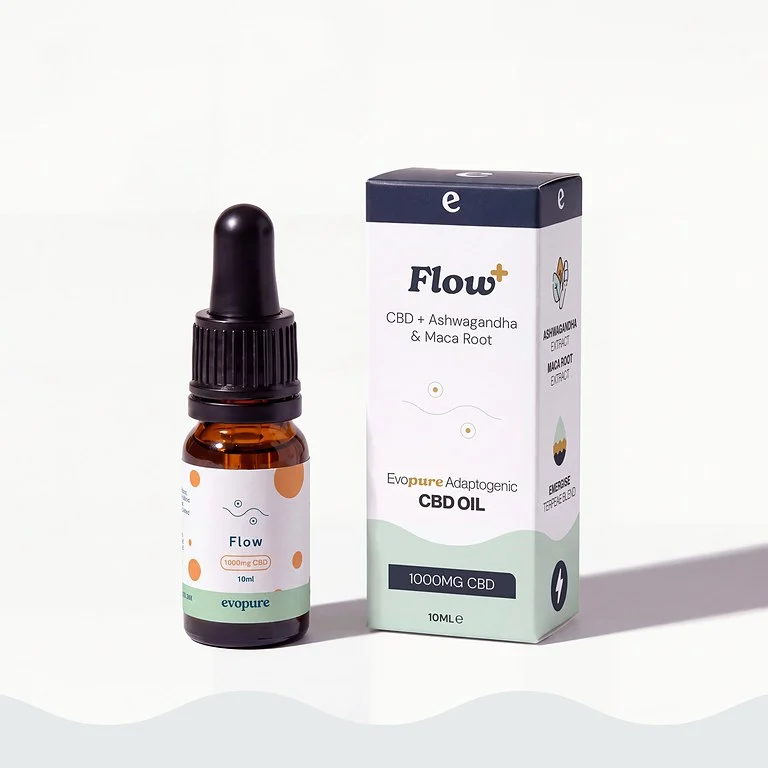
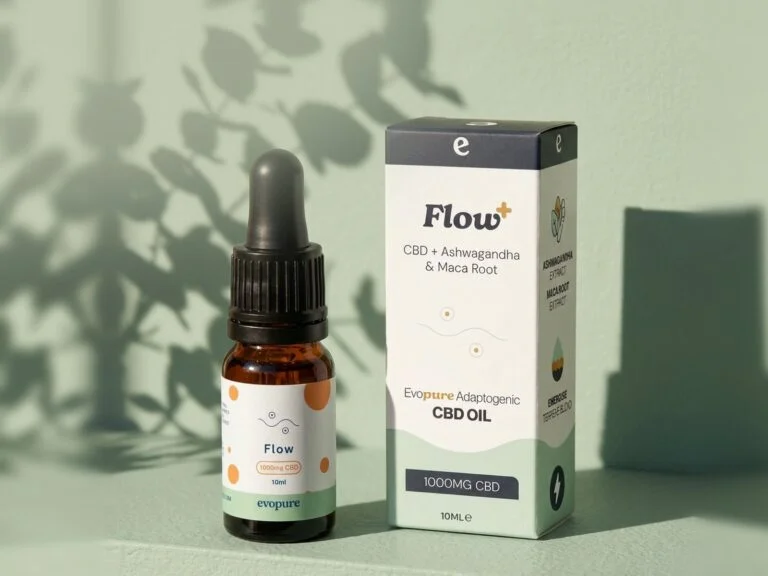
Some people pair an evening playlist with a drink as part of winding down. Our Magnesium Glycinate Sleep Complex is a caffeine-free berry drink with magnesium bisglycinate, L-theanine and chamomile, and magnesium contributes to normal psychological function. Our Reishi Mushroom Adaptogenic Complex is a reishi hot chocolate with cacao and maca. It contains a little natural caffeine from the cacao, so it suits the afternoon better than late evening. Some people take our Flow CBD Oil, with ashwagandha and maca, as part of their day.
None of these is a treatment for anxiety, and CBD isn’t a treatment for anxiety. The FSA’s 10mg a day figure is precautionary advice rather than a legal limit, set while longer-term safety research continues. At Evopure we think it is a very cautious figure, and many adults use more. If you go above it, increase slowly, and check with your GP or pharmacist first if you take any medication. Our products are for adults only, and we don’t recommend our products during pregnancy or breastfeeding.
Can music help during a panic attack?
There’s little research on music during a panic attack itself. Some people find a familiar song gives them something to focus on while the wave passes, a bit like a grounding exercise. If you want to try it, save one short, calm, familiar playlist on your phone in advance, so you aren’t searching for it in the moment.
Breathing slowly and reminding yourself that a panic attack passes are the core skills. See how to stop a panic attack, grounding techniques and how to calm down fast.
When to get help
Music can help with everyday stress, but see a GP if anxiety is affecting your sleep, work, relationships or enjoyment of life, if you’re having panic attacks, or if it isn’t easing. Generalised anxiety disorder and panic disorder are common and treatable, usually with talking therapy such as CBT first. Adults in England can refer themselves to NHS Talking Therapies without seeing a GP.
If you need help now: call 111 and choose the mental health option, or call Samaritans free on 116 123, any time. Call 999 or go to A&E if you feel you can’t keep yourself or someone else safe.
FAQs
Does music actually help anxiety?
For everyday stress and nerves, yes for many people. A review of 104 trials found music lowered stress on both how people felt and body measures such as heart rate. It isn’t a treatment for an anxiety disorder.
What is the best music for anxiety?
Slow, steady music you like, at around 60 to 80 beats per minute, with few or no lyrics. Slow piano, ambient music, gentle strings and slow classical pieces are good places to start, but personal taste matters.
Is Weightless really the most relaxing song in the world?
That claim comes from a commercial test of about 40 women commissioned by Radox Spa, not a peer-reviewed study. The track is slow and steady, so it’s worth trying, but no single song is proven to be the most relaxing.
Do binaural beats help anxiety?
The evidence is weak and inconsistent. Studies are small and varied, and the idea that the beats change your brainwaves isn’t well supported. They’re unlikely to harm you at a low volume, but there’s no good evidence they beat ordinary calm music.
How long should I listen to calming music for anxiety?
About 15 to 30 minutes is a good target. One daily-life study linked at least 20 minutes of listening with lower stress afterwards. Listening on purpose to relax seems to work better than background music.
Can music help with a panic attack?
There’s little research on this, but a familiar, calm song can give you something to focus on while the panic passes. Slow breathing and grounding are the core skills, and see a GP if panic attacks keep happening.
Can music replace therapy or medication for anxiety?
No. Music is a helpful extra for everyday stress, not a replacement for treatment. If anxiety affects your daily life, see a GP or refer yourself to NHS Talking Therapies, and don’t stop any medicine without advice.
Sources
- de Witte M, et al. Effects of music interventions on stress-related outcomes: a systematic review and two meta-analyses. Health Psychol Rev. 2020.
- de Witte M, et al. Music therapy for stress reduction: a systematic review and meta-analysis. Health Psychol Rev. 2022.
- Harney C, et al. Is music listening an effective intervention for reducing anxiety? A systematic review and meta-analysis of controlled studies. Musicae Scientiae. 2023.
- Bradt J, et al. Music interventions for preoperative anxiety. Cochrane Database Syst Rev. 2013.
- Bradt J, et al. Music interventions for improving psychological and physical outcomes in people with cancer. Cochrane Database Syst Rev. 2021.
- Aalbers S, et al. Music therapy for depression. Cochrane Database Syst Rev. 2017.
- Adiasto K, et al. Music listening and stress recovery in healthy individuals: a systematic review with meta-analysis of experimental studies. PLoS One. 2022.
- Linnemann A, et al. Music listening as a means of stress reduction in daily life. Psychoneuroendocrinology. 2015.
- Linnemann A, et al. Music listening and stress in daily life: a matter of timing. Int J Behav Med. 2018.
- Thoma MV, et al. The effect of music on the human stress response. PLoS One. 2013.
- Martin-Saavedra JS, et al. Standardizing music characteristics for the management of pain: a systematic review and meta-analysis of clinical trials. Complement Ther Med. 2018.
- Sharman L, Dingle GA. Extreme metal music and anger processing. Front Hum Neurosci. 2015.
- Garcia-Argibay M, et al. Efficacy of binaural auditory beats in cognition, anxiety, and pain perception: a meta-analysis. Psychol Res. 2019.
- Ingendoh RM, et al. Binaural beats to entrain the brain? A systematic review. PLoS One. 2023.
- Fatima I, et al. Efficacy of theta binaural beat therapy on pain, cognition and anxiety in adults: a systematic review and meta-analysis. Explore (NY). 2026.
- Hohneck A, et al. Differential effects of sound interventions tuned to 432 Hz or 443 Hz on cardiovascular parameters in cancer patients. BMC Complement Med Ther. 2025.
- Stylist. Report on the Radox Spa “Weightless” test. 2016.
- NHS. Generalised anxiety disorder (GAD).
- NHS. Breathing exercises for stress.
- NHS. Where to get urgent help for mental health.
- World Health Organization. Deafness and hearing loss: safe listening.
This guide is general information, not medical advice. Evopure makes the Magnesium Glycinate Sleep Complex, Flow CBD Oil and Reishi Mushroom Adaptogenic Complex.