Last updated: 10 November 2026
A cluster headache is a rare, very severe headache felt on one side of the head, usually in or around one eye. Attacks last 15 minutes to 3 hours, can happen several times a day for weeks, then stop for months. Ordinary painkillers don’t work, but oxygen and triptan injections or nasal sprays prescribed by a doctor can.
Below: the symptoms, how it differs from migraine and tension headache, what triggers a bout, the NHS and NICE treatments, and when to get urgent help. Checked against the NHS cluster headaches page and NICE’s headache guideline (CG150) in November 2026.
Is it an emergency? The NHS says call 999 or go to A&E if you have a drooping eyelid or a smaller pupil in one eye for the first time, even if you’ve already been diagnosed with cluster headaches. Also call 999 for a sudden, extremely painful headache, or a headache with weakness, confusion or trouble speaking. See when to get help.
What is a cluster headache?
A cluster headache is a primary headache disorder: the headache itself is the condition, not a sign of another illness. It causes attacks of severe one-sided pain around the eye with a red, watering eye and a blocked nose on the same side. Attacks come in “clusters” lasting weeks or months, often at the same time of day.
It is much rarer than migraine. A meta-analysis of population studies found about 1 in 1,000 people have cluster headaches at some point in their life, and men are affected about four times as often as women. The NHS says it is more common in men in their 30s and 40s, and in people with a close family member who has it. The cause isn’t known.
Cluster headache symptoms
The main symptom is a sharp, burning or piercing pain on one side of the head, usually around the eye. The NHS says attacks start and stop quickly, last 15 minutes to 3 hours and often come at the same time of day or year. The pain can make you restless, so many people pace rather than lie still.
On the same side as the pain, the NHS lists:
- a red, watering eye
- a drooping or swollen eyelid
- a smaller pupil
- a sweating face
- a blocked or runny nose
Some people also feel sick. NICE describes the pain as severe or very severe, and says attacks can come from once every other day to 8 times a day. The Migraine Trust says many people find attacks come on at night, often at the same time every night, which is why cluster headache is one of the causes in our guide to waking up with a headache.
Cluster headache vs migraine vs tension headache
These are the three most common primary headaches. This table is based on NICE’s headache features table (CG150) and the NHS pages for each.
| Feature | Cluster headache | Migraine | Tension headache |
|---|---|---|---|
| Where | One side, around or above the eye and side of the head | One or both sides, often one | Both sides, head, face or neck |
| Feels like | Sharp, boring or burning | Throbbing | Pressing or a tight band |
| How bad | Severe or very severe | Moderate or severe | Mild or moderate |
| How long | 15 minutes to 3 hours | 4 hours to 3 days | 30 minutes to several days |
| During an attack | Restless or agitated | Want to lie still in the dark | Can usually carry on |
| Other signs | Red, watery eye, blocked nose, drooping eyelid on that side | Feeling sick, light and sound sensitivity, aura | Usually none |
| Painkillers | Don’t work | Can help if taken early | Usually help |
For more on the other two, see our migraine guide and how to get rid of a tension headache. For every type side by side, including sinus, hormone and medication overuse headaches, see types of headaches and their red flags.
What are clusters and remission?
A cluster, or bout, is the stretch of weeks or months when attacks happen. Remission is the pain-free gap between bouts, which can last weeks, months or years. The NHS says some people have no gap at all.
- Episodic cluster headache: bouts separated by pain-free periods of more than 1 month (NICE). This is the most common form.
- Chronic cluster headache: attacks continue with pain-free periods of less than 1 month in a year (NICE). The Migraine Trust says up to 2 in 10 people with cluster headache have the chronic form.
The Migraine Trust also says cluster headache tends to get better with age, with less frequent bouts and longer remissions.
What triggers cluster headaches?
Possible triggers listed by the NHS include smoking, alcohol, strong smells such as perfume, paint, nail varnish or petrol, and exercise. Many people find that alcohol sets off an attack during a bout but not during remission, so avoiding alcohol for the length of a bout is a common step. A headache diary can help you spot your own pattern.
If you’re cutting out alcohol during a bout, our guides to alcohol-free drinks and alcohol and sleep may help.
Cluster headache treatment
There’s no cure, but cluster headache treatment from a GP or specialist can ease and prevent attacks. For an attack, NICE recommends oxygen and/or a triptan given as an injection under the skin or as a nasal spray. To prevent attacks during a bout, NICE suggests verapamil, started with specialist advice and heart (ECG) checks. Ordinary painkillers such as paracetamol and ibuprofen don’t work.
Oxygen
NICE recommends 100% oxygen at a flow rate of at least 12 litres a minute, through a non-rebreathing mask with a reservoir bag, with oxygen arranged at home and to take out with you. In a London trial of 76 people, breathing oxygen at 12 litres a minute for 15 minutes left people pain free or with adequate relief in 78% of attacks, compared with 20% with air.
Triptans
Sumatriptan is the triptan most often used, given as an injection under the skin. The Migraine Trust says a 6mg sumatriptan injection provides relief within 15 minutes. NICE also allows nasal triptans, though it notes these were off-label for cluster headache in the UK as of June 2025. NICE says not to offer triptan tablets for cluster headache, and to prescribe enough injections or sprays to cover your usual bouts.
Nerve stimulation
The NHS lists a device that gives mild electrical pulses to the back of the neck as another option during an attack. Rarely, when other treatments haven’t worked, surgery to implant a small device may be offered.
Why don’t regular painkillers work?
The NHS says painkillers such as paracetamol and ibuprofen do not work for cluster headaches. NICE says not to offer paracetamol, NSAIDs such as ibuprofen, opioids such as codeine, ergots or oral triptans for cluster headache. Taking them often can also lead to medication overuse headache.
Preventing attacks during a bout
The NHS lists corticosteroids, verapamil and lithium as preventive medicines a doctor may prescribe. Verapamil is a heart medicine, so it needs ECG checks, and NICE notes its use for cluster headache is off-label. NICE says to get specialist advice if verapamil doesn’t work, or if treatment is needed during pregnancy. Never stop a prescribed medicine without speaking to your prescriber.
How is a cluster headache diagnosed?
There’s no specific test. The NHS says a GP will ask about where the pain is, how often it comes, how long it lasts and what else happens during an attack, and may refer you for a brain scan to rule out other causes. NICE advises doctors to discuss a scan with a headache specialist or neurologist for anyone with a first bout. Keeping a diary of every attack (time, length, side and symptoms) makes diagnosis quicker. If one-sided headaches are new for you, our headache location guide and headache behind the eyes cover other causes.
When to get urgent help
Call 999 or go to A&E if:
- you have a drooping eyelid or a smaller pupil in one eye for the first time, even if you’ve already been diagnosed with cluster headaches (NHS)
- a headache started suddenly and is extremely painful
- you have numbness or weakness in your face or body, or find it hard to speak, balance, walk or remember things
- you’re drowsy or confused, have had a fit, or have lost your vision
- you have a very high temperature, a stiff neck, bright lights bother you, or a rash doesn’t fade when a glass is rolled over it
Do not drive yourself to A&E. Ask someone to drive you or call 999 for an ambulance.
Get an urgent GP appointment or call 111 if:
- you have a severe headache with jaw pain when eating, blurred or double vision, a sore scalp, or numbness or weakness in the arms or legs (the NHS says these can be signs of temporal arteritis)
See a GP if:
- you think you might have cluster headaches
- your headaches keep coming back, or painkillers don’t help
- the pain makes you restless or agitated
- your cluster headaches are getting worse, lasting longer, or not responding to your usual treatment
If the pain is affecting your mood: cluster headaches can be exhausting and frightening. If you feel hopeless or have thoughts of harming yourself, call Samaritans free on 116 123, any time, or call NHS 111. In an emergency, call 999.
Support and living with cluster headaches
The NHS points people to two UK charities: OUCH UK, the charity for people with cluster headache and their families, and The Migraine Trust. Both have information on getting oxygen at home, talking to your GP and finding a headache clinic.
- Plan for bouts: if your bouts come at the same time each year, ask your GP or specialist about having oxygen and triptans ready before the next one.
- Keep a diary: time, length and side of each attack, plus alcohol, smoking and strong smells.
- Protect your sleep: night attacks break up sleep, so a steady routine helps the rest of the day. See sleep hygiene habits that work.
- Tell people: family and work need to know an attack is brief but disabling, and that you may need to step away and use oxygen.
Where Evopure fits (honestly)
No supplement treats or prevents cluster headaches, and Evopure’s products are not a treatment for any headache. The treatments above come first. What we can offer is help with an evening routine during a bout:
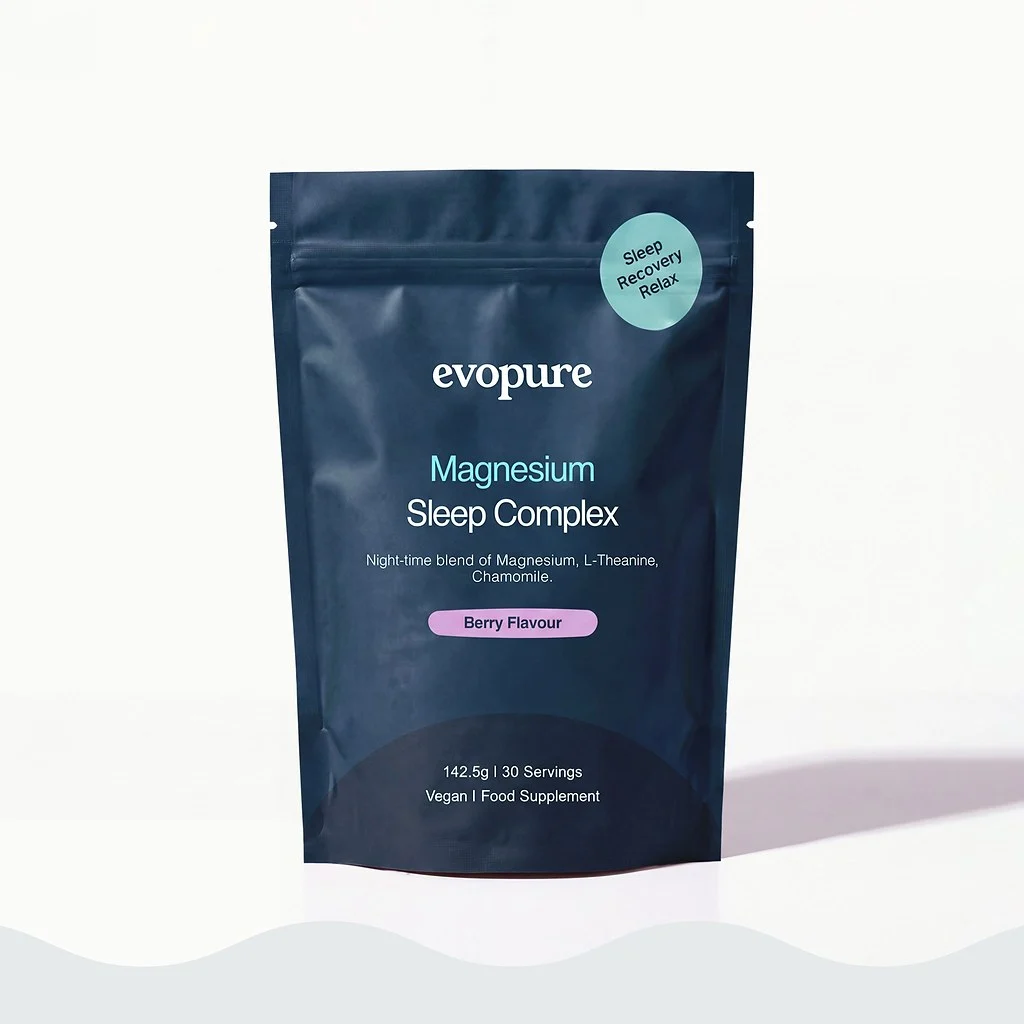
- Magnesium Glycinate Sleep Complex: a caffeine-free berry drink powder with 290mg of magnesium (77% NRV) per 4.75g scoop, from bisglycinate and citrate, plus glycine and L-theanine. Magnesium contributes to a reduction of tiredness and fatigue and to normal psychological function.
- Reishi Mushroom Adaptogenic Complex: a reishi hot chocolate (0.5g reishi and 0.5g maca per 8g serving) if you’re swapping out an evening drink during a bout. It contains a little natural caffeine from the cocoa, and the pack says it isn’t for people on medication, so check with your pharmacist first if you take verapamil, lithium or any other medicine.
For what the research says about magnesium and headache, see our magnesium for migraines evidence review.
Next step
Magnesium Glycinate Sleep Complex
if night attacks are leaving you drained, add the Magnesium Glycinate Sleep Complex to your evening routine: 290mg of magnesium (77% NRV) per 4.75g berry drink, caffeine-free. Magnesium contributes to a reduction of tiredness and fatigue. It doesn’t treat cluster headaches.
Add Magnesium Glycinate Sleep Complex to bag See ingredients and reviews
Subscribe and save 25% on your first order, then 20%. New to Evopure? Join our emails for 20% off a one-off first order. Free UK delivery over £40. Vegan and made in the UK. If you take any regular medicines, check with your GP or pharmacist first. We don’t recommend our products during pregnancy or breastfeeding. For adults (18+) only.
Subscribe £22.49One-off £29.99
View productSources 8
- NHS. Cluster headaches (reviewed 18 August 2023).
- NHS. Headaches (reviewed 17 April 2024) and Temporal arteritis.
- NICE. Headaches in over 12s: diagnosis and management (CG150), recommendations 1.3.34 to 1.3.41 and table 1.
- Cohen AS, Burns B, Goadsby PJ. High-flow oxygen for treatment of cluster headache: a randomized trial. JAMA, 2009.
- Fischera M et al. The incidence and prevalence of cluster headache: a meta-analysis of population-based studies. Cephalalgia, 2008.
- OUCH UK. Organisation for the Understanding of Cluster Headache.
- The Migraine Trust. Cluster headache.
- Samaritans. Contact Samaritans.
This guide is general information, not medical advice. Always follow your doctor’s advice and the leaflet that comes with your medicine. Evopure makes the Magnesium Glycinate Sleep Complex and doesn’t make or sell headache medicines.