

















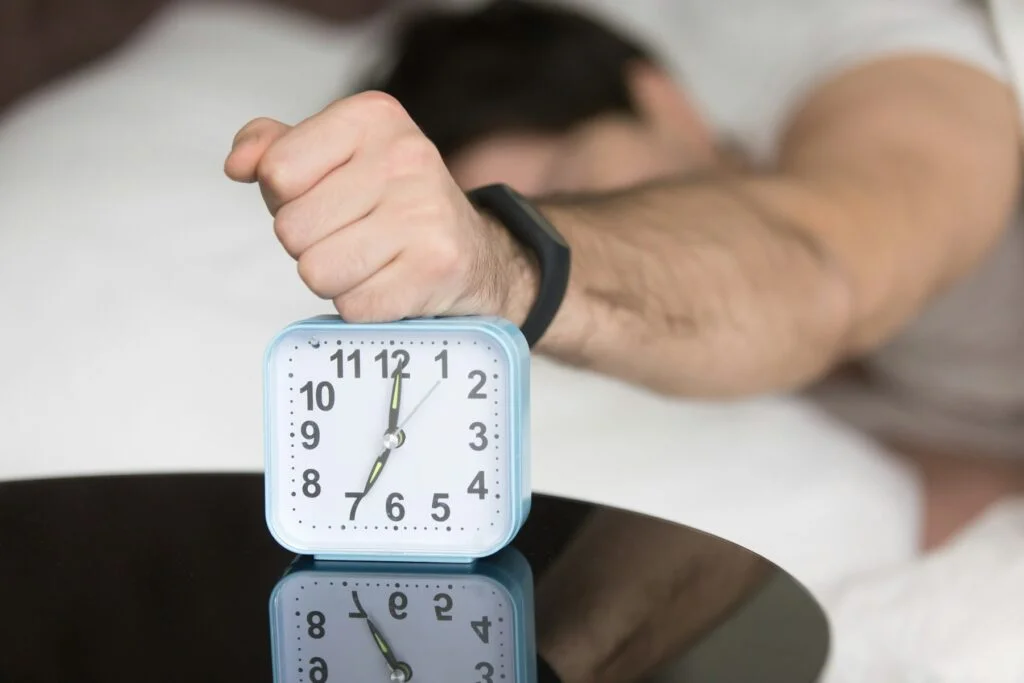
Last updated: October 2026
An occasional lie-in after a short or busy week is fine. But regularly sleeping much more than 9 hours and still waking tired can be a sign of poor-quality sleep, low mood or a health problem worth checking with a GP. Studies link long sleep with health risks, but mostly as a marker of illness, not a cause.
Below: how much sleep is too much, oversleeping vs hypersomnia, the common causes, what the research really shows, why a long sleep can leave you groggy, how to stop oversleeping and when to see a GP.
How much sleep is too much?
There’s no single magic number, but there is a normal range. A National Sleep Foundation expert panel recommends 7 to 9 hours a night for adults, 7 to 8 hours for adults over 65 and 8 to 10 hours for teenagers. The same panel notes that sleeping far outside that range is rare, and that people who habitually do so may be showing signs of a health problem.
So as a rough guide for adults:
- 7 to 9 hours on most nights is normal.
- An occasional 10 or 11 hours after late nights, travel or illness is just your body catching up.
- Regularly needing 10 hours or more, or sleeping 9 hours and still feeling unrefreshed, is worth paying attention to.
Your own need sits somewhere in that range. To work out a bedtime that fits your wake time, try our sleep calculator.
Oversleeping vs hypersomnia
“Oversleeping” is an everyday word: sleeping through your alarm, or sleeping longer than you meant to. Hypersomnia is a medical term. The NHS describes excessive daytime sleepiness (hypersomnia) as falling asleep repeatedly during the day, which is different from feeling tired all the time. People with it may nap regularly and still sleep for long hours at night.
Two less common conditions are worth knowing about:
- Idiopathic hypersomnia. Narcolepsy UK says it typically involves a long sleep of 11 hours or more, then waking unrefreshed, confused and irritable, a foggy state called sleep inertia that can last for hours. Diagnosis usually needs an overnight sleep study and a daytime nap test in a specialist sleep clinic.
- Narcolepsy. The NHS describes uncontrollable sleepiness, falling asleep suddenly during the day and, in some people, sudden muscle weakness triggered by emotions such as laughter (cataplexy).
Most people who oversleep have neither, but if you can’t stay awake in the day despite long nights, tell your GP.
Why do I oversleep? Common causes
Oversleeping is usually a sign that something else is going on, rather than a problem in itself. These are the usual suspects.
| Cause | Clues | What to do |
|---|---|---|
| Sleep debt | Short nights in the week, then very long sleeps at the weekend | Earlier bedtimes on work nights. See sleep deprivation |
| Poor-quality sleep, including sleep apnoea | Loud snoring, gasping or choking noises, waking a lot, headache on waking | See a GP. Read sleep apnoea |
| Low mood or depression | Low mood, little interest in things, using sleep to escape | Talk to your GP. See low mood vs depression |
| Medicines | Drowsiness started with a new medicine or dose change | Ask your pharmacist. Don’t stop prescribed medicine on your own |
| Underactive thyroid | Tiredness, weight gain, feeling the cold | Ask about a blood test. See underactive thyroid symptoms |
| Anaemia | Very tired, pale skin, shortness of breath, palpitations | Blood test. See iron deficiency symptoms |
| Winter and SAD | Sleeping more and feeling low from autumn, easing in spring | Daylight, routine, a GP if it affects daily life. See seasonal affective disorder |
| Alcohol | Longer, heavier sleep after drinking, but waking unrefreshed | Drink less, and not close to bedtime |
| Body clock running late | Wide awake at midnight, can’t get up in the morning | Fixed wake time and morning light. See circadian rhythm |
| Hypersomnia or narcolepsy | Falling asleep in the day despite long nights | See a GP, who may refer you to a sleep clinic |
The NHS also lists restless legs, bipolar disorder and ME/CFS among the causes of excessive sleepiness. Many of these cause general tiredness too: see why am I always tired?
Is oversleeping bad for you? What the research shows
Long sleep and long-term health
A 2010 meta-analysis led by Professor Francesco Cappuccio at the University of Warwick pooled 16 studies with over 1.3 million people. Long sleepers had a 30% higher risk of dying during follow-up than people who slept a normal amount, and short sleepers a 12% higher risk. A follow-up analysis found long sleep was also linked with a higher risk of heart disease and stroke. A larger 2018 review of 137 studies found similar links with diabetes and heart disease.
But these studies show an association, not cause and effect. The Warwick team described long sleep as a predictor, or marker, of poor outcomes, and the 2018 authors said it’s still unclear whether the link is causal. The most likely explanation is that illness, low mood, inactivity or poor-quality sleep make people sleep longer, rather than the extra hours themselves doing harm.
The oversleeping headache
Lots of people wake with a dull headache after a big lie-in. The NHS advice for headaches includes not sleeping more than you usually would, as it can make a headache worse. In a study of 1,207 people with migraine, 32% said sleeping late was a trigger. For other reasons you might wake with a sore head, see waking up with a headache.
Weekend lie-ins and “social jet lag”
Sleeping in at the weekend shifts your body clock later, so Monday morning feels like flying across a time zone. Researchers call this social jet lag, and in a large study it was associated with a higher body mass index. A small lab study found that catching up at the weekend didn’t undo the effects of short sleep in the week: when short nights resumed, people’s body clocks were later and their insulin sensitivity was lower. A steady routine beats a big weekly catch-up. See how to wake up early.
Why oversleeping makes you tired
Why can 11 hours leave you feeling worse than 7?
- Sleep inertia. This is the groggy spell after waking, when alertness is temporarily lower. A 2024 review found it tends to be worse when you wake from deeper sleep or after a run of short nights, which is exactly what a big weekend catch-up looks like.
- A shifted body clock. A late wake time means a later bedtime, a shorter night before work and another tired morning.
- The cause, not the hours. If apnoea, low mood or an underactive thyroid is behind the long sleep, you’ll feel tired however long you stay in bed.
If that sounds familiar, read why you wake up tired.
How to stop oversleeping
- Pick one wake time and keep it, weekends included. The NHS says getting up at similar times each day helps your body know when it’s time to sleep, even on days off.
- Get daylight early. Open the curtains straight away and get outside within an hour of waking if you can. Daylight reaching your eyes is the main signal that keeps your body clock in time with the 24-hour day.
- Put the alarm across the room so you have to get up to switch it off, and skip the snooze button.
- Cap weekend lie-ins at about an hour past your normal wake time. If you’re short of sleep, go to bed earlier instead.
- Keep naps short and early so you’re still sleepy at bedtime. See how to power nap.
- Build a wind-down routine so you fall asleep at a sensible time and don’t need the extra hours. Our bedtime routine for adults walks you through it.
- Keep a sleep diary for two weeks. It shows patterns and helps if you see a GP.
A calm evening drink can be part of that routine. Our Magnesium Glycinate Sleep Complex is a caffeine-free berry drink made with magnesium bisglycinate and citrate, glycine, L-theanine and botanicals. Magnesium contributes to the reduction of tiredness and fatigue and to normal psychological function. It isn’t a fix for oversleeping or a sleep disorder, so see a GP if the steps above don’t help. For more on the mineral, see magnesium for sleep.
When to see a GP
See a GP if:
- you regularly sleep 10 hours or more and still feel tired
- you fall asleep during the day, at work or mid-conversation
- someone has noticed you snore loudly, stop breathing or gasp in your sleep
- long sleep comes with low mood, weight changes, feeling cold or breathlessness
- sleepiness started after a new medicine
- it’s affecting your work, studies or relationships
Your GP may ask you to keep a sleep diary, look at your medicines, arrange blood tests and refer you to a sleep clinic if needed.
Sleepy at the wheel? Don’t drive if you feel drowsy. GOV.UK says you must tell the DVLA if you have narcolepsy, moderate or severe obstructive sleep apnoea with excessive sleepiness, or another sleep condition that has caused excessive sleepiness for at least 3 months. You can be fined up to £1,000 if you don’t. If you’re not sure whether your sleepiness affects your driving, ask your doctor.
If oversleeping comes with thoughts of self-harm or suicide, get help now: call 111, contact your GP urgently or call Samaritans free on 116 123. In an emergency, call 999.
Related guides
- How sleep debt builds up and why weekend lie-ins don’t clear it.
- For a regular schedule that gives you enough sleep without too much, see the best time to go to bed.
- If lie-ins have become a habit, see how to get your sleep schedule back on track.
FAQs
Is oversleeping bad for you?
An occasional lie-in isn’t. Regularly sleeping much more than 9 hours is linked with health problems in studies, but mostly as a sign of an underlying issue such as poor-quality sleep, low mood or illness, rather than a direct cause.
How many hours of sleep is oversleeping?
Most adults need 7 to 9 hours. Regularly needing 10 hours or more, or sleeping 9 hours and still feeling unrefreshed, is worth discussing with a GP. Idiopathic hypersomnia typically involves 11 hours or more.
Can oversleeping cause headaches?
It can. The NHS advises not sleeping more than you usually would when you have a headache, and about a third of people with migraine in one study said sleeping late was a trigger.
Why do I oversleep and still feel tired?
Common reasons are sleep inertia after a long sleep, a body clock thrown out by late wake times, and poor-quality sleep from sleep apnoea, low mood, alcohol or medicines. An underactive thyroid or anaemia can also play a part.
Is oversleeping a sign of depression?
It can be. The NHS lists depression as a possible cause of excessive sleepiness, and sleeping more than usual is a symptom of seasonal affective disorder. Talk to your GP if long sleep comes with low mood.
Is it normal for teenagers to oversleep?
Teenagers need more sleep than adults, about 8 to 10 hours a night, so longer sleeps and weekend lie-ins are common. See a GP if a teenager is sleepy in the day despite long nights, or seems low.
Sources
- NHS. Excessive daytime sleepiness (hypersomnia).
- NHS. Headaches.
- NHS. Seasonal affective disorder (SAD).
- Narcolepsy UK. Idiopathic hypersomnia.
- GOV.UK. Excessive sleepiness and driving.
- Hirshkowitz M, et al. National Sleep Foundation’s sleep time duration recommendations. Sleep Health, 2015.
- Cappuccio FP, et al. Sleep duration and all-cause mortality: a systematic review and meta-analysis. Sleep, 2010. See also sleep duration and cardiovascular outcomes (2011) and Jike et al. on long sleep and health outcomes (2018).
This guide is general information, not medical advice. Evopure makes the Magnesium Glycinate Sleep Complex.




















