

Last updated: October 2026
Good posture matters less than most people think. Research has found no single “correct” way to sit or stand that prevents back or neck pain, and slouching isn’t the danger it’s made out to be. What helps most is changing position often, a comfortable desk set-up, regular movement and stronger muscles. Your best posture is your next one.
Below: what the research really says, what “good posture” means, how to set up your desk and laptop, phones and “tech neck”, posture correctors, simple exercises, posture and mood, pregnancy, and when to see a GP.
The short version: stop worrying about sitting perfectly straight. Set your screen and chair up sensibly, get up and move every 30 to 60 minutes, build some strength twice a week, and see a GP or physio if pain doesn’t settle. A slouch on the sofa is fine. Staying in any one position for hours is the real problem.
Does good posture matter?
Most of us grew up being told to sit up straight. But when researchers look for proof that a particular posture causes or prevents pain, the evidence is surprisingly thin.
- Back pain: a 2020 review of 41 systematic reviews looked at sitting, standing, bending, twisting and awkward postures. Some studies found links with low back pain, but the authors concluded there is no consensus that any of these things actually cause it.
- Neck pain: a study of 1,108 Australian 17-year-olds sorted them into four sitting neck postures, from upright to slumped with the head forward. There was no difference in their odds of neck pain or headaches.
- Physiotherapists: in a survey of 544 physiotherapists, almost all picked some version of upright sitting as ideal, even though the authors note there is no strong evidence that any specific posture leads to better health.
A widely read 2019 physiotherapy paper, “Sit up straight: time to re-evaluate”, argued that the belief that pain comes from sitting, standing or bending “incorrectly” has spread far beyond the evidence.
Posture isn’t irrelevant. Holding any position for a long time can leave you stiff, and pain can change how you hold yourself, so the link may partly run the other way. The useful message: comfort and variety matter more than one perfect shape.
Posture myths vs the evidence
| Common belief | What the research suggests |
|---|---|
| Slouching causes back pain | No consistent proof. People with upright and slumped postures both get back pain. |
| Forward head posture causes neck pain | Adults with neck pain do tend to hold their heads further forward, but this is seen in snapshot studies, so it’s unclear which comes first. In teenagers, no clear link was found. |
| Looking down at your phone damages your neck | A study of 150 young adults found no link between neck posture while texting and neck pain. |
| Always lift with a straight back | A 2020 review found low-quality evidence that bending your lower back more when lifting was not a risk factor for back pain. Lifting within your strength matters more. |
| There is one correct posture | Even experts don’t agree on one. The best position is the one you can hold comfortably and change easily. |
| Standing up straight boosts your hormones | The famous “power pose” hormone effect didn’t hold up in a large repeat study. |
What good posture really means
A more helpful definition of good posture is:
- Comfortable: you aren’t straining, shrugging or craning to see or reach things.
- Relaxed: you’re not holding yourself rigidly upright, which is tiring in its own way.
- Varied: you shift, fidget, stand, walk and stretch through the day. Think of posture as something that moves, not a pose you hold.
- Supported by a strong, active body: regular activity makes it easier to sit and stand in lots of positions without aching.
If leaning back or slouching feels good for a while, that’s fine. Notice when you’ve been still for a long time, and move.
How to set up your desk
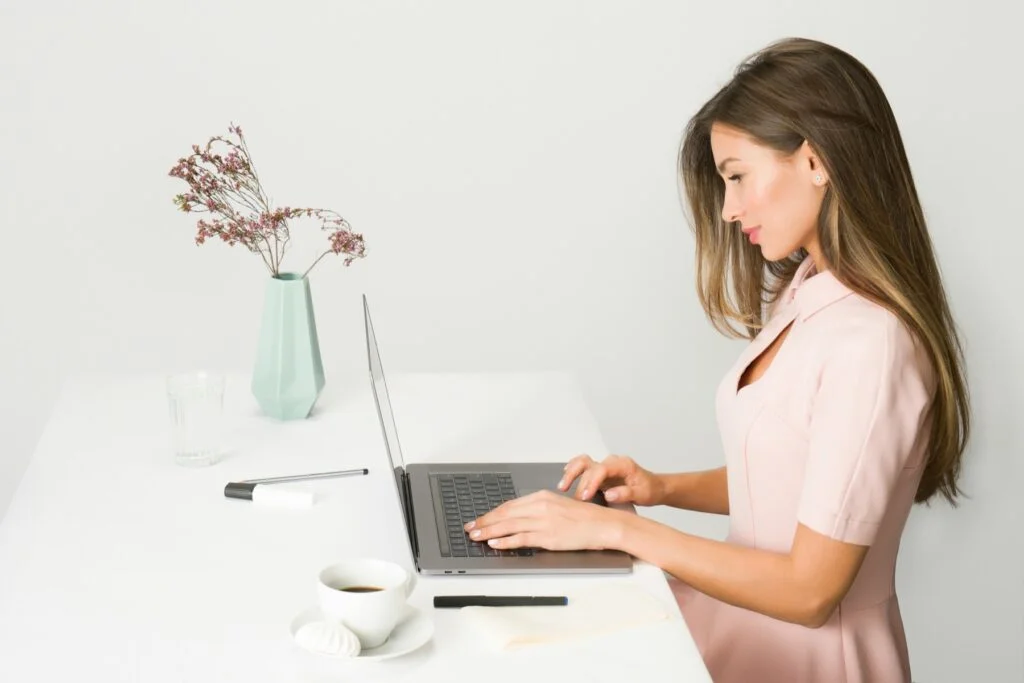
The Health and Safety Executive (HSE) gives simple guidance for anyone who uses a computer for work. The aim is comfort, not a perfect pose.
| Part of your set-up | HSE guidance | Quick fix |
|---|---|---|
| Screen | Directly in front of you, top of the screen level with your eyes, about an arm’s length away | Raise it on a stand or a stack of books |
| Keyboard | Just below elbow height, centred with the screen so you don’t twist | Raise your chair, then add a footrest if your feet don’t reach the floor |
| Mouse | In line with your elbow | Keep it close, not out at arm’s length |
| Shoulders | Relaxed, high enough that you don’t need to shrug | Check chair height and armrests |
| Chair | Seat supports your thighs evenly; backrest supports your lower back; a 2 to 3cm gap between the seat edge and the back of your knee | A small cushion can help in a chair without lumbar support |
| Breaks | Short, frequent breaks: 5 to 10 minutes every hour is better than 20 minutes every 2 hours | Set a timer, stand for calls, walk to get water |
By law, employers must plan work so screen users get breaks or changes of activity. If you use a screen for work, you’re also entitled to an eye test paid for by your employer if you ask for one. Squinting at a screen often goes hand in hand with craning your neck forward and with headaches behind the eyes or tired, dry eyes.
If you never get away from your desk, see our guides to stress at work and work-life balance.
Laptops, working from home and the sofa
Laptops are the hardest set-up to get right, because the screen and keyboard are joined. The HSE suggests a separate keyboard and mouse so the laptop can sit on a riser, or plugging into a separate screen.
If you work from home long term or split your week between home and office (hybrid working), the same display screen rules can apply at home. Your employer should carry out a workstation (DSE) assessment, which you may be able to do yourself after training, and you can’t be charged for any equipment the assessment says you need.
What about the sofa or bed? Now and then is fine. The trouble is hours in one curled-up position. If you’re on the sofa:
- Put a cushion behind your lower back and the laptop on a cushion or tray so the screen is higher.
- Swap positions every 20 to 30 minutes: sit, lean, then get up.
- Use the kitchen table for longer tasks.
Working from home can also mean far fewer steps. See our working from home tips.
Phones and “tech neck”
“Tech neck” is the idea that looking down at a phone damages your neck. A widely shared 2014 paper calculated that forces on the neck rise as the head tilts forward, but it measured forces, not pain in real people.
When researchers did look at real people, a study of 150 young adults aged 18 to 21 found no link between how they held their neck while texting and whether they had neck pain. A 2019 review found adults with neck pain tend to hold their heads further forward than adults without it, but because those studies were snapshots, it’s not clear whether the posture came first or the pain did.
Your neck is built to bend. The practical advice:
- Lift your phone a little higher for long reads, or prop it up.
- Swap hands and positions, and take breaks from long scrolling sessions.
- If your neck feels tight, a few gentle movements usually help. See our stiff neck guide for a 5-minute routine.
If you clench when you concentrate, see jaw pain and tension headaches.
Are standing desks better for posture?
Standing all day isn’t the answer either: reviews of sitting also study prolonged standing. The real benefit of a sit-stand desk is that it makes changing position easy.
A Cochrane review found that sit-stand desks cut sitting time at work by between 30 minutes and 2 hours a day in the short term, although the quality of the evidence was very low. If you have one, alternate: sit for a while, stand for a while and walk when you can. The NHS recommends adults reduce time spent sitting and break up long periods of not moving with some activity.
No standing desk? Stand for calls and walk at lunch. Our guides to how many steps a day and Japanese walking make it easy to build in.
Sleeping posture
There’s no single best sleeping position for everyone. Choose one that feels comfortable and lets you wake without stiffness. For neck pain, the NHS suggests sleeping on a low, firm pillow.
Our full guide to the best sleeping position compares side, back and front sleeping for back pain, snoring and pregnancy, with pillow tips for each.
Do posture correctors work?
Posture correctors are braces, straps, shirts or wearable buzzers that pull your shoulders back or buzz when you slouch. There is very little good-quality evidence that wearing one prevents or reduces back or neck pain. The 2019 “Sit up straight” paper singled out the many products that claim to “correct” posture and prevent pain without strong evidence behind them.
If you like one as a short-term reminder, bear in mind:
- It holds you in one position, which is the opposite of what helps most: moving and changing position.
- It doesn’t build strength. Regular exercise does.
- Take it off if it rubs, causes pins and needles or makes pain worse.
A physiotherapist may recommend a support for a specific condition, which is different from a generic brace bought online.
Posture exercises and strength
A stronger, more mobile body is more comfortable in any position. The NHS recommends strengthening activities that work all the major muscle groups, including the back, abdomen, shoulders and legs, on at least 2 days a week, alongside 150 minutes of moderate activity.
A simple 10-minute routine for desk workers
Move gently and stop if anything causes sharp pain.
- Chin tucks: sitting tall, gently draw your chin straight back, as if making a double chin. Hold for 3 seconds. Repeat 10 times.
- Head turns and tilts: slowly turn your head to look over each shoulder, then tilt each ear towards your shoulder. 5 each side.
- Shoulder rolls and blade squeezes: roll your shoulders backwards 10 times, then squeeze your shoulder blades together for 5 seconds, 10 times.
- Doorway chest stretch: forearms on either side of a door frame, step through until you feel a stretch across your chest. Hold for 20 to 30 seconds.
- Seated twist: sitting tall, turn your upper body to one side, holding the chair back. Hold for 15 seconds each way.
- Glute bridges: lying on your back, knees bent, lift your hips until your body forms a straight line. 10 to 15 times.
- Wall angels: back against a wall, arms bent at shoulder height, slide them up and down the wall slowly. 10 times.
For more targeted routines, see shoulder pain exercises and lower back pain stretches. Walking, swimming, yoga and Pilates are all good options, and the NHS lists them as activities that may help ease back pain.
If tension builds up with stress, try somatic exercises.
Posture, confidence and breathing
Power posing. A famous 2010 study suggested that briefly holding an expansive “power pose” raised testosterone, lowered cortisol and made people take more risks. A large repeat study in 2015 found no effect on hormones or risk-taking, and a 2017 study of 247 men found no overall effect on hormones, risk-taking or feelings of power. The hormone claims haven’t held up.
Mood under stress. In a small 2015 trial, 74 people were taped into either an upright or a slumped sitting position before a stressful speaking task. Those sitting upright reported higher self-esteem, better mood and less fear. It’s one small study, but sitting up before a stressful moment costs nothing.
Breathing. In a lab study of 70 volunteers, slumped sitting reduced lung capacity and how fast people could breathe out, compared with sitting normally. Standing gave the best results. For breathing exercises, see our breathwork guide.
Posture and back pain in pregnancy
Back pain is common in pregnancy as your body changes. The NHS suggests:
- bend your knees and keep your back straight when you lift or pick something up from the floor, and avoid lifting heavy objects
- keep your back straight and well supported when sitting; maternity support pillows can help
- wear flat shoes to spread your weight evenly
- get enough rest, especially later in pregnancy
Contact your GP or midwife urgently if you have back pain and you’re in your second or third trimester (it could be a sign of early labour), or you also have a fever, vaginal bleeding, pain when you pee, or pain in one or both sides under your ribs. Call 999 or go to A&E if you have back pain and lose feeling in one or both legs, your bottom or your genitals.
For sleeping in pregnancy, see our sleeping position guide. We don’t recommend our products during pregnancy or breastfeeding.
Where our products fit
No supplement or balm will fix your posture, and CBD isn’t a treatment for back or neck pain. Movement, a sensible set-up and proper medical advice come first.
Our CBD Balm, Muscle and Joint Support is a massage balm made with broad spectrum CBD, peppermint, eucalyptus and juniper. It feels cooling and non-greasy, and some people use it for a shoulder and neck self-massage after a long day at the desk. Read more in our CBD balm guide.
Our Magnesium Glycinate Sleep Complex is an evening drink with magnesium bisglycinate and citrate, glycine and L-theanine. Magnesium contributes to normal muscle function.
If you also take CBD by mouth: the FSA’s 10mg a day figure is precautionary advice rather than a legal limit, set while longer-term safety research continues. At Evopure we think it is a very cautious figure, and many adults use more. If you go above it, increase slowly, and check with your GP or pharmacist first if you take any medication.
Our products are for adults (18+) only. We don’t recommend our products during pregnancy or breastfeeding. If you take prescribed medicines, check with your pharmacist before adding a supplement.
When to see a GP or physiotherapist
Most back and neck pain improves within a few weeks. The NHS says to stay active and keep up your daily activities where you can, rather than resting in bed for long periods. See a GP if pain:
- doesn’t improve after a few weeks of looking after it at home
- stops you doing day-to-day activities, or you’re struggling to cope
- is worse at night or doesn’t improve with rest
- comes with weight loss you can’t explain, a lump or swelling, or a change in the shape of your back
- is in your upper back, between your shoulders, rather than your lower back
- comes with pins and needles or a cold arm (for neck pain)
Call 999 or go to A&E if you have back pain and:
- pain, tingling, weakness or numbness in both legs
- loss of feeling around your genitals or bottom
- changes in your bladder or bowels, such as difficulty peeing or wetting or soiling yourself
- chest pain
- it started after a serious accident, such as a car accident
Get an urgent GP appointment or call 111 if you also feel hot, cold, shivery or generally unwell, or the pain is severe, sudden or getting worse quickly.
A physiotherapist can help if aches keep coming back. In many areas you can refer yourself to NHS musculoskeletal (MSK) physiotherapy without seeing a GP first.
Tingling fingers after a day at the keyboard? Read carpal tunnel: symptoms and what helps for desk tips and when to see a GP.
Aching on the outside of the elbow after a day at the mouse? Read our tennis elbow guide for desk and grip changes that help.
FAQs
Does bad posture cause back pain?
Research hasn’t shown that it does. A 2020 review of 41 systematic reviews found no consensus that sitting, standing or bending postures cause low back pain. Staying in one position for too long can still leave you stiff, so moving often matters more.
How can I improve my posture?
Change position often, set up your screen at eye level with your keyboard just below elbow height, take short breaks every hour, and do strengthening exercises at least twice a week. There’s no need to hold yourself rigidly upright.
Is slouching bad for you?
An occasional slouch isn’t harmful, and people with upright and slumped postures both get back pain. The problem is staying in any one position for hours. If slouching feels comfortable for a while, that’s fine; then move.
Do posture correctors work?
There is very little good-quality evidence that posture correctors prevent or reduce back or neck pain. They hold you in one position and don’t build strength. Regular movement and exercise are better uses of your time and money.
What is the best sitting posture at a desk?
The HSE suggests the top of your screen level with your eyes about an arm’s length away, keyboard just below elbow height, mouse in line with your elbow, relaxed shoulders and a chair that supports your lower back. Then change position regularly.
Can bad posture affect your breathing?
In a lab study of 70 volunteers, slumped sitting reduced lung capacity compared with sitting normally, and standing gave the best results. If you feel short of breath often, see a GP rather than putting it down to posture.
How long does it take to improve posture?
Changes to your desk set-up can feel better straight away. Building strength and mobility takes regular practice over several weeks. Aim for strengthening activities at least 2 days a week and short movement breaks every day.
Sources
- HSE. Working safely with display screen equipment: good posture.
- HSE. Display screen equipment: work routine and breaks.
- HSE. Display screen equipment: home working.
- HSE. Display screen equipment: eye tests.
- NHS. Back pain.
- NHS. Neck pain and stiff neck.
- NHS. Back pain in pregnancy.
- NHS. Physiotherapy.
- NHS. Physical activity guidelines for adults aged 19 to 64.
- Slater D, et al. “Sit up straight”: time to re-evaluate. J Orthop Sports Phys Ther, 2019. PMID 31366294.
- Swain CTV, et al. No consensus on causality of spine postures or physical exposure and low back pain: a systematic review of systematic reviews. J Biomech, 2020. PMID 31451200.
- Korakakis V, et al. Physiotherapist perceptions of optimal sitting and standing posture. Musculoskelet Sci Pract, 2019. PMID 30469124.
- Richards KV, et al. Neck posture clusters and their association with biopsychosocial factors and neck pain in Australian adolescents. Phys Ther, 2016. PMID 27174256.
- Mahmoud NF, et al. The relationship between forward head posture and neck pain: a systematic review and meta-analysis. Curr Rev Musculoskelet Med, 2019. PMID 31773477.
- Damasceno GM, et al. Text neck and neck pain in 18 to 21-year-old young adults. Eur Spine J, 2018. PMID 29306972.
- Hansraj KK. Assessment of stresses in the cervical spine caused by posture and position of the head. Surg Technol Int, 2014. PMID 25393825.
- Saraceni N, et al. To flex or not to flex? Is there a relationship between lumbar spine flexion during lifting and low back pain? J Orthop Sports Phys Ther, 2020. PMID 31775556.
- Shrestha N, et al. Workplace interventions for reducing sitting at work. Cochrane Database Syst Rev, 2016. PMID 26984326.
- Ranehill E, et al. Assessing the robustness of power posing: no effect on hormones and risk tolerance in a large sample of men and women. Psychol Sci, 2015. PMID 25810452.
- Nair S, et al. Do slumped and upright postures affect stress responses? A randomized trial. Health Psychol, 2015. PMID 25222091.
- Smith KM, Apicella CL. Winners, losers, and posers: the effect of power poses on testosterone and risk-taking following competition. Horm Behav, 2017. PMID 27840104.
- Lin F, et al. Effect of different sitting postures on lung capacity, expiratory flow, and lumbar lordosis. Arch Phys Med Rehabil, 2006. PMID 16571389.
This guide is general information, not medical advice. If you have pain that worries you, speak to a GP, pharmacist or physiotherapist. Evopure makes the CBD Balm, Muscle and Joint Support and the Magnesium Glycinate Sleep Complex.