Last updated: October 2026
Brittle nails are usually caused by everyday wear rather than a vitamin deficiency: hands often in water, cleaning products, nail polish remover, cold dry air and simply getting older. Wearing gloves for wet jobs, moisturising your nails and keeping them short helps most people. See a GP if your nails change shape or colour without a clear reason.
Below: causes, conditions to rule out, what helps, a weekly routine, an honest look at biotin and other supplements, what nail changes can mean, and when to see a GP.
What causes brittle nails?
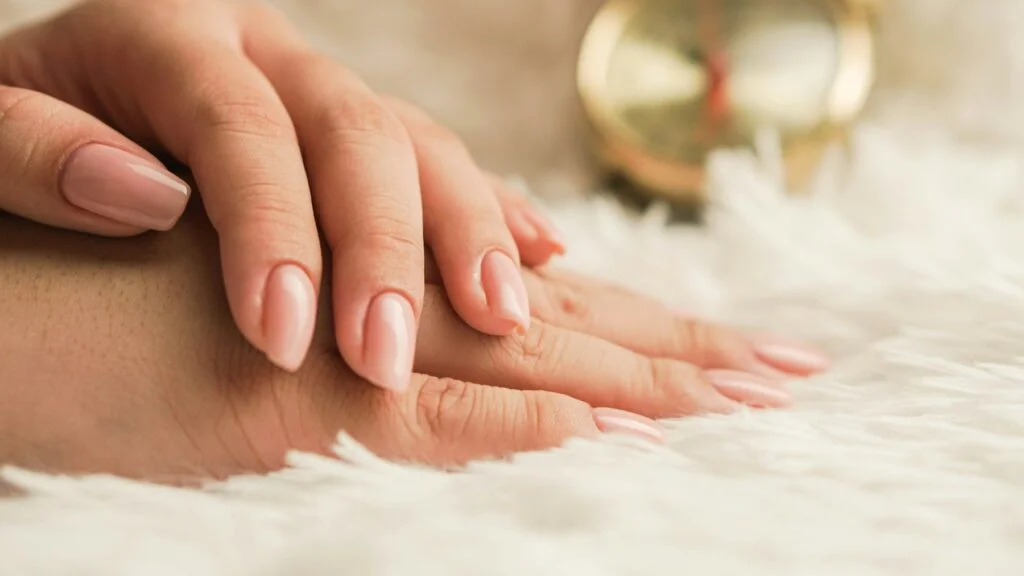
Brittle nails split, peel, flake or break easily. They’re very common: reviews estimate up to 1 in 5 people have them, women about twice as often as men, especially after 50. The nail is made of layers of keratin held together by natural fats, and anything that repeatedly dries out or strips those fats weakens it.
| Cause | Why it weakens nails | What to do |
|---|---|---|
| Repeated wetting and drying | Causes tiny fractures between the nail’s layers | Gloves for wet jobs; moisturise after washing |
| Washing up and cleaning products | Detergents and solvents strip the fats that hold the layers together | Rubber or vinyl gloves, ideally with cotton liners |
| Nail polish remover | It’s a solvent, so frequent use dries the nail | Use it as rarely as you can |
| Cold, dry air and central heating | Dry nails split more easily | Moisturise nails; gloves outdoors |
| Getting older | The NHS says nails normally get thicker or more brittle with age; nail fats fall, especially after the menopause | Daily moisturising and gentle care |
| Using nails as tools, biting, picking | Small cracks at the edge spread | Keep nails short; use a tool instead |
Peeling nails that flake into thin layers at the tip (onychoschizia) are usually water and detergent damage, according to the dermatology reference site DermNet. They’re typical of people who wash their hands many times a day, such as nurses, cleaners and hairdressers.
Health conditions that can cause brittle nails
Less often, brittle nails are a sign of something else, especially if several nails change shape, colour or thickness, or you have other symptoms.
- Iron deficiency anaemia. The NHS lists spoon-shaped nails (koilonychia) among the less common signs, alongside tiredness, shortness of breath and paler skin. See iron deficiency symptoms.
- Underactive or overactive thyroid. Both can cause nail problems. A dermatology review describes nails in an underactive thyroid as thin, brittle and slow-growing. See underactive thyroid symptoms.
- Psoriasis. Up to half of people with psoriasis have nail changes, such as pits and crumbling. See psoriasis and CBD.
- Fungal nail infection. The NHS says the nail may become brittle, crumbly, thicker and white or yellow. It usually affects toenails.
- Lichen planus and eczema can thin the nails and cause ridges and splitting.
- Pregnancy. Nails can become softer or more brittle; the NHS says they should be healthier within 6 months of the birth.
- Some medicines, including some cancer treatments and retinoids.
Brittle nails and hair loss together? Iron deficiency and thyroid problems are the two to ask a GP about. Hair can also shed after a stressful time: see stress and hair loss. And if your nails changed around the menopause, see perimenopause symptoms.
How to fix brittle nails
There’s no overnight fix: the nail you can see has already formed. Fingernails grow about 3.5mm a month and take around 4 to 6 months to grow out fully, so give changes at least 3 months. What dermatologists and the NHS recommend:
- Wear gloves for wet work, on dry hands. Gloves over wet hands can make nails worse. Cotton liners under rubber or vinyl gloves are kinder still.
- Moisturise your nails, not just your hands. Rub cream into nails, fingertips and cuticles after every wash. Creams with urea, glycerin or lanolin, or a thin layer of petroleum jelly, hold moisture in best. See our dry skin guide for choosing one.
- Keep nails short. Short nails break less often and lose less water.
- Trim after a bath or shower and cut straight across.
- File in one direction. The American Academy of Dermatology says filing back and forth weakens nails.
- Go easy on remover and polish, and leave your cuticles alone: they protect the nail from infection.
- Protect your hands in the cold. If your fingers also turn white or numb, read about Raynaud’s and cold hands and feet.
A weekly nail-care routine
| When | What to do |
|---|---|
| After every hand wash | Pat dry, then rub cream into nails, fingertips and cuticles |
| Washing up and cleaning | Dry hands, cotton liners, then rubber or vinyl gloves |
| Going out in the cold | Moisturise first, then warm gloves |
| Every night | A thicker cream or a thin layer of petroleum jelly on nails and cuticles |
| Once a week, after a shower | Trim straight across, keep short, file gently in one direction |
| Once a week | Check every nail for new changes in colour, shape or thickness, or a dark streak |
| Every few weeks | A few polish-free days |
For more on looking after yourself in the colder months, see our winter wellness guide.
Gel, acrylics and polish
The American Academy of Dermatology says gel manicures can cause brittleness, peeling and cracking, and acrylics thin your nails because the surface is filed rough first. If your nails are brittle after gel or acrylics, keep them short and bare while the damaged part grows out. If you go back to gel, choose soak-off rather than file-off, soak only your fingertips in remover, and ask the technician not to trim your cuticles. Wearing polish for months, or layering coat over coat, can also leave rough white patches on the nail.
Vitamins and supplements for brittle nails: an honest look
What deficiency causes brittle nails? For most people, none. A deficiency is worth checking if you have other symptoms, a restricted diet or heavy periods, and the way to know is a blood test, not guesswork.
Biotin
Biotin (vitamin B7) is the supplement most sold for nails, but the evidence is thin: three small studies from 1989 to 1993, none with a placebo group. In the largest, 41 of 45 people had firmer nails after taking 2.5mg a day for about 5 to 6 months. A 2021 review in the Journal of the American Academy of Dermatology concluded the evidence is insufficient to recommend biotin.
- No authorised nail claim. In Great Britain a claim that biotin is needed for healthy nails was assessed and rejected. Its authorised claims cover normal hair and skin, not nails.
- Deficiency is rare. The NHS says gut bacteria make biotin, and 0.9mg a day or less from supplements is unlikely to cause harm: far below the doses used in nail studies.
- High doses can upset blood tests, including thyroid and heart tests. Tell your GP or the lab if you take it.
Zinc and selenium
These are the only nutrients with authorised nail claims in Great Britain: zinc contributes to the maintenance of normal nails, and selenium contributes to the maintenance of normal nails. That’s about getting enough, not about extra fixing brittle nails. Most people get plenty from meat, shellfish, dairy and bread (zinc) and brazil nuts, fish and eggs (selenium). The NHS advises no more than 25mg of zinc a day from supplements unless a doctor advises it, and 350µg or less of selenium; too much selenium can cause hair and nail loss. See our zinc guide.
Iron
Only take iron if a blood test shows you’re low. If so, the NHS says iron tablets are usually taken for about 6 months, and a glass of orange juice afterwards may help absorption (see vitamin C). Iron can be dangerous to young children, so never take it “just in case”. See iron-rich foods.
Vitamin D and collagen
A 2024 review of 49 articles found limited evidence for vitamins treating nail problems, apart from prescribed vitamin D-type creams for nail psoriasis. A 2017 study of 25 people taking collagen reported fewer broken nails, but with no placebo group it can’t show the collagen caused it. For a wider view, see supplements for women over 40.
To be clear, Evopure doesn’t sell a biotin, zinc, iron or nail supplement, and none of our products is a treatment for nail problems. For why CBD isn’t a nail treatment either, see CBD for nails.
What nail changes can mean
| Change | Possible cause | What to do |
|---|---|---|
| Splitting or peeling at the tip | Water, detergent, remover, drying out | Gloves, moisturise, keep short |
| Ridges from base to tip | Often ageing; sometimes lichen planus, psoriasis or fungal infection | Nothing if all nails look alike; see a GP if one nail changes |
| Grooves across the nail (Beau’s lines) | A past illness or injury paused growth | Usually grows out |
| Small white spots | Minor knocks, manicures or biting | Nothing; they grow out |
| Spoon-shaped nails | Iron deficiency anaemia | See a GP for a blood test |
| Pitting or small dents | Psoriasis, eczema or alopecia areata | See a GP |
| Yellow, thick or crumbly | Fungal infection, nail psoriasis, smoking, red polish without a base coat | Ask a pharmacist; GP if it spreads or treatment fails |
| Red, sore, swollen nail fold | Infection (paronychia) or ingrown nail | See a GP |
| Dark streak or dark area under the nail | Often harmless, especially on darker skin, but occasionally melanoma | See a GP soon if new, changing or not from an injury |
When to see a GP
See a GP if:
- a nail has changed shape, colour or thickness, or fallen off, and you don’t know why
- you have a new or changing dark streak or dark area under a nail that wasn’t caused by an injury: don’t wait for it to fade
- the skin around a nail is sore, red, swollen and warm
- brittle nails come with tiredness, hair loss, feeling cold or shortness of breath: ask about blood tests for iron and thyroid. See why am I always tired?
- a fungal infection is spreading or hasn’t cleared with pharmacy treatment, or you have diabetes
- nothing has improved after 3 to 6 months of good nail care
A pharmacist can help with fungal nail treatments, and you may be able to refer yourself to a podiatrist for toenails that are too thick to cut.
If a blood test shows low iron, read iron tablets: who needs them and how to take them.
See also collagen for hair, nails, skin and joints: what the research shows.
FAQs
What deficiency causes brittle nails?
Usually none: most brittle nails come from water, cleaning products, nail polish remover, dry air and ageing. Iron deficiency can cause brittle or spoon-shaped nails, and an underactive thyroid can make nails thin and brittle. A GP blood test is the way to check.
Why are my nails suddenly brittle?
Common triggers are more hand washing or cleaning, colder weather and central heating, or removing gel or acrylic nails. If nothing has changed, or you feel unwell too, ask a GP about a blood test.
Does biotin help brittle nails?
The evidence is weak: three small studies without a placebo group. There’s no authorised nail claim for biotin in Great Britain, and high doses can affect some blood tests.
How long does it take to fix brittle nails?
Fingernails take around 4 to 6 months to grow out fully, so expect to wait at least 3 months to see a difference. Toenails take much longer.
Are brittle nails a sign of thyroid problems?
They can be, usually alongside other symptoms such as tiredness, feeling cold or hot, and weight changes. Brittle nails on their own are much more likely to be everyday wear.
Sources
- NHS. Nail problems.
- NI Direct (Northern Ireland government health information). Nail abnormalities.
- NHS. Fungal nail infection.
- NHS. Iron deficiency anaemia.
- NHS. Psoriasis.
- NHS. Melanoma skin cancer: symptoms.
- NHS. Vitamin B (biotin) and Other vitamins and minerals (zinc, selenium).
- DHSC. Great Britain nutrition and health claims (NHC) register.
- DermNet. Nail terminology, White nail (leukonychia) and Melanoma of the nail unit.
- American Academy of Dermatology. Nail care, Healthy nail tips and Gel manicures.
- Chessa MA et al. Pathogenesis, clinical signs and treatment recommendations in brittle nails: a review. Dermatol Ther, 2020.
- van de Kerkhof PC et al. Brittle nail syndrome: a pathogenesis-based approach with a proposed grading system. J Am Acad Dermatol, 2005.
- Lipner SR, Scher RK. Biotin for the treatment of nail disease: what is the evidence? J Dermatolog Treat, 2018.
- Floersheim GL. Treatment of brittle fingernails with biotin. Z Hautkr, 1989.
- Colombo VE et al. Treatment of brittle fingernails and onychoschizia with biotin. J Am Acad Dermatol, 1990.
- Hochman LG et al. Brittle nails: response to daily biotin supplementation. Cutis, 1993.
- Thompson KG, Kim N. Dietary supplements in dermatology: a review of the evidence for zinc, biotin, vitamin D, nicotinamide, and Polypodium. J Am Acad Dermatol, 2021.
- Curtis KL, Lipner SR. Vitamins for the management of nail disease: a literature review. Skin Appendage Disord, 2024.
- Hexsel D et al. Oral supplementation with specific bioactive collagen peptides improves nail growth and reduces symptoms of brittle nails. J Cosmet Dermatol, 2017.
- Yaemsiri S et al. Growth rate of human fingernails and toenails in healthy American young adults. J Eur Acad Dermatol Venereol, 2010.
This guide is general information, not medical advice. Evopure makes CBD oils, CBD capsules, a CBD balm, a magnesium drink and a reishi drink; none of them is a nail supplement or a treatment for nail problems.