
Last updated: October 2026
Acid reflux is worse at night because lying flat lets stomach acid flow back up more easily, and it takes longer to clear. To ease it, the NHS says don’t eat within 3 to 4 hours of bed, raise the head of your bed by 10 to 20cm and avoid your triggers. Sleeping on your left side may help.
Below: why heartburn flares when you lie down, the common triggers, a checklist for tonight, the best sleeping position, what a pharmacist or GP can offer, silent reflux, pregnancy and when to get help.
Why is acid reflux worse at night?
Reflux happens when stomach acid travels back up into your food pipe (oesophagus). A ring of muscle at the bottom of the oesophagus normally acts as a valve, and when it lets acid through you feel heartburn: a burning feeling in the middle of your chest.
Night is the worst time for several reasons:
- Gravity stops helping. When you’re upright, gravity keeps stomach contents down. The NHS says reflux symptoms are often worse after eating, when lying down and when bending over.
- Acid lingers. Studies that measure acid in the oesophagus overnight find it takes longer to clear when you’re lying down, especially on your right side.
- The biggest meal comes last. Dinner is often the largest and richest meal of the day, often eaten late.
- Evening habits stack up. A glass of wine, a coffee after dinner or a square of chocolate on the sofa all land just before bed.
Symptoms of acid reflux at night
The NHS lists the main symptoms as heartburn and an unpleasant sour taste in your mouth from stomach acid. You might also get:
- a cough or hiccups that keep coming back
- a hoarse voice
- bad breath
- bloating and feeling sick
At night that can mean waking with a burning chest, a sour taste or a coughing fit. If a cough is the main problem, see our guide to coughing at night. If you wake with a raw throat, our sore throat remedies guide explains what helps.
Is it really heartburn? The NHS says a heart attack can feel like indigestion, with a burning feeling in your chest. Call 999 if you have chest pain that feels tight or squeezing, spreads to your arms, neck or jaw, or you are struggling to breathe.
What causes acid reflux at night? Common triggers
The NHS says lots of people get heartburn from time to time, often for no obvious reason. These are the usual suspects, based on NHS and NICE guidance:
| Trigger | Why it matters at night | What to try |
|---|---|---|
| Late meals | In a Japanese study of 147 people with reflux disease and 294 without, finishing dinner less than 3 hours before bed was linked to about 7 times higher odds of reflux disease than a gap of 4 hours or more | Finish eating 3 to 4 hours before bed. See eating before bed |
| Large meals | A big dinner is often the last thing you do before lying down | Smaller, more frequent meals (NHS) |
| Fatty or spicy food, tomatoes | Named by the NHS as common food triggers | Keep the evening meal lighter |
| Alcohol | On the NHS and NICE trigger lists, and often drunk late | Cut down, especially in the evening. See alcohol and sleep |
| Coffee | On the NHS and NICE trigger lists | Have your last cup earlier. See how long caffeine lasts |
| Chocolate | On the NHS and NICE trigger lists, including a bedtime hot chocolate | Swap for a caffeine-free drink if it bothers you |
| Smoking | Named by the NHS and NICE | Ask your GP or pharmacist about stop smoking support |
| Being overweight | Named by the NHS and NICE; in studies, weight loss improved reflux | Losing weight if you need to. See sleep and weight loss |
| Pregnancy and hormones | The NHS lists pregnancy and rising progesterone or oestrogen | See pregnancy below |
| Stress and anxiety | Listed by the NHS as a possible cause | Find ways to relax. See anxiety stomach |
| Some medicines | Anti-inflammatory painkillers such as ibuprofen and aspirin can make it worse | Ask a pharmacist; never stop a prescribed medicine without advice |
| Tight clothing | Squeezes your middle | Loose waistbands in the evening |
Triggers are personal. A 2006 review of the research found evidence that weight loss and raising the head of the bed help, but little proof that cutting any one food helps everyone. NICE advises avoiding the triggers you yourself link to your symptoms, so a short food and symptom diary is worth a week of your time.
The NHS also lists medical causes, such as a hiatus hernia, a stomach ulcer or a stomach infection. If you start weight loss injections and get new heartburn, mention it to your prescriber or pharmacist; our guide to sleeping on Mounjaro covers the night-time side.
How to stop acid reflux tonight: a checklist
- Stay upright for now. If it starts in the evening, sit up rather than lying on the sofa or going straight to bed.
- Loosen your waistband. The NHS advises against tight clothing around your waist.
- Ask a pharmacist about an antacid or alginate. They give short-term relief; take them as the pack says, usually after meals or just before bed.
- No more food, coffee, alcohol or chocolate before bed tonight.
- Raise the head of your bed, not just your pillows. Books or blocks under the bed legs at the head end will do for tonight.
- Lie on your left side when you go to sleep.
- If you smoke, skip the last cigarette of the evening.
Best sleeping position for acid reflux
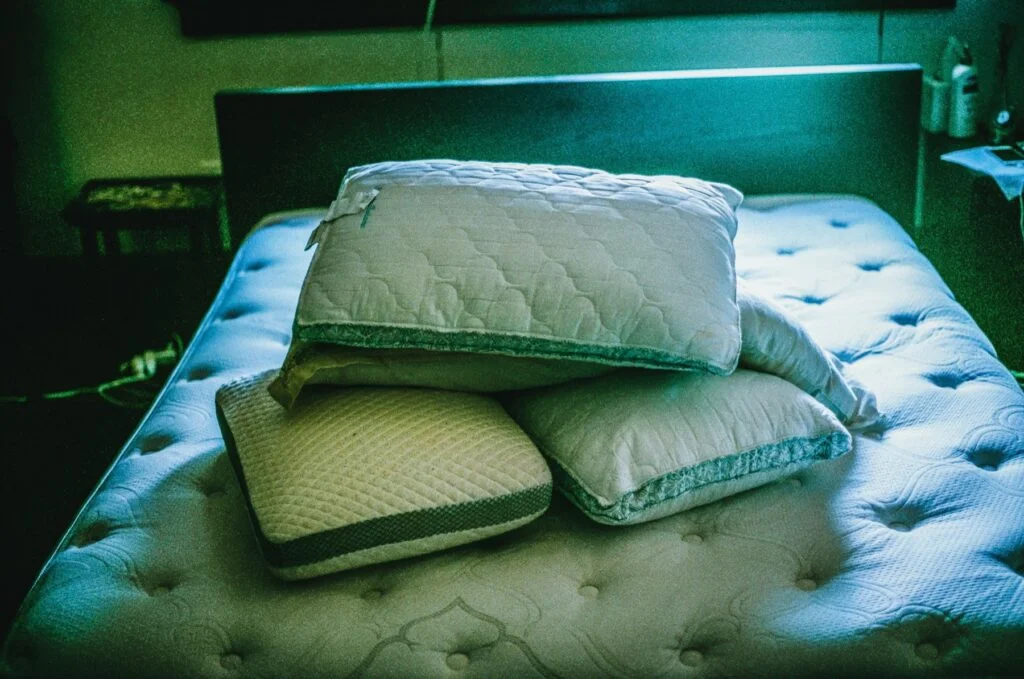
Raise the head of the bed by 10 to 20cm. The NHS suggests putting wood, bricks or books under the legs at the head end, so your chest and head are above your waist. It warns against just adding extra pillows, as bending at the waist can increase pressure on your stomach and make symptoms worse. A foam wedge that lifts your whole upper body works on the same idea. In a small trial of 20 people with night-time reflux, raising the bed head with a 20cm block for 6 nights cut the time acid spent in the oesophagus and improved sleep disturbance in 13 of them (65%).
Sleep on your left side. The research is small but points the same way:
| Position | What studies found |
|---|---|
| Left side | Less acid exposure than the right side. After a high-fat meal, 20 healthy volunteers had about half the reflux time lying on their left (117 minutes) compared with their right (231 minutes) |
| Right side | Most acid exposure and slowest clearing, in both healthy volunteers and people with reflux disease |
| On your back | More frequent reflux episodes in a study of 10 people with night-time reflux |
| Raised head of bed | Less acid exposure and better sleep in people who reflux lying down |
In a 2023 Dutch study, 27 people with night-time reflux wore a small device that buzzed when they rolled onto their right side. After 2 weeks, reflux episodes fell from a median of 8 a night to 3, and 70% said their symptoms were better.
Can you sleep sitting up? You can, but the option backed by the NHS and by studies is a gentle slope from a raised bed head, which most people find easier to sleep on night after night. For more on positions for snoring, back pain and pregnancy, see our guide to the best sleeping position.
What helps acid reflux in the long term
The NHS self-care advice for heartburn and acid reflux is:
- eat smaller, more frequent meals
- don’t eat within 3 or 4 hours of going to bed
- raise the head of your bed by 10 to 20cm
- lose weight if you’re overweight
- avoid foods and drinks that trigger your symptoms
- stop smoking and don’t drink too much alcohol
- avoid tight clothing around your waist
- find ways to relax
A 2022 systematic review of night-time reflux treatments recommended a step-by-step approach: raise the head of the bed, leave longer between dinner and bed, sleep on your left side, then add acid-reducing medicine if needed.
An earlier dinner is often the hardest change. Our guide to foods that help you sleep has lighter options if you get hungry later, and a steady bedtime routine makes an earlier kitchen curfew easier to stick to.
Pharmacy and GP treatments for heartburn at night
| Option | Where | What it does |
|---|---|---|
| Antacids | Pharmacy | Neutralise stomach acid for short-term relief |
| Alginates | Pharmacy | Form a protective layer that helps stop acid coming back up |
| Proton pump inhibitors (PPIs), such as omeprazole or lansoprazole | GP | Reduce how much acid your stomach makes, usually for 4 or 8 weeks |
| H2 blockers, such as famotidine | GP | Another way to reduce acid if a PPI doesn’t help |
The NHS says antacids and alginates relieve symptoms in the short term but don’t cure the problem, and shouldn’t be used regularly for long periods. Antacids can affect how other medicines work, so the NHS advises not taking other medicines within 2 to 4 hours of an antacid. Many antacids contain magnesium, calcium or aluminium, so tell your pharmacist about any supplements you take.
For night-time symptoms, placebo-controlled trials of PPIs reported success in 34% to 81% of people, against 10% to 52% on a placebo. If medicines don’t help, your GP may refer you for tests such as a gastroscopy, where a thin camera is passed down your throat.
How acid reflux affects your sleep
Researchers describe night-time reflux as having a major impact on sleep quality. Burning, coughing and a sour taste can wake you in the small hours, and it can be hard to drift off again. If you keep waking at the same time, see why you wake up at 3am and why can’t I sleep?
Reflux isn’t the only reason for a dry, sore throat in the morning. Sleeping with your mouth open is common too: see mouth breathing at night. And if a partner says you snore loudly or stop breathing in your sleep, read about sleep apnoea and mention it to your GP.
No supplement treats reflux, so treat this as part of a calm wind-down rather than a remedy. Our Magnesium Glycinate Sleep Complex is a berry-flavoured, caffeine-free bedtime drink with magnesium bisglycinate and citrate, L-theanine and chamomile. Magnesium contributes to a reduction of tiredness and fatigue and to normal functioning of the nervous system. It is for adults only. Because many antacids also contain magnesium, check with your pharmacist first if you take antacids or any reflux medicine, and don’t take them at the same time.
Silent reflux (LPR)
Sometimes reflux reaches the throat and voice box. Doctors call this laryngopharyngeal reflux, or LPR, and it is sometimes called silent reflux because people with it may not get heartburn.
Symptoms include frequent throat clearing, a hoarse voice, a feeling of a lump in the throat, a cough and extra mucus. Many other things cause the same symptoms, so see a GP if they don’t settle, rather than assuming it’s reflux. Treatment usually starts with the same lifestyle changes as for heartburn.
Heartburn at night in pregnancy
The NHS lists pregnancy as a common cause of heartburn. Antacids and alginates may help, but tell your pharmacist you’re pregnant, as the NHS says some antacids are not suitable. See your midwife or GP if diet and lifestyle changes don’t work, or if you have difficulty swallowing, a hoarse voice, a cough that won’t go away, weight loss or pain or swelling in your stomach. We don’t recommend our products during pregnancy or breastfeeding.
When to see a GP about acid reflux at night
See a GP if:
- you have heartburn most days for 3 weeks or more
- lifestyle changes and pharmacy medicines aren’t helping
- food feels like it’s getting stuck when you swallow
- you’re being sick often or losing weight without trying
- you’re 55 or over with weight loss and reflux, indigestion or upper tummy pain (NICE advises GPs to refer urgently for checks in this case, and for anyone with swallowing problems)
Ask for an urgent GP appointment or call 111 if your poo is black or dark red, or you’ve been sick for more than 2 days.
Call 999 or go to A&E if you’re vomiting blood and feel faint, dizzy, confused or unwell, or have black poo, or if you have the heart attack signs described above.
These symptoms are usually caused by something less serious, but they’re worth checking quickly.
FAQs
Why is acid reflux worse at night?
Lying flat removes the help of gravity, so acid flows back up more easily and takes longer to clear. Late, large meals, alcohol and coffee in the evening add to it.
Which side should I sleep on for acid reflux?
Your left side. Small studies found less acid in the oesophagus when lying on the left and the most when lying on the right.
How long before bed should I stop eating with acid reflux?
The NHS says don’t eat within 3 or 4 hours of going to bed.
Is it better to use extra pillows or raise the bed?
Raise the bed. The NHS suggests lifting the head end by 10 to 20cm, and warns that extra pillows can increase pressure on your stomach.
What can I take for heartburn at night?
A pharmacist can recommend an antacid or alginate for short-term relief. If you need them most days, see a GP, who may prescribe a PPI.
Can acid reflux cause a cough at night?
Yes. The NHS lists a recurring cough, hiccups and a hoarse voice as possible reflux symptoms, sometimes without obvious heartburn.
When should I worry about heartburn at night?
See a GP if you have it most days for 3 weeks or more, have trouble swallowing or lose weight without trying. Get urgent help for vomiting blood, black poo or crushing chest pain.
Sources
- NHS. Heartburn and acid reflux.
- NHS. Indigestion.
- NHS. Antacids.
- NHS. Symptoms of oesophageal cancer.
- NHS. Indigestion and heartburn in pregnancy.
- NHS. Heart attack and Vomiting blood.
- NICE. Gastro-oesophageal reflux disease and dyspepsia in adults (CG184) and Suspected cancer: recognition and referral (NG12).
- Schuitenmaker JM et al. Systematic review: clinical effectiveness of interventions for the treatment of nocturnal gastroesophageal reflux. Neurogastroenterol Motil, 2022.
- Schuitenmaker JM et al. The effect of sleep positional therapy on nocturnal gastroesophageal reflux. Neurogastroenterol Motil, 2023.
- Katz LC et al. Body position affects recumbent postprandial reflux. J Clin Gastroenterol, 1994.
- Khoury RM et al. Influence of spontaneous sleep positions on nighttime recumbent reflux. Am J Gastroenterol, 1999.
- Khan BA et al. Effect of bed head elevation during sleep in symptomatic patients of nocturnal gastroesophageal reflux. J Gastroenterol Hepatol, 2012.
- Fujiwara Y et al. Association between dinner-to-bed time and gastro-esophageal reflux disease. Am J Gastroenterol, 2005.
- Kaltenbach T et al. Are lifestyle measures effective in patients with gastroesophageal reflux disease? Arch Intern Med, 2006.
- Khan AM et al. Laryngopharyngeal reflux: a literature review. Surgeon, 2006; and Krause AJ et al. An update on current treatment strategies for laryngopharyngeal reflux symptoms. Ann N Y Acad Sci, 2022.
This guide is general information, not medical advice. Evopure makes the Magnesium Glycinate Sleep Complex.