


Last updated: October 2026
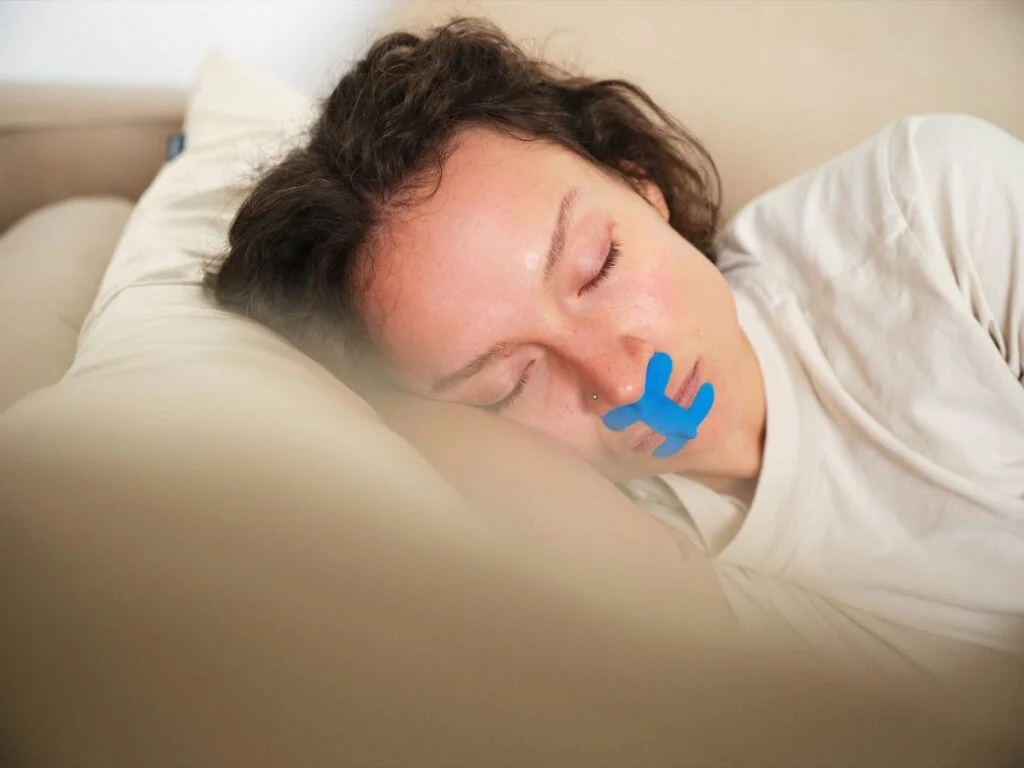
Mouth taping means putting a small strip of tape over your lips at night to make you breathe through your nose. It’s popular for snoring, dry mouth and better sleep, but the evidence is thin: a 2025 review of 10 studies found little proven benefit and warned of serious risk for people with sleep apnoea or a blocked nose.
Below: what the research shows for snoring, sleep and jawline claims, who should never try it, safer ways to breathe through your nose at night, and when snoring needs your GP.
What is mouth taping?
It’s the practice of taping your lips closed before sleep, usually with a small strip of gentle surgical tape or a purpose-made mouth tape, so you breathe through your nose all night. Fans say nose breathing reduces snoring, dry mouth and morning grogginess. It has spread fast on TikTok and Instagram, often linked to “sleepmaxxing”. See sleepmaxxing: which sleep trends work?
Breathing through your nose is the body’s normal way of breathing at rest, and it warms, filters and moistens air. The question is whether tape is a safe or useful way to make that happen.
Does mouth taping work? What the research shows
| Study | What it found |
|---|---|
| Systematic review, 2025 (10 studies, 213 people) | Two studies showed improvements in sleep apnoea measures; the others showed no difference. The authors warned of a potentially serious risk of harm, including suffocation if the nose is blocked. |
| Scoping review, 2025 (9 studies) | Some small studies found less snoring, mostly when tape was combined with other treatments. High-quality trials are missing. |
| Review, 2026 | Only 2 studies were good enough to include on mouth taping; both found fewer breathing pauses in mild sleep apnoea. A blocked nose made breathing during sleep clearly worse. |
| Pilot study, 2015 (30 people with mild sleep apnoea who breathed through their mouths) | A porous mouth patch reduced snoring and breathing pauses. There was no comparison group. |
In short: there may be a small benefit for some people who mouth-breathe and snore lightly, but the studies are tiny, and nobody has shown it improves sleep quality for healthy people.
Is mouth taping safe?
It isn’t safe for everyone. Don’t tape your mouth if you:
- snore loudly, stop breathing, gasp or choke at night, or are very sleepy in the day, as these can be signs of sleep apnoea, which needs diagnosis, not tape
- have a blocked nose from a cold, hay fever, sinusitis, polyps or a deviated septum
- have a lung or heart condition, such as asthma or COPD
- feel sick or might vomit, for example after drinking alcohol or taking sedating medicine
- are a child: never tape a child’s mouth
- feel anxious or panicky with your mouth covered
Other possible side effects include skin irritation, sore lips and broken sleep from discomfort. The bigger risk is that tape hides a problem like sleep apnoea, which is linked to high blood pressure and daytime sleepiness.
Mouth taping claims, checked
| Claim | Verdict |
|---|---|
| Stops snoring | Possibly for mild, mouth-breathing snorers; not for snoring caused by sleep apnoea or a blocked nose |
| Better, deeper sleep | No good evidence in healthy people |
| Less dry mouth in the morning | Plausible if you mouth-breathe, but untested |
| Sharper jawline | No evidence |
| Fresher breath, fewer cavities | Plausible, as mouth breathing dries the mouth; not proven for tape |
| Lower stress or cortisol | No evidence. See how to lower cortisol naturally |
If you want to try it: how to do it more safely
If none of the warning signs above apply to you, and you still want to try it:
- Check your nose first. Close your mouth and breathe through your nose for a few minutes while awake. If it’s hard, don’t tape.
- Use a small strip of gentle, skin-safe tape, vertically over the middle of the lips, so you can still open your mouth easily. Never seal the whole mouth.
- Practise while awake, for example while reading for 20 minutes, before trying it overnight.
- Skip it on nights when you’ve had alcohol, are unwell or have a cold.
- Stop if you wake up gasping, feel panicky or don’t feel better after a couple of weeks.
Ask your partner whether your snoring has changed, as that’s more reliable than how you feel.
Better ways to stop mouth breathing and snoring
- Treat a blocked nose: a pharmacist can advise on saline rinses or a steroid nasal spray for hay fever and allergies.
- Sleep on your side rather than your back.
- Cut down on alcohol, especially in the evening. See Dry January.
- Lose weight if you’re carrying extra around the neck.
- Stop smoking, which irritates the nose and throat.
- Try nasal strips or dilators, which open the nose rather than shutting the mouth.
- Ask about a mouth guard (mandibular advancement device), which your GP or dentist can advise on.
A calmer wind-down helps whatever is keeping you awake. See how to fall asleep fast, and if snoring is driving you apart, sleep divorce. Magnesium contributes to the reduction of tiredness and fatigue.
When to see your GP
The NHS advises seeing a GP if lifestyle changes don’t help your snoring, if it’s having a big impact on you or your partner, or if you feel sleepy during the day, your breathing stops and starts while you sleep, or you gasp or choke. These can be signs of sleep apnoea, which can be serious if not treated, and effective treatments are available.
FAQs
Does mouth taping work?
There’s little good evidence. A 2025 review found most studies showed no difference, with small benefits in a couple of studies of mild sleep apnoea.
Is mouth taping safe?
Not for everyone. Don’t do it if you might have sleep apnoea, have a blocked nose, a lung condition, have been drinking, or for children.
Does mouth taping stop snoring?
It may help some mild snorers who breathe through their mouths. Loud snoring with pauses in breathing needs a GP, not tape.
Does mouth taping help your jawline?
There’s no evidence that mouth taping changes your jawline or face shape.
What can I use instead of mouth tape?
Treat a blocked nose, sleep on your side, cut evening alcohol, or try nasal strips. Ask your GP or dentist about a mouth guard for snoring.
Sources
- Rhee J et al (2025). Breaking social media fads and uncovering the safety and efficacy of mouth taping in patients with mouth breathing, sleep disordered breathing, or obstructive sleep apnea: a systematic review. PLoS One.
- Fangmeyer SK et al (2025). Nocturnal mouth-taping and social media: a scoping review of the evidence. American Journal of Otolaryngology.
- Alshehri NA et al (2026). Impact of nasal obstruction and mouth taping on sleep apnea indicators: systematic review and meta-analysis. OTO Open.
- Huang TW et al (2015). Novel porous oral patches for patients with mild obstructive sleep apnea and mouth breathing: a pilot study. Otolaryngology Head and Neck Surgery.
- NHS. Snoring.
- NHS. Sleep apnoea.
This guide is general information, not medical advice. Evopure makes the Magnesium Glycinate Sleep Complex and Sleep CBD Oil.